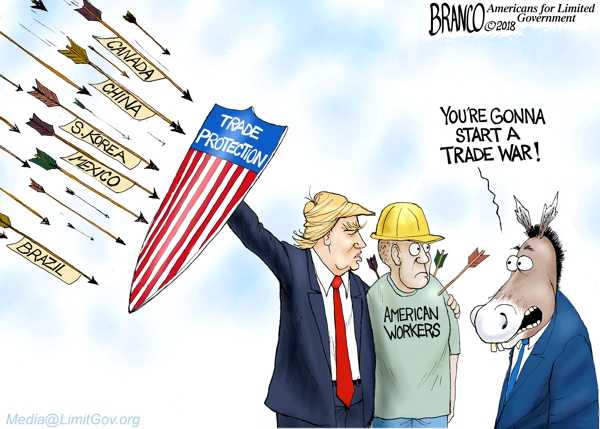
He’s pretty ticked at the Justices who voted down the tariffs imposed under the International Emergency Economic Powers Act (IEEPA).
He’s full of praise for the dissenting Justices which includes Clarence Thomas – the man who is generally the smartest person in the room.
Summary of today’s events
On February 20, 2026, the U.S. Supreme Court issued a landmark 6-3 ruling in the consolidated cases Learning Resources, Inc. v. Trump and related challenges, striking down President Donald Trump’s broad tariffs imposed under the International Emergency Economic Powers Act (IEEPA).
The majority opinion, authored by Chief Justice John Roberts and joined by Justices Sotomayor, Kagan, Jackson, Gorsuch, and Barrett, held that IEEPA—a 1977 law designed for regulating commerce during foreign national emergencies—does not authorize the president to impose tariffs of unlimited scope, amount, or duration.
Some have asked me to comment on the SCOTUS ruling striking down tariffs based on emergencies declared by the Executive. Why should I comment when Gorsuch has already nailed it right here? 💯 pic.twitter.com/jUe5MM0S3c
— Thomas Massie (@RepThomasMassie) February 20, 2026
The dissenters were Justices Thomas, Alito, and Kavanaugh.
🚨 BREAKING: SCOTUS Justice Clarence Thomas dropped straight TRUTH BOMBS in his dissent on the tariffs
— Eric Daugherty (@EricLDaugh) February 20, 2026
He nailed it.
"NEITHER the statutory text nor the Constitution provide a basis for ruling against the President." 🔥
"Congress authorized the President to “regulate . . .… pic.twitter.com/nhKtBQ669Y
The invalidated tariffs included a 25% duty on most imports from Canada and Mexico, a 10% duty on most Chinese imports (targeted at drug trafficking threats), and at least 10% reciprocal tariffs on imports from all trading partners (aimed at addressing trade deficits). These were often called the “Liberation Day” tariffs and had generated substantial revenue since their implementation in 2025.
Justices Kavanaugh, Thomas, and Alito broke with the majority, arguing Trump’s tariffs were fully authorized by federal law. “As a matter of text, history, and precedent, they are clearly lawful,” Kavanaugh wrote. pic.twitter.com/j0uPtlrNPC
— Daily Caller (@DailyCaller) February 20, 2026
“In essence, the Court today concludes that the President checked the wrong statutory box by relying on IEEPA rather than another statute to impose these tariffs.”
— Mike Lee (@BasedMikeLee) February 20, 2026
Kavanaugh, J., dissenting
Immediate Impacts of the Ruling
The ruling mandates an immediate cessation of IEEPA-based tariff enforcement, which is projected to lower import costs and ease financial pressures on U.S. households and businesses. Economists estimate that these tariffs added approximately $1,200 to $1,600 annually to the average family’s expenses in 2025, with potential savings of $600 to $800 per household in 2026 if fully unwound. The decision remands implementation details, including phase-outs and enforcement halts, to lower courts like the U.S. Court of International Trade.
A key uncertainty revolves around refunds: With more than $200 billion collected unlawfully, importers and businesses are poised to seek reimbursements, potentially with interest. This could strain federal finances, equating to sums larger than some departmental budgets, and lead to a wave of claims processed through administrative channels or litigation. While some costs were passed to consumers, refunds might primarily benefit large importers, indirectly influencing prices over time.
Not all tariffs fall under this ruling—those imposed via other statutes, such as Section 232 national security tariffs on steel and aluminum, remain intact, preserving portions of Trump’s protectionist framework. The ruling does not affect tariffs imposed under other laws, leaving room for alternative approaches.
President Trump’s Response and Remarks
In a White House press briefing shortly after the ruling (captured in coverage of the event around the 28:30 mark in the provided YouTube link), President Trump voiced sharp criticism, labeling the decision “deeply disappointing” and expressing “shame” toward certain justices, including some he appointed, whom he called “unpatriotic” and a “disgrace to our nation.” He accused the majority of undermining U.S. interests and being influenced by “foreign interests.”
Defiantly, Trump pledged to circumvent the setback by imposing a new temporary 10% global tariff “effective immediately” under alternative authorities, such as the Trade Act of 1974 or Sections 301 and 232 of existing trade laws. He asserted that this would not only replace lost revenues but make presidential trade powers “more powerful and crystal clear,” while vowing to push Congress for supportive legislation. His remarks highlighted a commitment to sustaining protectionist policies, framing the ruling as a temporary hurdle rather than a defeat.
LOL! SCOTUS’s ruling basically said Trump was using the wrong law for his tariffs, so Trump just issued the same tariffs under different laws and increased them by 10%.
— Wall Street Mav (@WallStreetMav) February 20, 2026
“Thank you for your attention to this matter.” – Trump 🤣
Follow: @WallStreetMav pic.twitter.com/GDoVuYyCuV
Broader Implications and Next Steps
This ruling serves as a significant restraint on executive authority in trade policy, clarifying that emergency laws like IEEPA cannot be stretched to encompass broad, indefinite tariffs without explicit congressional backing. It reaffirms the separation of powers, potentially encouraging lawmakers to reform trade statutes for better balance between flexibility and oversight.Looking ahead, the trajectory is multifaceted rather than straightforward relief or chaos. In the short term (weeks to months), expect administrative actions: The Treasury and Customs and Border Protection will likely issue guidance on halting collections, while importers file for refunds, possibly leading to a streamlined claims process amid legal disputes over timelines and eligibility. This could result in partial refunds totaling tens of billions, offsetting some federal revenue losses but injecting fiscal uncertainty—projections suggest a $1.2 trillion shortfall over the next decade if no replacements emerge, though dynamic economic growth from lower costs might mitigate this.
President Trump’s announced pivot to other legal tools introduces moderated continuity: Alternative authorities like Section 301 (for unfair practices) or Section 232 (national security) allow targeted tariffs but with narrower scopes and procedural hurdles, such as investigations and public comment periods, limiting their breadth compared to IEEPA’s flexibility. This could mean a patchwork of new duties—perhaps escalating on specific sectors like autos or tech—rather than blanket impositions, potentially sparking fresh legal challenges and trade partner retaliations.
Economically, anticipate a mixed bag: Immediate price drops on consumer goods (e.g., electronics, apparel) could boost spending and curb inflation, with GDP gains of 0.2-0.3% in the near term from reduced trade barriers. However, renewed policy flux may deter investments in supply chains, as businesses hedge against evolving duties, leading to temporary disruptions in manufacturing and exports. Globally, allies like Canada and Mexico might seek renegotiations, while adversaries like China could exploit divisions.
Politically, the decision exposes rifts within the Republican Party and the conservative judiciary, prompting bipartisan calls for trade law updates ahead of midterms. Congress could introduce bills to curb executive discretion or authorize new tariffs, though gridlock risks prolonging ambiguity.
Overall, while the ruling injects short-term volatility, it may foster longer-term stability if it catalyzes legislative clarity, transforming a legal defeat into a catalyst for refined U.S. trade strategy.
Meanwhile Bessent says “slow your roll”
🚨 JUST IN: Treasury Sec. Scott Bessent just STUNNED the "Experts," he and Trump have been making big plans and it's FULL-STEAM AHEAD
— Eric Daugherty (@EricLDaugh) February 20, 2026
Tariff revenue will be *unchanged* in 2026. Boom.
"Let's be clear about what today's ruling WAS and what it WASN'T. Despite the misplaced… pic.twitter.com/tYHk1DoEvy