
Friday, April 3rd, marked one of the most intense days in the ongoing conflict involving the United States and Iran. For the first time in this war, U.S. Air Force combat aircraft were shot down over enemy territory. An F‑15E Strike Eagle, one of the Air Force’s most advanced fighter jets, was struck and crashed inside Iran. One crew member was rescued, but the second remains missing, prompting an urgent search-and-rescue operation.
🚨 ABC News confirms: Iran used 'advanced' passive infrared detection to shoot down the American F-15.
— Tony Seruga (@TonySeruga) April 3, 2026
Inside Baseball: China has bolstered Iran's overall air defense network (especially radar and some missile components), the specific passive infrared detection emphasized in… pic.twitter.com/EMg9apThS3
At the same time, a second U.S. aircraft, an A‑10 Warthog, was also lost in a nearby engagement, though its pilot ejected safely.
🚨 BREAKING: The US Air Force A-10 Warthog which crashed today TOOK FIRE and was DAMAGED during the search and rescue mission for downed F-15 pilots in Iran – CBS
— Nick Sortor (@nicksortor) April 3, 2026
The pilot is SAFE & receiving medical treatment
Current tally of US aircraft taking fire from Iran today
1x F-15E… pic.twitter.com/iY07NvqmfJ
Bravery Under Fire
The courage and professionalism displayed by U.S. aircrews cannot be overstated. These men and women operate under extreme pressure, navigating hostile skies while knowing that a single misstep could cost their lives. The missions they undertake require split-second decision-making, exceptional skill, and the ability to remain calm amid chaos. Even in the face of direct enemy fire, the focus of these pilots and rescue teams remains unwavering: complete the mission and bring every airman home.
The Missing Airman
Concern for the missing F‑15E crew member, believed to be a US weapons systems officer, is profound. Rescue teams raced against time, navigating difficult terrain and hostile territory, often under fire, to locate the downed airman. Every effort was made to ensure his safe return, reflecting the military’s unwavering commitment to leave no one behind. The world watched as these elite teams confronted danger to recover their comrade.
He evaded the enemy for 𝐨𝐯𝐞𝐫 𝟐𝟒 𝐡𝐨𝐮𝐫𝐬 in hostile territory. During that time, the IRGC and affiliated Basij militia units 𝐚𝐜𝐭𝐢𝐯𝐞𝐥𝐲 𝐡𝐮𝐧𝐭𝐞𝐝 𝐡𝐢𝐦 on the ground. Armed tribesmen in the region joined the search (Turkiye Today). And then Iranian state television made it worse. An anchor on 𝐈𝐫𝐚𝐧𝐢𝐚𝐧 𝐬𝐭𝐚𝐭𝐞-𝐜𝐨𝐧𝐭𝐫𝐨𝐥𝐥𝐞𝐝 𝐓𝐕 went on the air and put a 𝐛𝐨𝐮𝐧𝐭𝐲 𝐨𝐧 𝐭𝐡𝐞 𝐦𝐢𝐬𝐬𝐢𝐧𝐠 𝐀𝐦𝐞𝐫𝐢𝐜𝐚𝐧: 10 billion toman, approximately $𝟔𝟎,𝟎𝟎𝟎, for anyone who captured the “𝘦𝘯𝘦𝘮𝘺 𝘱𝘪𝘭𝘰𝘵” alive and handed him to police (𝘞𝘢𝘴𝘩𝘪𝘯𝘨𝘵𝘰𝘯 𝘗𝘰𝘴𝘵, Newsweek). A state broadcaster calling for the capture of a wounded American servicemember. That’s what he was evading. (Other Iranians, brave supporters of regime change gathered on the roads with their cars and a mass of bodies to delay access in these mountainous areas.) Roads around the extraction area were bombed by the USAF — cratering them to create massive traffic jams as IRGC units scrambled to respond. The bottlenecks worked: Iranian forces couldn’t get through in time.
BREAKING: Residents of Location of F-15 Fighter Jets in Chaharmahal and Bakhtiari Province report the sound of American rescue helicopters overhead. pic.twitter.com/VrzMWxEFyC
— Sulaiman Ahmed (@ShaykhSulaiman) April 4, 2026
Training for the Worst-Case Scenario
U.S. pilots are trained for exactly this kind of situation. Years of advanced flight instruction prepare them for high-risk missions in contested airspace. They undergo combat survival and evasion courses, learning how to survive if forced down and how to signal rescuers effectively.
Downed U.S. air crews receive SERE training — Survival, Evasion, Resistance, and Escape. This prepares pilots and aircrew for isolation behind enemy lines through quick decision-making, evasion, short-term survival, resistance to interrogation if captured, and escape.SERE includes classroom instruction on navigation, signaling, shelter, food/water procurement, and first aid, followed by realistic field exercises and high-stress captivity simulations. The focus is on returning with honor per the U.S. Code of Conduct, relying on Combat Search and Rescue teams for extraction rather than prolonged combat.
Equipment Issued
Gear is compact, worn on the survival vest or deployed with the ejection seat/parachute. It supports 24–72 hours of evasion while awaiting rescue. Common items include:
- Survival radio (with GPS and beacon) — the highest priority for contacting rescuers.
- Signaling tools: mirror, strobe, flares, smoke, whistle.
- Navigation: compass and evasion maps (often on durable fabric).
- Knife or multi-tool, fire starter, water purification tablets.
- First aid supplies: bandages, tourniquet, pain medication.
- Blood chit: A small, rugged document (often Tyvek or fabric) printed with an American flag and messages in multiple local languages. It identifies the bearer as a U.S. service member, states they mean no harm, and promises a substantial reward (historically cash, gold, or equivalent) to anyone who helps return them safely to friendly forces. It has been used since WWII and remains standard for theater-specific operations.
Additional items from the ejection kit may include a space blanket, fishing gear, raft (for water), or basic escape tools. A handgun is sometimes carried for signaling or last resort. Pilots inventory and ration gear immediately after landing, supplementing with improvised items from the environment or wreckage.
The Human and Strategic Stakes
Yesterday’s events highlight both the human and strategic stakes of the conflict. Behind every headline are real lives, immense courage, and the meticulous training that allows airmen to operate effectively in hostile environments.
Response
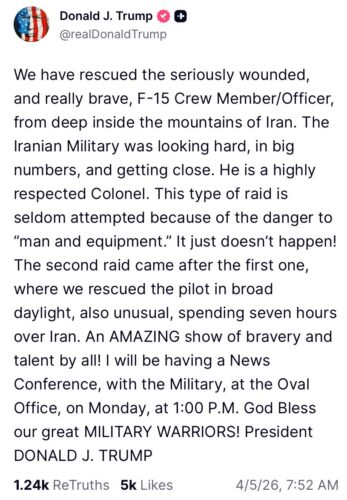
The weapons systems officer’s extraction followed a frantic U.S. search-and-rescue operation after the Friday crash of the F-15E Strike Eagle, as Iran also promised a reward for anyone who turned in an “enemy pilot.” Trump said he was injured but in stable condition. President Trump announced it on Truth Social.
“WE GOTHIM! My fellow Americans, over the past several hours, the United States Military pulled off one of the most daring Search and Rescue Operations in U.S. History, for one of our incredible Crew Office Members, who also happens to be a highly respected Colonel, and who I am thrilled to let you know is SAFE and SOUND!” – President Donald J. Trump
Fog of war and clickbait posts confuse the issue during these time. But this is interesting and possible.
48-HOUR RESCUE INSIDE IRAN
HOUR BY HOUR
APRIL 3
– F-15E Strike Eagle (Viper 21) shot down by Russian missile over southwestern Iran.
– Mach 2.8 intercept, proximity fuse detonation.
– Both crew eject successfully.
HOUR 0
– Pilot recovered within minutes by ground team.
– WSO lands alone, injured (broken ankle), deep in enemy territory.
HOURS 1-4
– WSO starts evasion using night and terrain.
– IRGC launches massive manhunt with drones and dogs.
HOURS 4-8
– Thousands of Iranian civilians join the search for bounties.
– U.S. jams Iranian radars and communications.
HOURS 8-12
– WSO climbs 7,000-ft ridge despite injury.
– U.S. strikes crater roads to block IRGC reinforcements.
HOURS 12-18
– WSO reaches ridge top, hides in rocky crevice.
– Makes first brief radio contact with friendly forces.
HOURS 18-24
– A-10 Warthog shot down by Chinese MANPADS.
– Pilot safely recovered by naval assets.
HOURS 24-30
– Two HH-60W rescue helicopters hit by ground fire during attempt.
– Crews wounded but return to base.
HOURS 30-36
– U.S. escalates with cruise missile strikes on IRGC air defenses.
– WSO survives near-miss drone strike, relocates under fire.
HOURS 36-42
– Nighttime full extraction launched.
– Special operations teams insert and engage IRGC in firefight.
HOURS 42-48
– WSO located, stabilized on site, and extracted under heavy fire.
APRIL 5 — EARLY HOURS
– WSO pulled out alive and conscious.
– Both F-15E crew members safe.
BREAKING:
— World updates (@itswpceo) April 5, 2026
🇺🇸 This is the greatest Rescue operation in history of America.
48-HOUR RESCUE INSIDE IRAN
HOUR BY HOUR
APRIL 3
– F-15E Strike Eagle (Viper 21) shot down by Russian missile over southwestern Iran.
– Mach 2.8 intercept, proximity fuse detonation.
– Both… pic.twitter.com/XFEVE0U3Dl
In addition, people around Dehdasht provided important help to the American pilot. By showing up in large numbers on the roads, they effectively blocked the ONLY POSSIBLE ground route for the Islamic regime’s forces to reach the area where the pilot had ejected.