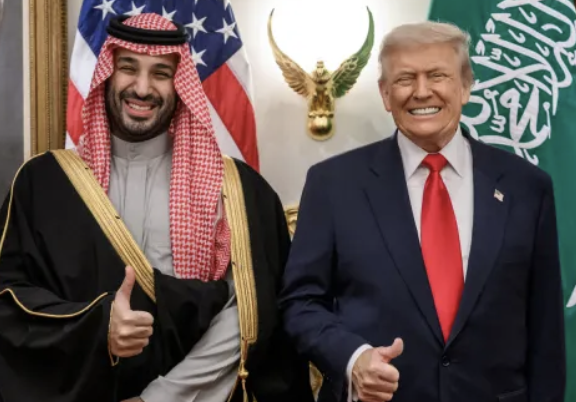
Folks, the Middle East is a tar pit that swallows American blood and treasure faster than you can say “historic opportunity.” Rumors have been swirling for weeks that a late-night phone call from Saudi Crown Prince Mohammed bin Salman flipped President Trump from eyeing a quick exit in the Iran war to doubling down on crushing the regime until it collapses. The story broke in late March, right as the fighting that kicked off February 28 was hitting its stride. Multiple calls over several days, MBS telling Trump this was the moment to remake the region by destroying Iran’s hard-line government once and for all. Iran, he argued, would always threaten the Gulf unless the mullahs were gone. Even a failed state next door beat leaving the regime intact to lick its wounds and come back swinging.
UAE President Mohammed bin Zayed and Saudi Crown Prince Mohammed bin Salman have warned US President Donald Trump in recent days against ending the Iran war without securing meaningful constraints on Tehran’s regional threat, two sources familiar with the matter told The… pic.twitter.com/IBIzJNwC6R
— Rita Rosenfeld (@rheytah) March 31, 2026
Trump didn’t deny the conversations. He went further, calling MBS a “warrior” fighting alongside us. The president had been signaling openness to winding things down after the initial strikes that took out Supreme Leader Ali Khamenei and other top figures. A temporary ceasefire brokered by Pakistan kicked in around April 8, tied to reopening the Strait of Hormuz. Talks in Islamabad followed, but they collapsed fast. By April 13 – today – Trump announced a full naval blockade of Iranian ports and the strait. The war isn’t over. Pressure is back on, and the regime-change talk is louder than ever.
The rumor isn’t baseless gossip. It lines up with what U.S. officials briefed on the calls described: MBS saw the U.S.-Israeli campaign as a once-in-a-generation shot to eliminate the Iranian threat permanently. He pushed for escalation beyond air strikes, including the kind of sustained campaign that could topple the government. Saudi officials pushed back publicly, insisting the kingdom always backed de-escalation and wasn’t urging prolongation. But the private pressure was real, and it came at a moment when Trump was balancing decisive action with the reality that Americans don’t want another Iraq-style quagmire.
What the Saudis Promised in Return: Big Talk, Thin Details, and a Whole Lot of Self-Interest
Here’s where the rumor mill gets creative. Unofficial chatter on social media and in some regional reports floated a lavish package: up to $100 billion to cover U.S. war costs, over $1 trillion in investments pouring into the American economy, massive new weapons purchases, full normalization with Israel once the regime fell, even a direct oil pipeline from Saudi fields to an Israeli port to make the Jewish state an energy hub. Add in a new regional defense pact under American leadership, joint naval control of key chokepoints, funding for U.S. bases in Israel, and a reconstruction fund for a post-regime “moderate” Iran.
Sounds like a sweetheart deal on paper. The problem? None of it checks out as confirmed fact. No White House readout, no Saudi statement, no credible reporting pins down those exact numbers or commitments as the price for Trump’s continued pressure. What we do know is the broader alignment: Saudi Arabia has every incentive to see Iran neutered without spending its own blood or treasure. Riyadh wants the mullahs gone because a weakened but intact Iran still threatens shipping lanes, oil markets, and the kingdom’s borders. MBS has lobbied hard for the U.S. to handle the heavy lifting – air power, blockade, whatever it takes short of Saudi boots on the ground.
In practice, the “promise” boils down to the same old Gulf bargain: continued access to bases if needed, steady oil production to stabilize markets, and the usual arms deals that keep the U.S. defense industry humming. Trump has already highlighted Saudi partnership in the fight. But the grand trillion-dollar windfall and instant Israel-Saudi peace treaty? Those remain in the realm of hopeful speculation, not ironclad deals. The Saudis are playing their traditional game – let America bleed for Gulf security while they bank the profits and diversify away from us anyway.
The Likelihood of Success: Regime Change Sounds Great Until You Remember History
Can it work? The war has already delivered body blows. Khamenei is dead. His son Mojtaba stepped in as supreme leader, but the regime took hits to its military, nuclear sites, and command structure. Iranian retaliation spooked the region, but it didn’t break the U.S.-Israel axis. The blockade now squeezing ports and the strait will starve the regime of revenue and force hard choices in Tehran. Protests could flare if the pressure holds. A failed state next door terrifies the Saudis for good reason – chaos breeds new threats.
But full regime change – the kind that installs something stable and pro-Western – is a long shot. Iran isn’t Iraq in 2003. The mullahs have survived sanctions, assassinations, and internal revolts before. Their revolutionary guards and proxy networks run deep. History shows these operations rarely deliver the clean outcome hawks promise: think Libya after Gaddafi or the endless mess in Afghanistan. Trump knows this. He’s not rushing in with ground troops. The strategy is maximum pressure to force a better deal – nuclear surrender, strait security, proxy pullbacks – without owning the aftermath.
Success depends on what “success” means. If it means degrading Iran’s ability to threaten neighbors and the world for years, the current path has a decent shot. If it means guaranteed regime collapse and a friendly government in Tehran, the odds drop fast. The Saudis want the latter because it solves their problem forever. America wants the former because we don’t need another nation-building bill.
America First Reality Check: This Isn’t Our Fight to Finish for Riyadh
Trump got elected to put America first, not to play global policeman for Gulf royals who fund Wahhabi extremism one day and beg us to save them the next. The Iran war started for clear U.S. reasons – stopping nuclear breakout, hitting proxies that kill Americans, securing energy flows that matter to our economy. Continuing until regime change sounds noble until you tally the costs in American lives, dollars, and focus. We have borders to secure, an economy to unleash, and a China threat that dwarfs desert dictators.
MBS’s call may have stiffened spines in the Oval Office, but Trump doesn’t take marching orders from Riyadh. The blockade today shows decisive action without endless commitment. If the Saudis want the mullahs gone so badly, they can pony up real skin in the game instead of vague promises and private pleas. Regime change in Iran would be a bonus for the region, but only if it doesn’t come at the expense of American strength elsewhere.
The rumor is real enough to matter. It highlights how allies try to steer U.S. policy toward their priorities. Trump has the leverage to take the win – a crippled Iran that can’t threaten us or our interests – and walk away without owning the rubble. That’s the smart play. Anything more is just another Middle East trap dressed up as opportunity. America didn’t sign up to fight Saudi Arabia’s forever war. We signed up to win ours and come home stronger.