By Joseph F. Dunford, Frances Townsend & Michael Morell
April 17, 2026
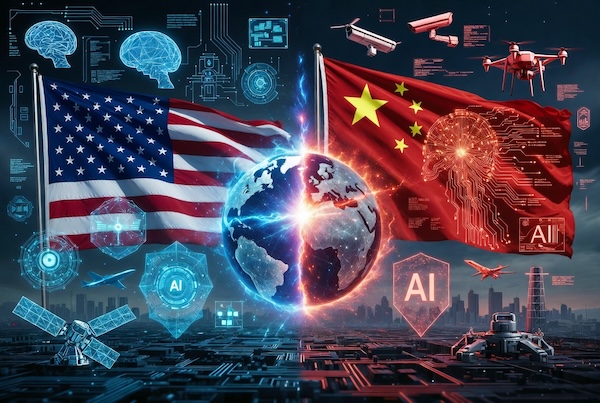
America and China are racing for technological supremacy, and the margin is razor thin. Today, tech supremacy is increasingly synonymous with artificial intelligence (AI) leadership. And China has an aggressive five-part plan to overcome what advantages America still has in AI. For decades, America’s military edge was unquestioned. That era is over. China is closing the gap fast, and the nations that move decisively now will lock in advantages that compound over time. Those who hesitate will be left behind permanently.
The good news: American innovation — particularly AI— is already delivering results for America’s national security, preventing supply-chain shortfalls, detecting cyberattacks in real time, and optimizing military logistics. Not as experiments, but as operational reality. The question is no longer whether these technologies work. It’s whether America will build the infrastructure and maintain the policies to stay ahead of an adversary running hard to catch us.
Accelerating New Weapons Design and Procurement
As the United States navigates existing and evolving threats, producing advanced munitions at adequate scale will be a prerequisite for success. Traditionally, the path from concept to fielded capability stretched across years, or even decades, as weapon designs moved through prototyping, testing, and federal procurement bureaucracy.
However, AI-assisted design, manufacturing, and supply chain management have compressed these timelines at a speed we have never seen before. For example, California-based company Divergent Technologies utilizes AI-enabled engineering software and robotic assembly to 3D print components and machinery in the automotive and aerospace industries.
Last year Divergent and CoAspire announced that AI-driven manufacturing had taken the Rapidly Adaptable Affordable Cruise Missile (RAACM) from concept to flight-tested hardware in 16 weeks. What once took years can now be done in months – a revolutionary development.A nation that can surge weapons production in weeks rather than years holds a decisive advantage in any conflict, and that advantage will increasingly belong to whoever builds the AI infrastructure to support it.
Autonomous Technologies Bypass Enemy Countermeasures
Autonomous drone technology further proves how AI has crossed from theory to operational reality, and nowhere is that more evident than in Ukraine. By reducing human presence in high-risk combat environments, autonomous vehicles protect servicemember lives while maintaining battlefield effectiveness.
Take for example Shield AI’s V-BAT drone, which last year executed more than 35 missions and enhanced U.S. drones’ ability to skirt Russian jammers that were previously grounding many U.S. systems. Traditional drones rely on GPS for navigation and radio links to human operators—both targets of Russian electronic warfare. Jamming these signals effectively renders a drone blind or uncontrollable. The V-BAT drones’ resilience to jammers helped turn a once aspirational idea into a tangible advantage on the front lines, handing American and allied efforts a competitive edge.
Defending Critical Infrastructure in Real-Time
America’s critical infrastructure is under constant cyberattacks from sophisticated state-backed adversaries. In 2024, multiple U.S. government agencies warned that Chinese hackers had embedded malicious code inside U.S. communications, energy, transportation, and water systems, prepped to launch disruptive attacks during a future conflict.
Threats at this scale exceed what human analysts can monitor alone. Our adversaries are increasingly using AI to accelerate attacks and almost instantaneously adapt to changing defenses, underscoring the need for the U.S. to match this evolving threat with an equally adept defense. AI meets this need by continuously scanning network traffic, detecting anomalies, and neutralizing threats before they become breaches.
In December 2025, Darktrace Federal was awarded a State Department contract to deploy AI-powered network detection and response capabilities across the Bureau of Diplomatic Security’s global IT infrastructure, protecting U.S. diplomatic personnel, facilities, and sensitive information in more than 170 countries, including conflict zones.
The real-time response capabilities of AI have proven critical in protecting sensitive information and infrastructure, especially for agencies under persistent pressure from Chinese and Russian AI-enabled adversaries. The U.S. needs to enable, not undermine, American AI innovation if we want to remain ahead in national security.
Domestic Infrastructure Enables our Security
None of this works without infrastructure. The weapons systems, autonomous platforms, and cyber defenses described above all run on massive compute power. They all depend on the data centers and energy systems that power modern AI.
That means the local decisions being made today about AI infrastructure are also decisions about national security. Every community that says yes to this infrastructure is helping to strengthen our nation’s security. And every conflicting state mandate, every permitting delay, is ultimately a choice to cede that future — and America’s technological edge — to competitors like China who will not hesitate.
The question facing U.S. leaders is no longer whether AI will shape national security. The tools are already deployed, and the results are already measurable. Weapons systems fielded in weeks rather than years. Autonomous drones operating where human pilots cannot. Critical networks defended in real time against state-backed attacks.
These use cases make one reality clear: the nations that harness AI fastest will not only gain a tactical edge, but will set the terms that others follow. The infrastructure that determines American leadership is being built right now, community by community, across hundreds of towns and cities. Washington’s only real choice is whether to accelerate that buildout, or hand China the advantage by slowing it down.
General Joseph F. Dunford Jr. is the 19th chairman of the Joint Chiefs of Staff. Frances F. Townsend is former White House counterterrorism and homeland security adviser. Michael J. Morell is former deputy director and acting director of the Central Intelligence Agency (CIA). All serve as AEP national security advisory board members.
This article was originally published by RealClearDefense and made available via RealClearWire.
