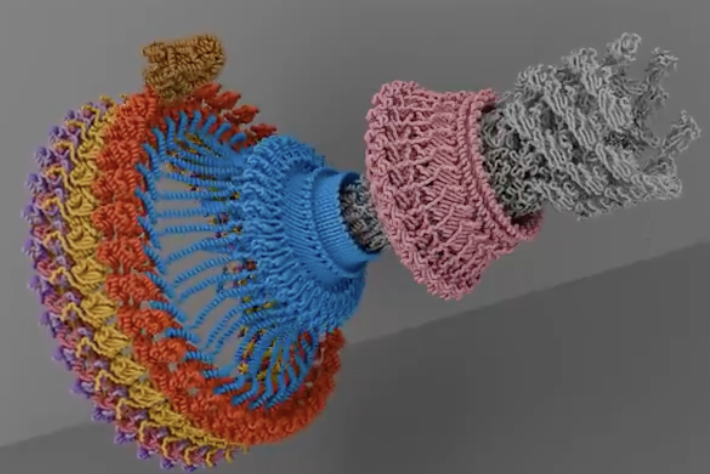
In the hidden world of single-celled organisms, engineers of the microscopic realm have long marveled at a tiny machine that puts our best human technology to shame. The bacterial flagellar motor, a microscopic rotary engine powering the whip-like flagella of bacteria, spins at astonishing speeds of hundreds of revolutions per second—faster than many of our tiniest electric motors—while operating with flawless precision and incredible efficiency.
A Proton-Powered Wonder
At its heart, this biological motor runs not on electricity or gasoline, but on a gentle flow of protons. These positively charged particles stream inward through stator units embedded in the cell membrane, generating torque that drives the rotor with remarkable smoothness. The stator itself features an exquisitely precise 5:2 geometry of MotA and MotB proteins, a structural arrangement so elegant it seems almost engineered rather than evolved.
The motor harnesses the proton motive force—the same electrochemical gradient that powers respiration and ATP synthesis across all living cells—turning a fundamental biological process into directed motion. It is nature’s way of converting chemical energy into mechanical work at the nanoscale, a feat that continues to leave biophysicists in awe.
Bacteria move around using a molecular machine called the flagellar motor that rotates faster than the flywheel of a race car engine and switches directions in an instant. After 50 yrs, scientists have finally figured out how it works. “My lifelong quest is now fulfilled.” Link⤵️ pic.twitter.com/AGiwOGOGXY
— Natalie Wolchover (@nattyover) April 20, 2026
Steering with Molecular Signals
What makes this motor even more impressive is its built-in navigation system. A signaling protein called CheY acts as a molecular switch, flipping the direction of rotation on command. One direction propels the bacterium forward in a smooth “run,” while the reverse causes it to tumble chaotically, allowing it to reorient and swim toward food sources or away from toxins. This simple yet brilliant chemotaxis mechanism enables bacteria to navigate their environment with surprising intelligence.
Decades of Discovery
The story of this discovery spans generations of dedicated scientists. Howard Berg first observed the motor’s remarkable spinning action in the 1970s, opening a window into a previously unseen world of biological machinery. Michael Manson, who began his own investigations into bacterial motility back in 1975, recently described the latest revelations as the fulfillment of a lifelong quest.
Modern breakthroughs have come through advanced cryo-electron microscopy (cryo-EM) studies combined with meticulous experiments from research teams at Harvard, Oxford, Copenhagen, Berlin, and Vanderbilt. These efforts have peeled back the layers of the motor’s intricate design, revealing details once thought impossible to visualize at such atomic resolution.
A Blueprint for the Future
The bacterial flagellar motor stands as one of biology’s most sophisticated nanomachines—an elegant, self-assembling, proton-driven rotary engine that operates with near-perfect efficiency in a noisy, chaotic cellular environment. It reminds us that evolution has already solved problems of miniaturization, energy conversion, and control that human engineers are still struggling to match.
Elon Musk is probably already building one!
As we continue to unravel its secrets, this tiny motor not only deepens our fascination with the living world but also inspires new frontiers in nanotechnology, synthetic biology, and bio-inspired engineering. In the end, it proves once again that the smallest things in nature often hold the most profound wonders.