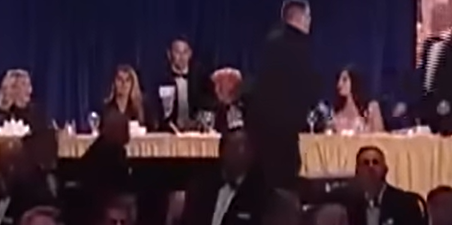
Three assassination attempts. One that came within inches of blowing the President’s head off in Butler. Another on a golf course. And now this weekend’s clown show at the White House Correspondents’ Dinner where a California nutjob with a shotgun, handgun, and knives nearly turned a black-tie media love-fest into a bloodbath. The Secret Service agents on the ground did their jobs when the bullets flew, tackling the threat and shielding the President. But the fact that we’re even talking about a breach at all after two prior near-misses shows the agency is still stuck in the same failed mindset that got us here. The free ride for incompetence ends now. America demands a Secret Service that stops threats before they start, not one that brags about heroic reactions after the gunfire begins.
The Saturday Night Disaster That Should Never Have Happened
April 25, 2026, at the Washington Hilton. Two thousand six hundred guests, the President, First Lady, Vice President Vance, and half the Cabinet packed into a cavernous ballroom for the annual press corps self-congratulation party. Around 8:34 p.m., Cole Tomas Allen, a 31-year-old tutor and computer engineer from Torrance, California, decided it was time to play “Friendly Federal Assassin.” The guy was a registered hotel guest, which let him waltz past the outermost layers. He barreled straight through a Secret Service checkpoint, shotgun blazing, and put a round into an agent’s chest. The vest saved the officer, who returned fire five times before agents swarmed and tackled Allen. Trump and the rest got yanked off stage in seconds while guests dove under tables. No one died, but only because the bad guy’s aim was as lousy as the planning that let him get that close.
JD Vance rushed off stage before Trump as White House Correspondents’ Dinner shooting sparks panic The Secret Service rushed to evacuate Vice President JD Vance and President Donald Trump from the White House Correspondents’ Dinner after reports of a sho… https://t.co/u12NAb7KNq pic.twitter.com/9FtLt9STqB
— UnfilteredAmerica (@NahBabyNahNah) April 27, 2026
Acting Attorney General Todd Blanche laid it out: Allen was targeting Trump and senior administration officials. The suspect had sent messages railing against the government’s direction right before the attack. This wasn’t random. It was the third time in under two years someone tried to murder the President of the United States. And once again, the Secret Service found itself in full scramble mode instead of full prevention mode.
A Secret Service after-action review is underway to examine the security and possible lapses from the White House Correspondents’ Association dinner in the wake of Saturday’s shooting, according to officials briefed on internal procedures at the agency. https://t.co/rvB3rPjpM9
— World News Tonight (@ABCWorldNews) April 27, 2026
The Preventable Failures Staring Everyone in the Face
The response was textbook fast. Agents moved like they train to move. The President was out. Vance was yanked from his seat. The ballroom went into lockdown. But prevention? That’s where it fell apart again, just like Butler and the Florida golf course. Allen made it to the metal detectors because the outer perimeter treated a massive hotel like it was Fort Knox. A registered guest with obvious weapons and clear intent slipped through the cracks. Officers at the checkpoint didn’t stop him cold before he opened fire. The venue itself—a sprawling, unsecured hotel with too many entrances and too much open space—turned what should have been a controlled environment into a shooting gallery.
This isn’t hindsight. Trump himself called the Hilton “not a particularly secure building” right after. The same agency that missed a rooftop sniper in Pennsylvania and let a gunman get within range on a golf course now let a guy with multiple firearms rush a checkpoint at a high-profile event full of the exact people the bad guys want dead. Multi-layered security sounded great on paper, but layers mean nothing if the first one fails and the guy with the shotgun is already inside the wire. The pattern is clear: repeated lapses in advance planning, venue vetting, and basic threat interdiction. The Secret Service keeps delivering excellence in the moment while ignoring the basics that keep moments like this from ever happening.
HOT MIC CLIP PUTS DC EVENT SECURITY UNDER THE MICROSCOPE
Fox reporters were picked up on a hot mic at the White House Correspondents’ Dinner at the Washington Hilton, questioning why hotel staff appeared to be holding open doors instead of tighter Secret Service control at entry… pic.twitter.com/JONKxkD4E7
— Shred Newz (@shrednewz) April 27, 2026
Why the Same Old Agency Can’t Keep Delivering the Same Old Excuses
After Butler, the agency promised reforms, reviews, and accountability. After the second attempt, more promises. Now, with the third, we’re hearing the same song: the plan “worked,” the response was “excellent,” and the multi-layered approach saved the day. Saved the day? The day shouldn’t have needed saving in the first place. The Hilton has hosted presidents before, including the Reagan shooting in 1981, yet here we are in 2026 repeating the same vulnerabilities on a grander scale. Choosing an unsecured hotel ballroom for the President after two assassination attempts isn’t leadership—it’s rolling the dice and hoping the agents’ vests hold up.
The bureaucracy hasn’t changed. The same culture that let a 20-year-old climb a roof with an AR-15 still runs the show. No serious house-cleaning at the top. No admission that venue selection for major events has to prioritize hardened, controllable spaces over media-friendly hotels. No recognition that political violence isn’t going away and the old playbooks are obsolete. The Secret Service is still in business because Washington protects its own, even when the cost is measured in near-misses on the President’s life.
What Real Fixes Look Like – No More Half-Measures
Enough with the after-action reports that gather dust. Fire the leadership that keeps repeating the same mistakes and install people who treat protection like the no-fail mission it is. Mandate hardened venues only—no more gambling on downtown hotels when the White House ballroom project, already under construction with missile-resistant walls, blast-proof everything, and underground command facilities, sits ready to handle exactly these events. Accelerate that build and make it the default for any large gathering involving the President or senior officials.
Revamp training to emphasize prevention over reaction. Tighten advance intelligence sharing so hotel guests with red-flag histories don’t get anywhere near checkpoints. Increase manpower and resources for perimeter security without the usual budget excuses. And hold every level accountable: if a breach happens because of sloppy planning, careers end. No more praising the response while ignoring the failure that made it necessary. America First security means stopping the threat on the sidewalk, not in the ballroom after shots are fired.
The agents who took fire Saturday deserve respect. They did their jobs under fire. But the agency as a whole has now failed three times to keep the President safe before the gunfire starts. Three strikes is more than enough. The Secret Service doesn’t get a fourth chance to prove it still hasn’t learned. The President is back in the Oval Office because good men and women with vests and guts stepped up. The country deserves an agency that makes sure they never have to. The ballroom can’t come online fast enough, the reforms can’t be tough enough, and the excuses have to end today.