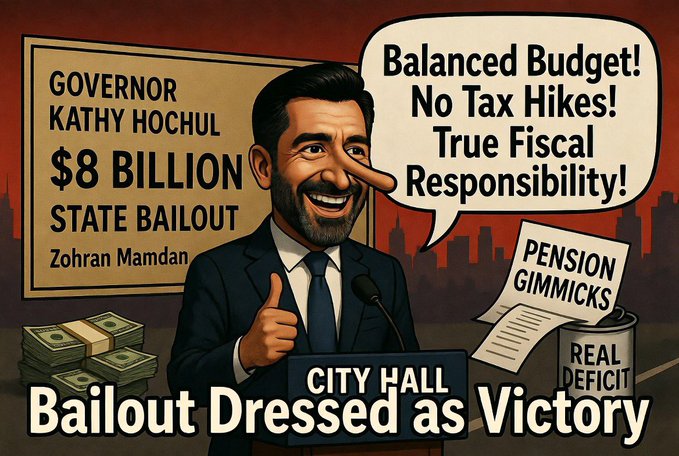
New York City’s new socialist mayor is strutting around City Hall like he just walked on water. Zohran Mamdani stood up on May 12 and declared victory over the $12 billion budget hole he “uncovered” when he took office in January. No property tax hikes. No service cuts. No raiding the rainy-day fund. Just a shiny $124.7 billion balanced budget for fiscal year 2027 that supposedly proves Democratic socialism delivers without hurting working people. The man is celebrating like he invented fiscal gravity. Regular New Yorkers who actually pay the bills should be reaching for the barf bag, because this isn’t magic. It’s the same old left-wing sleight of hand that always ends with higher taxes, fewer jobs, and the next guy holding the bag.
The Bag of Tricks That Made the Deficit Disappear Overnight
Mamdani inherited a mess from the previous crowd—underbudgeted expenses, bloated obligations, and the kind of structural gaps that had watchdogs warning about a crisis bigger than anything since the Great Recession. Instead of facing it head-on, he pulled every short-term lever he could find. First came the lifeline from Albany. Governor Kathy Hochul and state lawmakers funneled billions in extra cash into the city over the next two years—direct aid, policy changes, and the whole kit. That alone plugged a massive chunk of the hole without Mamdani having to touch city coffers.
Then he hit the rich with a brand-new tax on luxury second homes worth more than $5 million owned by non-residents. That pied-à-terre levy is supposed to bring in about $500 million a year, money the mayor calls a win for fairness. Throw in higher-than-expected tax receipts from Wall Street bonuses and some one-time revenue windfalls, and suddenly the books look balanced on paper.
But the real heavy lifting came from the accounting gymnastics. The city found roughly $1.77 billion in operational savings by trimming overtime, renegotiating contracts, modernizing tech, and phasing out unused programs. Another $1.2 billion came from fixing inefficiencies in special education, class sizes, and housing vouchers. The biggest shell game? Stretching out pension payments to the tune of $1.64 billion in savings for fiscal year 2027 alone. That means today’s retirees get their checks, but the next generation of taxpayers gets stuck with the tab later. No cuts to current benefits, the mayor brags, but future New Yorkers will be paying for today’s party.
He also delayed a costly mandate on reducing class sizes and leaned on state help to expand free child care without the city footing the full bill. On the surface it looks like genius. Dig in and it’s a house of cards built on one-shots, future obligations, and money from outside the city that won’t be there forever.
This is an excellent breakdown of how Comrade Mamdani “balanced the Budget”
This is the equivalent of your broke kid deciding to open another credit card and saying “See I can afford it” https://t.co/TgUoM59vQI
— Jason Robertson (@JRobFromMN) May 14, 2026
The Catch That’s Already Baked Into Next Year’s Books
Here’s where the celebration turns into a hangover. The same budget that erased this year’s $12 billion gap quietly projects a fresh $7 billion shortfall for fiscal year 2028—just one year from now. That’s not a rounding error. It’s the direct result of using temporary cash to fund permanent spending. One-time revenues and short-term fixes covered today’s gap, but they don’t repeat. Pension stretching just kicked the can down the road. The luxury-home tax might bring in some cash, but it also signals to high earners and businesses that New York is open season on success.
Watchdogs already flagged the reliance on roughly $2.8 billion in one-shot money to pay for ongoing programs. That’s not fiscal responsibility. It’s the same trick every big-spending mayor tries until the music stops. Mamdani didn’t raise property taxes this time, but the structural problems—sky-high costs, out-migration of taxpayers, and the wealth flight his own tax-the-rich rhetoric is accelerating—haven’t gone away. They’re just papered over for one more budget cycle.
🚨 NYC Mayor Zohran Mamdani “Balances” $124.7 Billion Budget With $8 BILLION State Bailout From Hochul And NOTHING Else
After inheriting a massive $12B deficit, Mamdani just released his FY2027 executive budget and is touting it as “balanced” without raising property taxes or… pic.twitter.com/yLcaVPMllc— ThePatriotTea🇺🇸🪶 (@ThePatriotTea) May 14, 2026
What Comes Next When the One-Shots Run Dry
The City Council still has to negotiate the final version by June 30, and they usually add a few hundred million in pet projects. But the real test hits in 2027 when the next budget rolls around. That $7 billion projected gap will force choices Mamdani dodged this time: deeper cuts, more taxes on the people who actually create jobs, or another round of begging Albany for bailouts. Meanwhile, the very policies that “closed” this gap—higher taxes on luxury property, business tax tweaks, and the anti-wealth tone—are speeding up the exodus of the high earners who pay the freight. Every millionaire who packs up for Florida or Texas takes income, investment, and tax revenue with them.
The mayor is framing this as proof that government can deliver parks, libraries, housing, and safety without burdening working New Yorkers. In reality it’s proof that socialist budgeting is a temporary illusion built on other people’s money and tomorrow’s obligations. The deficit didn’t disappear. It just got deferred, disguised, and dressed up for the cameras.
The America First truth is brutal but obvious. You cannot tax, spend, and borrow your way to fiscal health while chasing productive people out of town. Mamdani’s victory lap today will look like a bad joke when next year’s gap reappears and the bills for today’s one-shots come due. New Yorkers who stuck around expecting real leadership are about to learn the hard way what happens when the magician runs out of rabbits. The city’s fiscal health isn’t restored. It’s just been kicked down the road one more time, and the road is getting shorter every year.