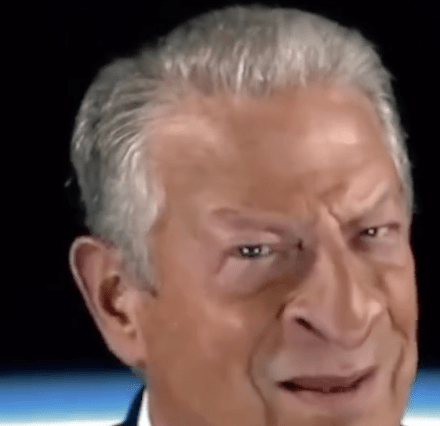
Decades of Failed Predictions and a Legacy in Tatters
Al Gore has always been the high priest of climate alarmism, jetting around the world while preaching sacrifice for the little people. From his 2006 Oscar-winning sermon An Inconvenient Truth to his endless slide shows and Nobel Prize victory lap, Gore built an empire on terrifying forecasts that never materialized. Twenty years later, his predictions read like a comedy routine of epic misses. The boring, stiff politician of the 1990s transformed into a multimillionaire doom merchant, but reality refused to cooperate. His legacy? A cautionary tale of hype over science, enrichment through fear, and the left’s refusal to admit error even as the Arctic stubbornly refuses to melt on command.
Al Gore Hit with Major Reality Check After Making this Wild Boast About ‘Climate Change’ During Interview Touting His Infamous Propaganda Film (VIDEO) https://t.co/YoONiZLFSe #gatewaypundit via @gatewaypundit
— Vote RED! (@PetsRescues) June 18, 2026
The Big Predictions That Collapsed
Gore’s signature film and speeches were packed with specific, testable claims. Almost none held up.
Ice-Free Arctic Summers by 2014: Gore repeatedly hyped this one, citing scientists who suggested the North Pole could be ice-free in summer as soon as 2014 or within five to seven years. He warned of catastrophic tipping points. Reality? Arctic sea ice has declined but remains substantial. Summer ice extent is down but nowhere near vanished. Predictions of total disappearance by now were wildly off, yet Gore and his allies keep moving the goalposts.
No More Snows of Kilimanjaro: Gore declared that within a decade, Africa’s tallest mountain would lose its iconic snows. That decade came and went. Kilimanjaro still has snow, and while glaciers are retreating globally due to various factors, the total disappearance Gore implied never happened on schedule.
20-Foot Sea Level Rise Flooding Cities: The film’s dramatic animations showed Florida, Manhattan, and other areas underwater. Gore suggested massive, rapid rises from melting ice sheets. Actual sea level rise since 2006 has been modest — a few inches — consistent with long-term trends, not the apocalyptic surge promised. Coastal cities aren’t submerged.
More Extreme Weather and Hurricanes: Gore linked warming directly to stronger, more frequent storms like Katrina. Hurricane frequency and intensity haven’t followed the script. Some metrics show stability or declines in certain basins, contradicting the narrative of immediate catastrophe.
Polar Bears Doomed: Iconic images of drowning bears implied imminent extinction. Polar bear populations have been stable or growing in many areas, with hunting and other factors mattering more than the modest warming observed.
These weren’t vague warnings. They were presented with charts, animations, and urgency as settled science demanding immediate action. Decades later, temperatures have warmed modestly, CO2 has risen, but the catastrophes Gore sold haven’t arrived. Adaptation, technology, and human resilience proved far more effective than his prescribed panic.
Gore used “drowning polar bears” as a way to emotionally manipulate his audience, saying “they’re finding polar bears that have actually drowned” searching for ice.
The truth is that 4 polar bears drowned during a single storm and that the polar bear population has more than… https://t.co/TKLI6X0UW1 pic.twitter.com/X4WabisdB2
— Flappr (@flapprdotnet) June 17, 2026
How Badly He Erred — and Profited Anyway
Gore’s errors weren’t minor tweaks. They were foundational exaggerations designed for maximum emotional impact. Critics at the time noted the alarmism, but media and Hollywood amplified it. He won an Oscar, a Nobel (shared with the IPCC), and speaking fees in the hundreds of thousands. His green investment funds and carbon trading advocacy positioned him to profit from the very crisis he hyped. The “formerly boring” Al Gore became a celebrity multimillionaire, buying beachfront properties while warning of rising seas.
The science of modest warming deserves pragmatic response — innovation, nuclear power, adaptation. Gore turned it into a quasi-religious movement of guilt, sacrifice, and elite control. When predictions failed, he doubled down, blaming skeptics or “deniers” instead of revising models. This pattern eroded trust. Public skepticism grew as ordinary people noticed winters still happened, seas didn’t swallow cities, and polar bears persisted.
The Legacy: From Vice President to Punchline
Gore’s political career was already wounded by 2000. His climate crusade was supposed to define his post-office life as a visionary statesman. Instead, it cemented him as the face of failed doomsaying. Late-night jokes, memes, and “Al Gore’s Ice-Free Arctic” references became shorthand for overblown environmental hysteria. His credibility tanked among anyone paying attention to actual data versus rhetoric.
The broader impact damaged the climate debate itself. Reasonable discussion of energy policy and emissions got hijacked by apocalyptic cultists. Policies pushed in Gore’s name — rushed renewables, energy poverty in Europe, suppression of debate — delivered higher costs and unreliable power without the promised salvation. Trump’s practical America First approach — energy dominance, innovation over mandates — stands in stark contrast and delivers results.
Al Gore started as a wooden politician and evolved into a wealthy alarmist whose signature predictions collapsed under scrutiny. His legacy is a textbook example of how fear sells but reality endures. The planet didn’t end. The forecasts did. And normal Americans are better off ignoring the next round of hysteria from the same crowd.