What your grandparents’ grass actually looked like — and why this summer might be a good time to let some of it back in
If you’ve been eyeing the patches of clover or dandelions creeping into your lawn this June and wondering whether to reach for a spray bottle, it’s worth knowing this: for most of American history, you wouldn’t have needed to make that choice at all. Clover wasn’t a weed. It was the point.
A lawn was never just grass
Walk into any garden shop before the 1950s and buy a bag of lawn seed, and you’d be buying clover along with your grass — usually white Dutch clover (Trifolium repens), the low, three-leafed plant with the round white blooms. It wasn’t an accident or a contaminant. Seed companies put it there on purpose, because clover does something grass can’t: it’s a legume, which means it pulls nitrogen out of the air and fixes it in the soil through bacteria living on its roots, feeding the grass around it for free. It also stays green through summer dry spells when cool-season turf grasses go brown and dormant. A lawn with clover in it was, by the standards of the day, simply a better lawn — hardier, greener, and self-fertilizing.
Before the 1950s, clover was a STANDARD component of American lawns.
— The Fourth Musketeer (@IV_Musketeer) June 19, 2026
Seed mixes included it on purpose.
Then broadleaf herbicides were invented.
They killed clover along with "weeds." So the chemical companies rebranded clover as a weed — to sell more herbicide.
That's it.… pic.twitter.com/7HNfwrXiGV
Dandelions occupied a different but equally unbothered place in the yard. They arrived in North America not as accidental stowaways but as deliberate cargo — colonists carried dandelion seed across the Atlantic in the 1600s because the plant was a staple of European herbal medicine and cooking, and they didn’t want to do without it in a new land. The roots were brewed into tonics for the liver and kidneys, the greens went into spring salads (when fresh vegetables were otherwise scarce after winter), and the flowers were turned into wine and syrup. Frontier households relied on dandelion as one of the first edible, vitamin-rich greens to appear after a long winter — not unlike how every part of a butchered animal got used, every part of the dandelion got used too. A lawn full of them wasn’t a sign of neglect. It was a sign of a useful yard.
Did you know that the dandelion has been used for years to fight everything from cholesterol to aging to high blood sugar? It’s one of those superfoods.
— Barbara Oneill (@BarbaraOneillAU) January 19, 2025
The dandelion plant is a rich source of beta-carotene, which our bodies convert to vitamin A.
It is also loaded full of :
•… pic.twitter.com/02wEaIKo1k
Then came a chemical that changed what “normal” meant
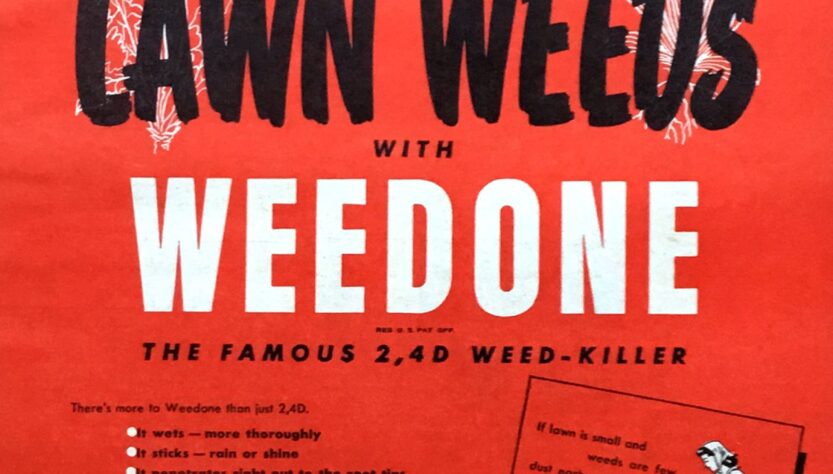
The turning point has a surprisingly specific date. In 1945, the American Chemical Paint Company introduced a product called Weedone — the first herbicide that could kill broadleaf plants like dandelions, clover, and plantain while leaving turfgrass untouched. Its active ingredient, 2,4-D, had been developed during World War II research into chemical weapons that might starve enemy crops; it turned out to be far more useful as a weedkiller than as a weapon, and after the war it was released onto the consumer market. Sales tell the story of how fast that caught on: about 631,000 pounds were sold in 1946, and more than 5.3 million pounds the year after — better than a fivefold jump in twelve months.
For the first time, a homeowner with no particular gardening skill could spray a lawn and have it come back as grass and nothing else. That technical capability needed a cultural reason to exist, though, and the lawn care and chemical industries supplied one: they spent the 1950s running ad campaigns recasting clover and dandelions — plants that had been welcome or actively useful for three centuries — as embarrassments. A patchy, mixed lawn became a sign of a careless homeowner; a uniform monoculture of turfgrass became the aspirational postwar suburban ideal, sold alongside the same chemical that made it achievable. Seed mixes quietly dropped clover and switched to pure fescue and Kentucky bluegrass. Within a generation, most Americans had grown up never knowing lawns had looked any other way.
What that shift costs, quietly, every summer
The “perfect lawn” habit that took hold in the 1950s comes with bills that don’t show up on the receipt. Two are worth knowing about heading into a season when a lot of households reach for the spreader.
Runoff. Whatever herbicide and fertilizer a lawn doesn’t absorb has somewhere to go, and a hard summer rain is an efficient way to send it there. Research on urban water quality has found that lawn chemical runoff is a meaningful contributor to pollution in lakes and streams, not just a footnote next to agricultural and road runoff — and the EPA has estimated that around 9 million pounds of 2,4-D and 6 million pounds of glyphosate are applied to American lawns each year. Once in waterways, the nitrogen and phosphorus from lawn fertilizer feed algae blooms, while 2,4-D shows up regularly in monitoring of urban streams and groundwater, even though it breaks down faster than older, more persistent chemicals like DDT.
Bees. Clover blooms right in the gap many home landscapes leave empty — after the early spring flowers fade and before late-summer plants take over — which makes it an outsized food source for a relatively small amount of yard space. One often-cited USDA Agricultural Research Service finding rated honey bee colonies foraging on clover-rich land in top health condition far more often than colonies near heavily farmed land with little flowering diversity. White clover used to be the dominant nectar source for beekeepers; by the back half of the twentieth century, after decades of replacement with synthetic fertilizer and herbicide, it had become a minor one. Dandelions do similar work — they’re often the very first reliable nectar source bees find after winter, which is exactly the moment new colonies and queens most need it. A lawn sprayed clean of both isn’t just tidier. To a bee, it’s a stretch of desert.
The pendulum, swinging back
None of this means anyone has to abandon a lawn entirely or let the yard go wild. But the binary that the 1950s sold us — grass or weeds, clean or careless — was never really how lawns worked for the previous three hundred years, and a growing number of extension offices, including those at Penn State, the University of Maryland, and the University of Minnesota, now actively recommend overseeding clover back into turf as a low-input, drought-tolerant, pollinator-friendly option. A common approach is mixing white clover or a shorter “microclover” variety into existing grass at roughly 5–10% of total seed by weight — enough to feed the soil and the bees without taking over the look of the lawn. Letting dandelions bloom for a couple of weeks before the first mow of the season costs nothing and feeds pollinators when almost nothing else is flowering yet.
This summer, before automatically treating every clover patch and dandelion head as a problem to solve, it’s worth remembering that they weren’t always one. For most of the time lawns have existed in this country, they were the plan.
A note on the chemistry: 2,4-D is still registered and widely used today, and current guidance from agencies like the Minnesota Department of Health is that typical exposure levels in drinking water are not expected to pose a health risk. The environmental concerns here are less about acute danger and more about cumulative effects — nutrient runoff into waterways and the steady loss of flowering plants that pollinators depend on — which is exactly the kind of thing that’s easy to overlook one lawn at a time and easy to notice in aggregate.