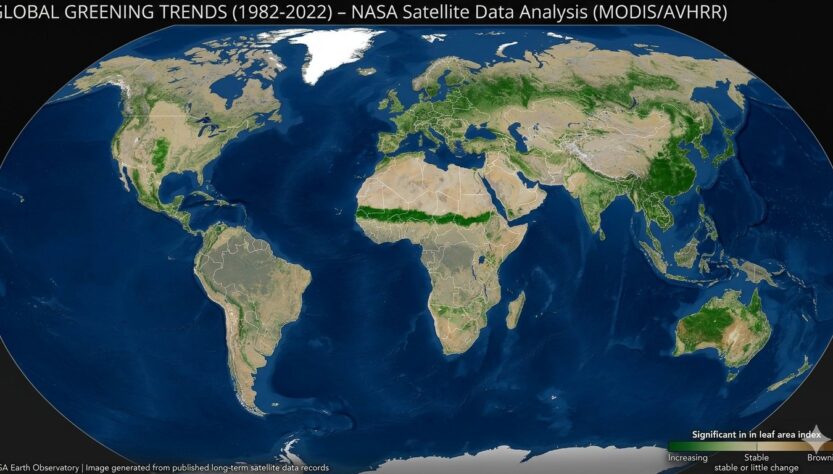
For four decades, NASA and NOAA satellites — MODIS and AVHRR — have recorded something conspicuously absent from the daily climate discourse: the Earth is greening, dramatically and measurably. The increase in leaf area since 1982 is equivalent to roughly twice the area of the continental United States. Carbon dioxide fertilization drives about 70 percent of that effect — nitrogen, land-use change, and shifting rainfall patterns trail far behind. Between 2000 and 2020 alone, NASA measured another 10 percent increase in global greening, an area of new leaf cover comparable to the entire Amazon rainforest. Even the Sahara has retreated — shrinking by roughly 8 percent over three decades as elevated CO2 allowed vegetation to reclaim marginal desert land.
This is not fringe data. It is NASA’s own satellite record, peer-reviewed, published in Nature Climate Change and Nature Sustainability, produced by international teams spanning Boston University, Peking University, and NASA Ames. And it tells a story rarely allowed to stand on its own: the gas cast as civilization’s great threat is simultaneously the primary engine of a planetary greening event unprecedented in the satellite era.
Today, NASA satellites confirm Earth is greening dramatically. CO₂ fertilisation has added biomass equivalent to two continents of new forest in recent decades, boosting crop yields and ecosystems alike.
— Peter Clack (@PeterDClack) July 5, 2026
Oceans, holding around 50 times more carbon than the atmosphere, continue… pic.twitter.com/0HLseWEEjL
Consider what CO2 actually is before it is anything else: the raw material of photosynthesis. Every leaf, every stalk of wheat, every tree ring on Earth is built from carbon pulled out of the air. Raising atmospheric concentration doesn’t poison plant life — it feeds it. Crops grow faster and use water more efficiently under elevated CO2, a finding replicated in greenhouse and field studies for decades before satellites ever confirmed it at planetary scale. That satellite confirmation is now impossible to dismiss: a quarter to half of Earth’s vegetated land has shown significant greening, and less than 4 percent has browned. This is not a marginal or contested pattern. It is one of the most robust trends in the entire satellite climate record.
Set this beside the ocean’s role. Seawater holds roughly fifty times more dissolved carbon than the atmosphere, and that carbon has been moving between air and sea for as long as there has been an ocean — governed by the same Henry’s Law equilibrium chemistry that governs a bottle of soda. This is not a system perched on the edge of collapse; it is a vast, ancient buffering mechanism that has absorbed far larger carbon perturbations than humanity’s, across geological time, without extinguishing life on Earth. Treating the current increase as an unprecedented emergency requires ignoring just how much capacity these natural systems have always had to absorb, circulate, and redistribute carbon.
None of this is a secret. It’s published NASA data, sitting right next to the warming narrative in NASA’s own press materials — just rarely given equal billing in how the story gets told. A planet whose deserts are shrinking, whose crop yields are rising, and whose forests are expanding is not a planet in simple, one-directional crisis. It is a planet responding to more atmospheric CO2 exactly the way basic plant biology predicts it should. The question worth asking is not whether this data is real — it demonstrably is — but why the public conversation so rarely lets it speak for itself.
NOTE: Mainstream researchers (including the authors of these same studies) argue the greening doesn’t offset warming risks — they treat it as a partial, saturating side effect running alongside sea level rise, ocean acidification, and heat extremes, not a replacement for them.