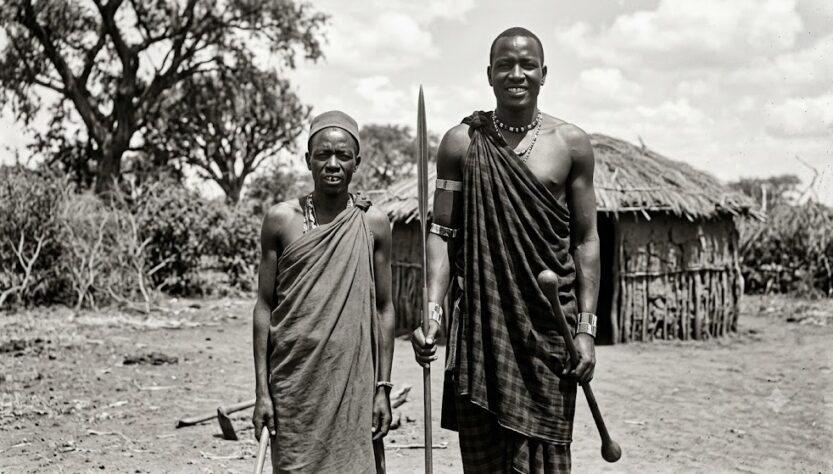
Long before “carnivore diet” was a hashtag, a Scottish nutrition scientist and a British colonial doctor stumbled onto living proof that a diet built almost entirely on meat, milk, and blood might be one of the healthiest a human can eat.
In the late 1920s, John Boyd Orr — who’d go on to become the first Director-General of the UN’s Food and Agriculture Organization — teamed up with J.L. Gilks, Kenya’s Director of Medical Services, to study two neighboring tribes living on the same land, breathing the same air, exposed to the same environment. The only major variable was what they put on their plates. It was about as close to a controlled experiment as real life gets.
The Kikuyu ate the diet modern nutrition guidelines have pushed for decades: heavy on cereals, roots, and vegetables, with meat reserved for special occasions. Plant-based, high-carb, low-fat, low-calcium.
The Maasai ate almost nothing but animal products — milk, meat, and raw blood. No grains. No vegetables to speak of. By modern standards, borderline zero-carb.
The results didn’t leave much room for interpretation. The Maasai were taller, heavier, and physically stronger than the Kikuyu. The Kikuyu, meanwhile, were plagued by tropical ulcers and other chronic health problems, and their growth was visibly stunted by comparison. When Orr and Gilks ran feeding experiments — deliberately shifting Kikuyu children onto richer, more animal-based diets — the kids grew faster. Not marginally. Reliably.
Orr and Gilks didn’t hedge in their conclusions. They pointed the finger squarely at the Kikuyu’s plant-heavy diet — low in protein, fat, and calcium — as the reason for their poorer health, weaker bodies, and slower growth compared to the meat-eating Maasai.
What goes around comes around
Here’s the irony: this study was published in The Lancet in 1927, nearly a century before “eat more animal protein, cut the carbs” became a wellness-world rallying cry. For most of the 20th century, official dietary advice moved in the opposite direction — pushing grains and plant foods to the base of the food pyramid while treating red meat, saturated fat, and animal products as things to minimize.
Now the pendulum is swinging back. Carnivore and animal-based diets have surged in popularity, with advocates pointing to improved energy, body composition, and metabolic markers — the same kinds of outcomes Orr and Gilks documented in the Maasai a hundred years earlier. It’s a strange loop: modern nutrition science rediscovering, through trial and error, what an old colonial-era field study already showed on the ground in Kenya.
In the 1920s, two British scientists accidentally ran the perfect diet experiment, and the answer was so inconvenient it was quietly buried for a hundred years.
— Sama Hoole (@SamaHoole) July 3, 2026
John Boyd Orr, later the first head of the United Nations food agency, and John Gilks, head of the Kenyan medical… pic.twitter.com/oMZ5hG88Sb
A fair caveat
It’s worth saying plainly: one field study from the 1920s isn’t a randomized controlled trial, and it doesn’t settle the broader debate over optimal human diets. The Maasai were also a physically selected, highly active pastoralist population, and historians have since questioned how much colonial assumptions about “productive labor” shaped the way Orr and Gilks framed their results. Mainstream nutrition science today is far more divided and cautious about extrapolating from one population comparison to “meat is simply better,” and long-term studies on heavily animal-based diets in modern, sedentary populations are still limited.
Still, as an early, vivid data point suggesting that a diet built on meat, milk, and blood can produce genuinely robust human health — long before that idea came back into fashion — the Orr-Gilks study is hard to ignore.