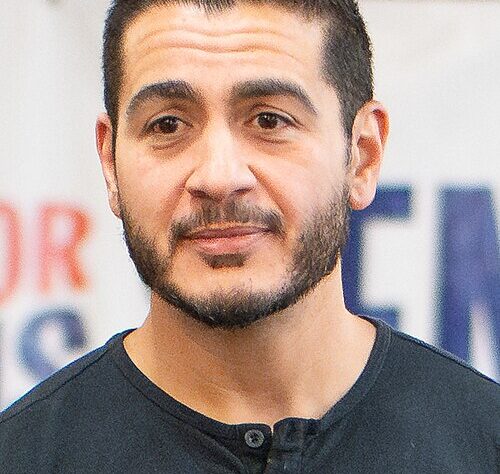
Michigan’s open Senate seat — Gary Peters is retiring — has turned into the marquee intraparty brawl of the 2026 midterms, and Bernie Sanders and AOC are right in the middle of it.
🚨 DEMS IN FULL CIVIL WAR MODE IN MICHIGAN!
— Gunther Eagleman™ (@GuntherEagleman) July 20, 2026
Bernie & AOC pushing hard for ultra-progressive Abdul El-Sayed (Medicare for All, wealth tax, “billionaires corrupt everything”).
But Main Street Dems are panicking, flooding money to stop him because Michigan’s blue-collar workers… pic.twitter.com/WgNVPednOY
Abdul El-Sayed (full name: Abdulrahman Mohamed El-Sayed), a Muslim born to Egyptian parents in Metro Detroit, is a former Wayne County health director who lost the 2018 governor’s race to Gretchen “Crazy Eyes” Whitmer, is running well to the left of the field: Medicare for All, Green New Deal, and pointed criticism of Israel and AIPAC’s role in Democratic primaries. Sanders and AOC are running a joint “The People vs. The Powerful” tour through Michigan July 18-19 to campaign for him.
AOC’s endorsement is notably her first in a contested Senate primary this cycle, and it puts her at odds with Chuck Schumer and the party establishment, who back Rep. Haley Stevens. Peters himself is also backing Stevens over El-Sayed — a signal from the one Michigan Democrat who’s actually had to win this seat statewide that he sees her as the safer bet to hold it.
It’s tight
A Tavern Research poll from early July had Stevens and El-Sayed in a statistical tie, 42% to 41%. There’s also a third candidate, state Sen. Mallory McMorrow, occupying a lane between them.
Democratic Socialists of America isn’t formally endorsing so much as mobilizing for El-Sayed. The organization has shifted organizers, volunteers and resources into Michigan to help him beat the more moderate Haley Stevens, and his campaign has coordinated with DSA on rallies. Coverage frames it as riding the same wave as recent DSA wins in deep-blue House districts in New York and Colorado.
This isn’t really about beating Stevens in a vacuum — it’s a proxy fight over whether the AIPAC-vs-progressive brawl that’s roiled other primaries (see: New York) is now a national template.
Establishment Democrats worry El-Sayed as the nominee would jeopardize a Democrat-held seat by pushing too far left in a state Trump carried in 2024, and El-Sayed has also drawn criticism for past controversial comments. Michigan-based political scientists are skeptical the star power moves many actual votes — Bernie’s endorsement had already gotten heavy coverage, and AOC’s adds only marginally — while noting a real risk of primary-loser voters staying home in November no matter who wins.
So Bernie and AOC are lending El-Sayed national visibility and fundraising juice, but Michigan’s own experts are telling reporters that celebrity progressive backing is more useful for narrative than for actually flipping persuadable Democratic primary voters — and it comes with a real electability risk in a genuine swing state. The primary is August 4.
El-Sayed and the DSA Agenda
Policy match — close but not identical:
- Healthcare: El-Sayed’s top stated Senate priority is Medicare for All — a core DSA plank, full match. Abdul for U.S. Senate
- Money in politics: he’s built his campaign around not taking corporate money and getting money out of politics — matches DSA’s anti-corporate-capture line. Abdul for U.S. Senate
- Foreign policy: sustained criticism of AIPAC and Israel — matches DSA’s pro-Palestinian, anti-AIPAC stance closely.
- Where he diverges from DSA orthodoxy: his actual governing record is more technocratic-administrator than movement-socialist — rebuilding Detroit’s Health Department, restructuring Wayne County’s health services, securing free glasses for kids, removing lead from schools, and canceling roughly $700 million in medical debt. That’s redistributive, public-health-forward policy delivered through existing government machinery, not the “abolish institutions” rhetoric sometimes attributed to DSA by critics.
Bottom line: He’s a Bernie-style Democratic Socialist-adjacent Democrat — ideologically the closest thing to a DSA candidate in a top-tier Senate race this cycle, embraced and organized-for by DSA, but running and identifying strictly as a Democrat, not a DSA member on the ballot, probably to confuse voters.