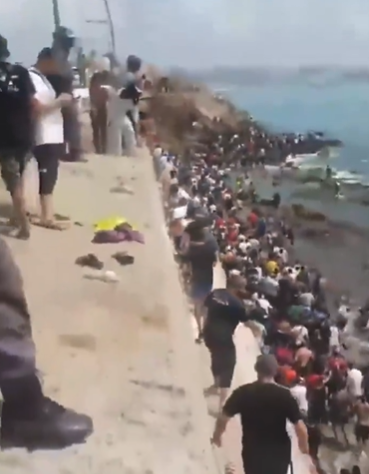
In a matter of hours this week, tens of thousands of mostly young Moroccan men poured into Ceuta, the tiny Spanish territory on the North African coast. Estimates from local and Spanish officials range from 50,000 to 60,000 crossings by land and sea since Thursday—roughly 70 percent of the city’s normal population. Many swam the short stretch of water, scrambled over fences, or simply walked through after Moroccan border controls appeared to loosen. At least 34 to 57 people died in the crush, drowning or in stampedes. By Friday evening the bulk had turned around and headed back, many citing hunger, thirst, and the absence of any reception.
The scenes were chaotic. Spanish troops and extra police were rushed in after local forces were overwhelmed. Shops shut. Residents stayed indoors. Viral videos circulating online appear to show groups looting stores, forcing entry into homes, and vehicles set alight—particularly on the Moroccan side of the border and in related clashes near Melilla, Spain’s other North African enclave. Local business owners reported fear of attack and theft. Moroccan forces eventually used tear gas and water cannons to push crowds back.
As everyone could have guessed, many of the 50 000 illegal migrants who crossed into Ceuta and Melilla yesterday spent the night by breaking into homes, looting stores and clashing with the Spanish police
— Visegrád 24 (@visegrad24) July 31, 2026
How It Happened
A Spanish Supreme Court ruling earlier in July limited the immediate return of migrants intercepted at sea. That decision, amplified by social media videos of successful crossings, spread rapidly among young Moroccans facing high youth unemployment and economic stagnation at home. Migrants themselves described hearing the border was “open.” Spanish officials blamed trafficking networks for exploiting the rumor. Opposition voices and some analysts pointed to Moroccan authorities looking the other way—or actively facilitating the surge—as leverage, a tactic Morocco has used before in disputes with Madrid. Whatever the precise mix, the result was an instantaneous, uncontrolled mass movement into a European territory.
Breaking: Spanish intelligence believes that the invasion of Moroccan immigrants into the Spanish enclave of Ceuta is a false flag operation orchestrated by the Moroccan government on the orders of King Mohammed VI. Not only are there many pardoned criminals and prisoners among… pic.twitter.com/zlmCOFMt1h
— Babak Taghvaee – The Crisis Watch (@BabakTaghvaee1) July 30, 2026
The Immediate Mess
Ceuta’s streets filled with young men carrying little more than plastic bags. Reception centers were swamped. Spanish authorities provided minimal support, accelerating voluntary returns. By late Friday the majority had left. The episode still left the city reeling: businesses shuttered out of fear, reports of property damage, and a temporary sense that the enclave had been overrun. Similar smaller-scale attempts hit Melilla. Italy floated suspending Schengen free-movement rules with Spain. France tightened its own border checks. The Spanish left-wing government under Pedro Sánchez called it a violation of sovereignty while scrambling to restore order.
The INVASION of Spain is unfolding right before our eyes 🇪🇸🚨
Prime Minister Pedro Sanchez’s government policies are actively encouraging massive waves of migration from Africa into Spain.
The Spanish territory of Ceuta – an enclave bordering Morocco near the Strait of… pic.twitter.com/w8i0JR04yR
— Predictivemoney (@Predictivemoney) July 30, 2026
What It Portends
This was not a slow drip of asylum seekers. It was a rapid, opportunistic surge enabled by policy signals, social media, and weak enforcement on both sides of a short border. Europe has seen versions of this before—2015, 2021 in Ceuta itself—but the speed and scale here expose how fragile the system remains. When incentives align and controls slip, numbers can spike overnight. Young male cohorts dominate these flows; integration, crime, and cultural friction follow in many European cities that absorbed earlier waves.
For the United States the lesson is straightforward. Soft signals, court rulings that constrain returns, and porous borders invite exactly this kind of sudden pressure. Economic desperation in origin countries plus the promise of entry produce self-reinforcing rushes. Once the numbers hit, local capacity collapses, public trust erodes, and political backlash hardens. Europe is already arguing over burden-sharing and Schengen integrity. America faces the same dynamics on a larger southern border if enforcement remains inconsistent. Mass uncontrolled arrivals do not stay temporary or orderly. They strain resources, test social cohesion, and reward those who treat borders as optional. Ceuta just demonstrated how fast the theory becomes reality.