I recently stayed in an Airbnb for the first time. I was visiting my older daughter in Milwaukee, where she was doing a summer undergraduate math fellowship at UWM. I generally prefer hotels, but there weren’t any near the university, so I downloaded the Airbnb app and began searching for a spot to stay. I looked at proximity, price, and pictures to find a good fit. I ruled out some places based on tangible reasons, such as a lack of air conditioning, but also on intangible ones. I couldn’t quite say why I didn’t like certain spots, but I didn’t. They just weren’t for me. As I narrowed down my options, I scanned customer reviews and ratings to see what others thought of my finalists. Some of their assessments of quality mattered to me; others didn’t. Then, I took the leap and booked my stay. It was a lovely home in a great location and I would happily return.
This experience got me thinking more about how we make choices in our lives. We all have distinct needs and preferences. Some of us like pickup trucks; others like Priuses. Some of us demand Dunkin’ coffee (me!); others swear by Starbucks. Some of us prefer to live in the city; others in the suburbs. Some of us like to read mystery novels; others prefer science fiction. Some of us want one type of Airbnb experience; others prefer something else. We are all different, and that diversity is what makes our society so dynamic.
It’s also why decentralization is crucial. No top-down policy could possibly satisfy all of our individual needs and preferences, and imposing such a policy would understandably breed discontent. As the Nobel Prize-winning economist Friedrich Hayek writes in The Road to Serfdom: “Our freedom of choice in a competitive society rests on the fact that, if one person refuses to satisfy our wishes, we can turn to another.”
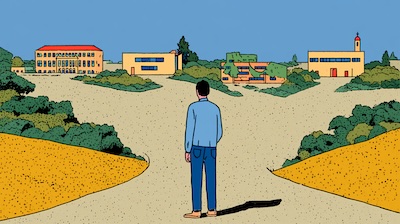
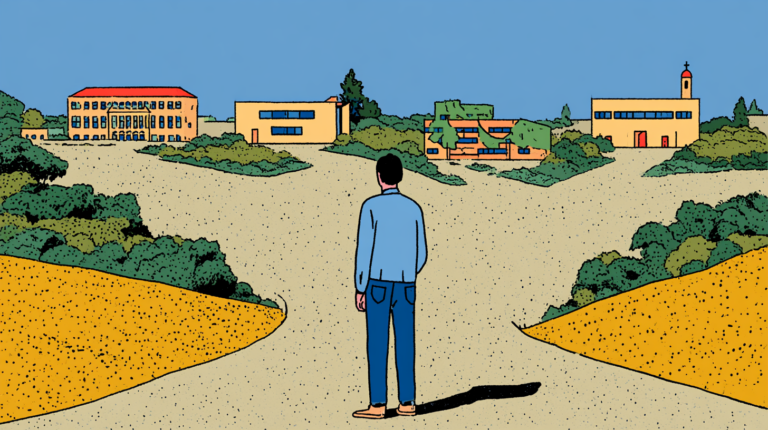
In education, we are thankfully starting to see the choice, variety, and abundance we enjoy in all other parts of our lives where market competition prevails. As education entrepreneurs launch new K–12 schools and learning spaces, and as the expansion of school-choice programs makes these learning environments more accessible, families are increasingly able to find an educational setting that satisfies their wishes, or turn to another when needed.
Like an Airbnb stay, that satisfaction is highly subjective. For some families, a school that satisfies their wishes is one that prioritizes rigorous, rote academics; for others, it could be a school where their kids spend most of the day outside, playing in nature. For many, it’s likely somewhere in between.
I met a mom who recently enrolled her son in a private high school whose stated pillars are athletics, faith, and academics. In that order. Some families might choose schools with those three pillars in a different order, while others will choose different pillars altogether. In a free society, freedom of choice is paramount.
All of us will have our educational wishes satisfied in myriad ways, which is why we should be leery when politicians and policymakers seek to impose one-size-fits-all school-accountability requirements or other top-down metrics of educational “quality,” such as student performance on standardized tests. This holds true for both public schools and private schools, including emerging ones and those participating in school-choice programs.
Some families value standardized test scores—the often-touted tool of education central planners—when choosing schools, but many do not. Polling from EdChoice finds that out of 14 reasons why parents chose their child’s current school, including public, private, charter, and homeschool, test scores ranked near the bottom of parents’ priorities. Other factors—such as proximity and peer socialization for public school parents, and safety and academic quality for private-school, homeschool, and charter-school parents—were cited as the top reasons for choosing a particular school.
As the economist Thomas Sowell reminds us in Knowledge and Decisions: “The most basic question is not what is best, but who shall decide what is best.” In education, that decision rests with parents, not policymakers. Look at their revealed preferences—where parents choose to enroll their children when given options—as the primary metric for educational quality and accountability. Which schools and learning spaces are growing, and which are shrinking? Which educational models are increasingly sought after, and which are stagnating?
In Massachusetts, for example, Boston University researchers found that enrollment is down 2% in traditional public schools, while it is up 14% in private schools and up an astonishing 45% in homeschooling, compared with pre-pandemic rates. That’s in a state without any private-school-choice programs. In choice-friendly Florida, where all K–12 students are eligible for an education savings account (ESA) of around $8,000 a year, more than half of students attend a school other than their assigned district school, with private schools and homeschools seeing particularly strong increases.
The path toward greater educational freedom for families is widening, despite ever-present centralizing and standardizing forces—including from some proponents of school-choice policies who think they know what makes a “good” school. To keep those forces at bay, we should encourage entrepreneurship and competition to expand education options and enhance consumer choice. We should favor decentralized decision-making over top-down planning. We should accept that some schools will close because they do not satisfy the wishes of their consumers, and recognize that as a sign of a healthy education marketplace. We should acknowledge that school “quality” is in the eyes of the consumer, and each of us will define it differently based on our own unique needs and preferences.
Finally, to unlock greater educational freedom and individual flourishing, we should, as FEE founder Leonard Read urged, have “a faith in free people.” We should trust that parents—not politicians or pundits—know what is best for their children’s education and should have the freedom to choose. “Freedom is impossible without this faith,” said Read.
By KERRY MCDONALD https://fee.org/articles/who-decides-what-makes-a-good-school/