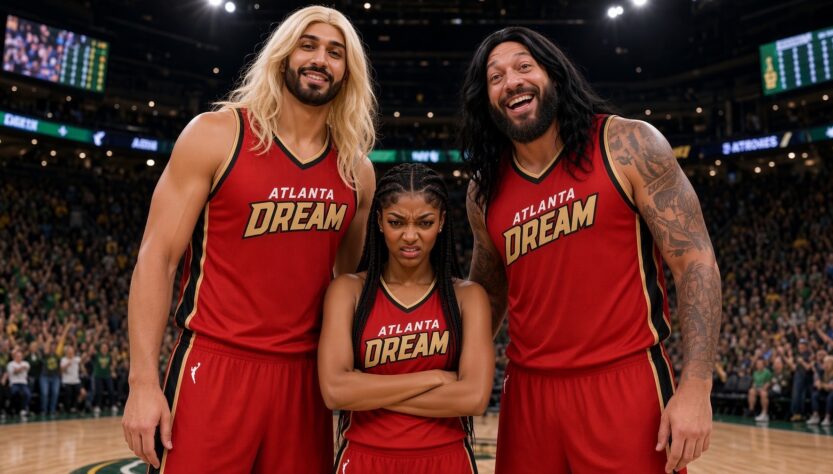
By declaring for the 2027 WNBA Draft as self-identified women, two former NBA players have handed the league a live grenade with the pin already pulled. The CBA says “only players who are women are eligible.” It does not define the word. That ambiguity worked fine as long as the only people testing it were activists and mid-tier overseas players. Now two actual NBA-sized men have said, essentially, “Cool rules. We’ll take them at face value.”
Enes Kanter Freedom and Royce White just declared themselves eligible for the 2027 WNBA Draft.
Two former NBA guys looked at the league’s “only players who are women are eligible” language, noticed it carefully avoids defining “women,” and decided the honest response was to announce they are now women (sometimes, for basketball purposes).
After careful consideration and reviewing the current eligibility guidelines,
— Enes Kanter FREEDOM (@EnesFreedom) August 7, 2026
I’m officially declaring myself a @WNBA prospect.
If simply declaring who you are is all that’s required, then I meet every single requirement necessary to compete in the WNBA.
My team and I have… pic.twitter.com/msncUZUT1J
Freedom, the 11-year veteran who once dunked on people for a living, posted that after “careful consideration” of the rules and the league’s public statements about inclusion, he qualifies. White followed almost immediately, telling Fox he’s transgender, a woman, and will declare too—while also noting he’d like the WNBA to just say plainly whether “guys with a pair of balls” are allowed. He added that he doesn’t want to be discriminated against as a “sometimes-identifying-as-a-transgender-woman athlete.”
It’s the sporting equivalent of two guys showing up at a “women’s only” yoga class with the same membership card the studio has been waving around and asking, “So… do we stretch or what?”
The comedy writes itself:
• Former NBA centers and forwards suddenly discovering their inner point guards for the women’s game.
• The mental image of the WNBA draft board having to decide whether to take the 6-foot-something former first-rounder or risk a lawsuit for “exclusion.”
• White’s charmingly precise phrasing: he identifies as a woman for the purpose of professional basketball. Outside of that, the jury is still out.
The league can no longer hide behind vague inclusion language or hope the issue stays theoretical. They either:
- Draft or invite one of them and accept biological males in the women’s league, or
- Publicly redefine “women” in a way that excludes males, which means admitting the previous posture was performative.
As I stated a few days ago, I am declaring for the 2027 WNBA Draft.
— Royce White 🇺🇸 (@Highway_30) August 7, 2026
I identify as a sometimes identifying transgender woman! My wig is in the mail. pic.twitter.com/lPVsmcMOVD
As I stated a few days ago, I am declaring for the 2027 WNBA Draft.
— Royce White 🇺🇸 (@Highway_30) August 7, 2026
I identify as a sometimes identifying transgender woman! My wig is in the mail. pic.twitter.com/lPVsmcMOVD
Either outcome ends the fog. That’s the real value of the stunt.
Secondary bonus: it momentarily steals the oxygen from the racial grievance machine that has been running nonstop around Caitlin Clark and Sophie Cunningham. For months the dominant media storyline treated any criticism of Clark’s treatment (or defense of biological women in women’s sports) as coded racism or “anti-Blackness.” Cunningham’s straightforward comments about protecting the women’s category got the same treatment. Suddenly the conversation has a new center of gravity: two Black and Turkish former NBA players forcing the league to answer a question it desperately wanted to keep fuzzy. The race narrative loses its monopoly on the oxygen for a minute. That’s useful.
The WNBA now has to pick a side in public. The longer it delays, the more ridiculous the silence looks. Freedom and White didn’t need to become women forever. They only needed to become women long enough to make the league say the quiet part out loud.