Blind Faith in the White Coat. Doctors as gods have a body count.
Settled, Until It Wasn’t
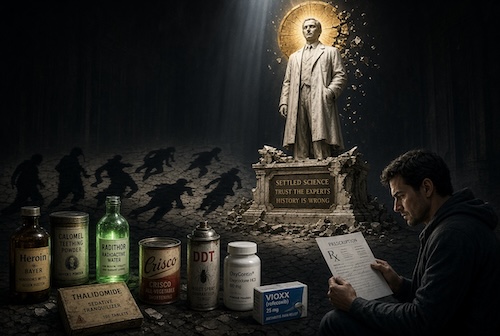
Doctors are not gods. Most of the time, medicine gets there through slow, careful, well-tested work — but “the doctor said so” has, on its own, an uneven track record. Here is what following the confident, mainstream, professionally-endorsed advice of the day would have looked like, decade by decade.
1890s. You dose the baby with Bayer’s new cough syrup — a non-addictive alternative to morphine, marketed for children. Bayer named it Heroin, from the German for “heroic,” and sold it as safe and effective. It was, of course, heroin.
1900s. You rub calomel teething powder on your infant’s gums. It’s a mercury compound. In a subset of children it triggers “pink disease” (acrodynia) — swollen, peeling hands and feet, screaming, photophobia — and some of them died before anyone connected the powder to the illness.
1910s. You cook in Crisco, launched by a soap-and-candle company as the modern alternative to lard. Partial hydrogenation, the process that made vegetable oil solid at room temperature, produced industrial trans fat — a category of fat the FDA would formally rule unsafe more than a century later.
1920s. You drink Radithor, radium-laced water sold on prescription as a tonic for vitality. Industrialist Eben Byers drank roughly 1,400 bottles. His jaw had to be removed in pieces, and he was buried in a lead-lined coffin.
1930s. A chemist dissolves a new sulfa drug in diethylene glycol — antifreeze — to make it more palatable. The Elixir Sulfanilamide kills over 100 people, many of them children. It is this disaster, not foresight, that gives the FDA the power to require safety testing before a drug reaches the market.
1940s. Your doctor smokes a Camel in the surgery — physicians favored that brand more than any other, in surveys the tobacco companies themselves ran and advertised, including in the pages of JAMA.
1950s. DDT is fogged over your street, your kitchen, your children at school. The chemist who identified its insecticidal power had already won a Nobel Prize for it.
1960s. Your wife takes thalidomide for morning sickness, marketed across Europe as remarkably safe, including for pregnant women. More than 10,000 children are born with limb malformations before it’s withdrawn.
1970s. The country swaps butter for margarine on the American Heart Association’s advice. The trans fats in that margarine are the same ones later banned as unsafe at any level of consumption.
1980s. Fat comes out of processed food to chase the new low-fat consensus; sugar goes in to keep it palatable. The obesity curve that begins here has not come back down.
1990s. Your father is prescribed OxyContin on the strength of an oft-cited claim that fewer than one percent of patients become addicted. Purdue Pharma later pleads guilty to criminal misbranding; the opioid overdose death toll runs into the hundreds of thousands.
2000s. You take Vioxx for your knee. Merck withdraws it in 2004; an FDA safety officer’s own estimate puts the excess heart attacks and strokes it caused in the tens of thousands.
None of this was fringe medicine. Every item had a professional body behind it, a peer-reviewed literature, a man in a white coat, and — in several cases — a company writing the checks for the research and the advertising both. Nobody who followed that advice was foolish. They were doing what most people reasonably do: trusting the most qualified people available.
What “settled” actually means
“Settled” is often less a statement about evidence than about funding and attention. When the money and the professional incentives point one direction, the questions that would complicate the picture tend to stop getting asked — not because they’ve been answered, but because nobody is paying to ask them anymore. Financial conflicts of interest, in particular, have a well-documented habit of showing up right where the “consensus” turns out to be wrong: the tobacco-funded surveys, the sugar industry’s funding of research that shifted blame onto fat in the 1960s, Purdue’s marketing of OxyContin, Merck’s handling of Vioxx’s cardiovascular signal.
Which candidates today
Run the pattern forward and the same fingerprints show up now, in the same places they showed up before: wherever the people producing the evidence are the same people who profit from the answer.
Just look at the current list your grandchildren may one day read in disbelief:
The industrial seed oils washed in hexane and built into every cell in your body, in almost every processed product on the shelf, is defended largely on research funded by the vegetable oil industry itself, in a near-mirror of the sugar industry quietly paying Harvard researchers in the 1960s to shift blame onto fat.
The statin that blocks the pathway your hormones need, to stop one heart attack in a hundred. Statin trials are still overwhelmingly run, designed, and reported by the drug’s own manufacturer, with the benefit routinely presented as a relative risk reduction — “36% fewer events” — rather than the far less impressive absolute number, often around one prevented heart attack for every hundred people medicated for years.
The injection where a third of the weight that vanishes is muscle. The new class of weight-loss injections is being prescribed at a scale and speed the long-term safety data hasn’t caught up to, with a real, openly acknowledged loss of lean muscle mass alongside the fat, in a population that will be taking them for the rest of their lives.
The infant formula, built substantially on seed oils, is regulated for nutrient minimums, not for the quality of the fat supplying them.
None of that proves any of these will end up on next century’s list. But “this went through a regulatory process” was also true of Vioxx, thalidomide in Europe, and OxyContin. A process run by, funded by, and staffed with the advice of the industry being regulated is not obviously a different thing from no process at all.
The people who took thalidomide weren’t reading fringe pamphlets — they were reading their doctor’s prescription pad. The question worth asking about any “settled” answer isn’t whether an agency approved it. It’s who paid for the study that got it approved, and what happens to the researcher who publishes the study that doesn’t.