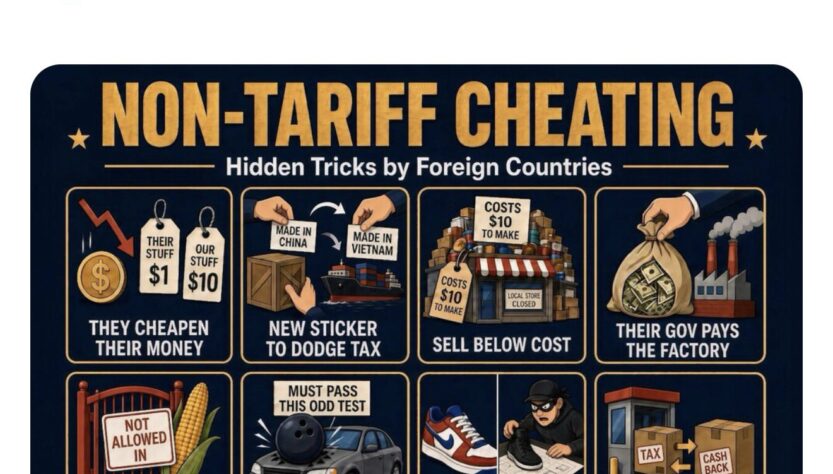
Trump just posted the playbook foreign countries use when they don’t want a fair fight: cheapen their currency, slap a new “Made in Vietnam” sticker over China, dump below cost, subsidize factories, ban our food, invent weird tests to keep our cars out, copy our products, then cash back their exporters.
Currency manipulation. Deliberately undervaluing a currency makes exports artificially cheap and American-made goods artificially expensive by comparison. It’s not a real efficiency advantage — it’s the exchange rate doing work that competitiveness should be doing.
Relabeling (“Made in Vietnam” stickers). Chinese goods get routed through a third country, repackaged, and re-exported as if they originated there, specifically to dodge tariffs and quotas aimed at China. It’s a direct end-run around trade enforcement.
Dumping below cost. Selling a product abroad below what it costs to make floods the market, undercuts domestic producers, and drives them out of business — after which the exporter raises prices once the competition is gone.
State subsidies. Direct cash, free land, subsidized loans, and state-bank financing let foreign manufacturers price below anything an unsubsidized competitor could match. That’s a company competing against a national treasury.
Blocking American food. Countries invoke “safety” rules — often disconnected from real science — to keep out competitive U.S. agricultural products, protecting their own farmers under the cover of a health regulation.
Rigged auto standards. Emissions tests, safety specs, and certification rules get written just different enough from U.S. standards that American automakers face costly re-engineering or outright exclusion — not because the cars are actually less safe.
Copying our products. IP theft, forced technology transfer, and counterfeiting let foreign firms skip the R&D costs their American competitors had to pay.
Export rebates. Governments refund taxes to their exporters specifically on goods sold abroad, subsidizing the export price without technically breaking tariff rules.
None of that is competing on quality or innovation. It’s changing the rules of the game and calling it free trade.