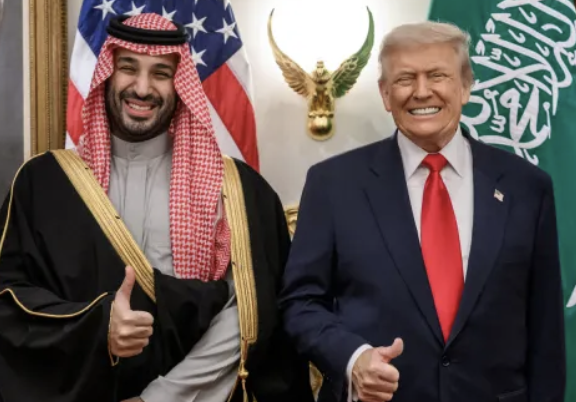
For forty years we have treated Riyadh like a showroom. Fighters, Apaches, Patriots, THAAD, tank engines, bombs with brains, and now a notification for a stack of F-35s that would make a smaller country faint. Obama-era offers ran past a hundred billion on paper. Real deliveries and contracts over the last decade are still tens of billions. Three-quarters of their major conventional kit in recent years has our stamp on it. We have trained tens of thousands of their people since 2009, plus the National Guard modernization that never seems to end. They spent about $83 billion on defense last year — fifth in the world. This month the Houthis put a missile toward Riyadh anyway, lit fuel at Yanbu, and spent six days out of seven throwing drones and ballistic junk at the south. Seventy-three wounded in one southern wave. Airport alerts in the capital. That is not a rounding error. That is a militia with a mountain and a patron.
Source: https://t.co/7WuFjX1Qsr
— CyberChick (@warriors_mom) September 23, 2026
The Arsenal They Bought
The kingdom does not lack airplanes. It lacks a reason for a lieutenant to die that the family will accept. The force was built to look like a deterrent and to stay too fractured to stage a coup. Different services, different princes, foreign contractors in the hangar, Americans and Brits keeping the jets in the air. You can buy a sortie. You cannot buy a staff that has spent twenty years doing combined arms in the same mountains the other side grew up in.
Air campaigns are what rich countries do when they do not want a body bag. Yemen is not a parking lot. It is ridges, wadis, and tribes. You can crater a depot. The launcher moves. The Houthis only have to hold Sanaa and keep enough missiles to make the evening news in Riyadh. Saudi Arabia has to defend oil, desalination, airports, pipelines, and cities across a country the size of Western Europe. That is a loser’s exchange rate even when the jet is new.
The Proxies They Hired
Riyadh has spent a decade training a “government” army that still cannot take a port without asking Abu Dhabi how. Southern fighters want their own map. Islamist factions want another one. The coalition that started in 2015 was never one army. It was a joint checking account with three business plans. When the shooting paused in 2022, the Houthis used the quiet to restock. When the Iran war blew the region open this year — Hormuz shut, Red Sea a shooting gallery — they walked the coast, grabbed Mocha, and put a lock on Bab el-Mandeb for Saudi hulls. The people we paid to be the ground game were not a ground game. They were a press release with rifles.
‘You no longer need an enormous blue-water navy to threaten global commerce. Cheap drones, missiles, mines, and control of the coastline can impose tremendous economic costs on ships worth hundreds of millions of dollars.’ – Armstronghttps://t.co/fqLLP7FUyf
— Trading Sunset (@Trading_Sunset) September 23, 2026
Why a Militia Beats a Budget
Iran does not need to occupy Jizan. It needs a cheap second front that makes the kingdom spend interceptors like popcorn. Every Patriot shot at a $20,000 drone is a win for the side that builds the drone in a shed. Reports this month have Riyadh asking other capitals for air-defense help because the magazine is not infinite. That is the deficiency in one sentence: they purchased a shield designed for the occasional incoming. They are living in a drizzle.
Add cohesion. The Houthis are a movement with a clergy, a tribe, and a pipeline from Tehran. They do not have to brief three ministries before they fire. The Saudi system has to protect the oil, the succession, and the brand. A military built to prevent a palace coup is not built to clear Saada province house by house. Scholars have said the quiet part for years: the monarchy kept the army weak on purpose. Weak armies do not seize the throne. They also do not finish irregular wars.
The Terrain Does the Rest
You cannot bomb a mountain into a parking lot. Every previous round proved it. The United States, the Emirates, and the kingdom have all hit launchers, chiefs, and warehouses. The group is still there. Geography plus a foreign missile shop plus a divided opposition is how a non-state actor acts like a navy. They do not have to “defeat” Saudi Arabia. They have to make Yanbu smoke and Riyadh duck. Mission accomplished on the days the sirens work.
What This Means
We did not fail to sell them weapons. We succeeded at selling them a substitute for will. Training a captain to fly an F-15 is not the same as training a nation to accept casualties for a border it cannot see from the palace. The Houthis are a difficult problem because they are the cheap version of the war Iran is already fighting — long range, deniable, and aimed at the one thing the kingdom cannot move: the export rack.
If Riyadh wants the south quiet, it needs a ground force that will fight for the same Yemen, interceptors it does not have to ration, and a political deal it has spent ten years refusing. If it wants us to fly the rest of the war, that is a different invoice. Billions bought them an air force. They still have a militia on the roof. That is not a mystery of technology. It is what happens when you purchase the hardware and rent the courage.