For years, cartel drones buzzing over the U.S.-Mexico border were mostly a nuisance border agents could watch but rarely stop. That changed late this summer, when the U.S. military began using a truck-mounted laser to destroy them.
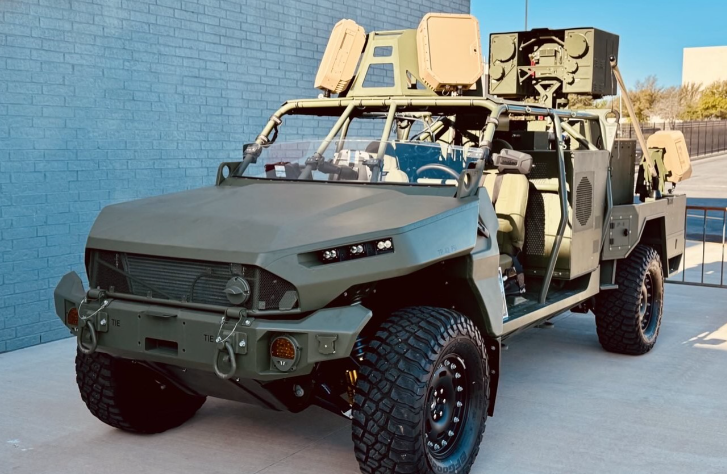
🔴 Cartel Drones Are Being Taken Down With High-Tech Lasers on the Southern Border. The Weapon Is Mounted on a Streamlined Jeep With a Turret.
— Bennetta Elliott (@belliott123) September 25, 2026
In late August, U.S. troops on the southern border used a high-energy laser against hostile drones. Joint Task Force–Southern Border… pic.twitter.com/anPOTSW7HK
The first shots
Joint Task Force–Southern Border said the operation spanned the late-night hours of August 25 and 26, using the Army Multipurpose High Energy Laser (AMP-HEL) system to take down three hostile drones. It marked the first time the laser was successfully used on a cartel drone at the border, though some members of Congress had been pushing for its use for years.
Northern Command said the drones were deemed hostile because they were supporting activities that posed a physical threat to U.S. military personnel and Customs and Border Protection. Maj. Gen. Curtis Taylor, the task force commander, said cartels are “increasingly employing unmanned aircraft systems” for smuggling and spying on U.S. personnel. Officials didn’t say exactly where the shootdowns happened or which cartels were involved, and it remains unclear whether the strikes occurred over U.S. or Mexican territory. Taylor also thanked Mexico’s government and military for their cooperation.
The “Jeep” with the turret
The vehicle in question isn’t technically a Jeep. It’s an Oshkosh-built Joint Light Tactical Vehicle, the Humvee’s successor, carrying AeroVironment’s LOCUST laser on a roof-mounted beam director. AeroVironment delivered two JLTV-mounted versions to the Army in December 2025, following an earlier pair mounted on GM Defense’s Infantry Squad Vehicle. The JLTV version uses the same 20-kilowatt-class laser but with a larger-aperture beam director for better lethality.
The system can track swarms of drones and hold its beam on a single target until it fails. It’s also cheap to fire: each shot is estimated to cost about $3. Putting it on a truck matters because crews can reposition it wherever a drone threat pops up.
Eleven down, and a drop in traffic
The laser has kept firing since August. According to Rio Grande Valley Sector Chief Patrol Agent Jared Ashby, the military has downed 11 cartel-linked drones in that sector since late August, all of them in the RGV. Military officials say the deployment has coincided with a roughly 75% drop in drones detected there, and that 300 drones have been “defeated” along the border this year, including 100 in August alone — the latter figure counting all methods, not just lasers.
Border Patrol itself doesn’t run the laser. Agents rely on signal jammers to disable drones, while the military operates the laser separately.
Why cartels fly drones
Officials told Congress that more than 27,000 drones were detected within about 1,600 feet of the southern border in the last six months of 2024. Cartels use cheap commercial drones to track police, move narcotics and trafficking victims, and attack rivals. Ashby added that operators on the Mexican side have used drones to steer migrant groups into the U.S. remotely, without a smuggler crossing with them. In Mexico itself, cartels have gone further and used drones in attacks, though they’ve seemed wary of doing so against U.S. forces.
Not without hiccups
The rollout has had a rough patch. In February, a military laser accidentally shot down a CBP drone near Fort Hancock in southwest Texas, and the FAA briefly shut airspace earlier that same month.
The bigger picture
The laser deployment is part of a broader militarization of the border. It comes as the Trump administration has expanded the military’s role there as part of its immigration crackdown and war on cartels, with roughly 8,000 service members deployed under the border task force. Supporters say the technology is overdue; critics have raised questions about airspace safety and the growing role of troops in domestic security. What’s clear is that directed-energy weapons, long a science-fiction staple, are now in routine use on U.S. soil.
Sources:
- CBS News
- Military.com
- The Hill
- Washington Times
- NewsNation
- Townhall
- AeroVironment
- Defence Blog
- Interesting Engineering
- AP via Yahoo