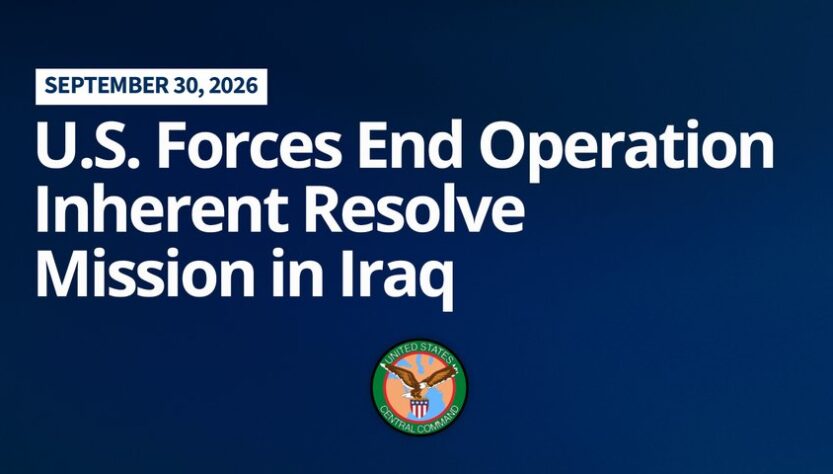
The last American troops have left Iraq. The U.S. military announced on Wednesday, September 30, that its withdrawal was complete, closing out a 12-year mission that began in 2014 when the Islamic State threatened Baghdad.
President Trump marked the moment on social media. “Today, I am pleased to announce, that the last American Forces are leaving Iraq!” he wrote, according to ABC News. He also called the day “a victory for the United States, a victory for Iraq, and a decisive victory over ISIS.”
What happened
Here are the reported facts.
The final troops departed from Erbil air base in northern Iraq’s semi-autonomous Kurdish region, according to PBS NewsHour. About 2,500 U.S. troops had been stationed in Iraq for years before the drawdown, ABC News reported.
The timeline was set in 2024, when the Biden administration and Baghdad agreed to wind down the U.S.-led coalition mission. The Trump administration kept the September 30, 2026 deadline and carried it out.
— U.S. Central Command (@CENTCOM) September 30, 2026
Chief Pentagon spokesman Sean Parnell said the milestone “reflects the success of a 12-year campaign that defeated ISIS as an organized military threat in Iraq.” He described the change as a move “from a wartime coalition mission to an Iraqi-led security effort.” ISIS has been reduced to what PBS called “scattered sleeper cells.”
Iraqi Prime Minister Ali al-Zaidi welcomed what he called “a new phase, one defined by Iraq’s sovereignty, the strength of its institutions, the readiness of its forces.”
This is the second time America has fully pulled out of Iraq. The first came in 2011, eight years after the 2003 invasion that toppled Saddam Hussein. About 4,500 American service members died in Iraq, most of them between 2003 and 2011, according to ABC News.
The worries
Not everyone is celebrating. Iraq’s Kurdish region says it faced more than 1,000 drone and ballistic-missile attacks during the recent U.S.-Iran conflict, according to Australia’s ABC News. The Kurdish Peshmerga Ministry said the U.S. departure “without the provision of a defense system, is a matter of concern.”
Iran-backed militias in Iraq, meanwhile, celebrated the withdrawal as the start of “full sovereignty,” PBS reported. U.S. bases in Iraq had been attacked regularly since the Iran war began on February 28.
Mission accomplished, and this time it’s real
President Trump has said for years that America got dragged into endless wars in the Middle East by leaders who never defined what winning looked like. On Wednesday he said it again, calling the long involvement a “quagmire” that came from “very bad decision making,” according to PBS.
He has a point. The 2003 war cost about 4,500 American lives. And within three years of our 2011 exit, ISIS was threatening Baghdad, which is what pulled U.S. troops back in 2014.
This exit is different. The mission our troops returned for was clear: break ISIS as a fighting force. By the Pentagon’s own account, they did it. The terror group that once held cities now operates as small hidden cells. That is what a defined mission with an end date looks like.
Conservatives who believe in limited government should welcome this. A government that can’t stop fighting wars it has already won is not limited in any meaningful sense. Every year a mission drags on past its purpose, it costs money, puts troops at risk from Iranian-backed militias, and ties down forces that could be needed elsewhere.
There are fair questions. The Kurds have been loyal partners, and their worries about air defense deserve a serious answer from Washington. Iran will try to fill any vacuum. And if ISIS regroups, America must be ready to strike hard and fast.
But striking a threat from a position of strength is not the same as occupying a country forever. Iraqis now say they want to run their own security. Good. It is their country. American taxpayers have carried the load long enough.
What to watch
Watch three things in the months ahead: whether Iraq’s own forces keep ISIS on the run, how hard Tehran’s militias push to dominate Baghdad, and what security help Washington offers the Kurdish region.
For now, the soldiers who finished this job deserve the nation’s thanks. They did what they were sent to do, and they are leaving with the mission complete.