The Army has scheduled former Maj. Nidal Hasan to be executed by firing squad at Fort Hood on December 3, 2026. It has not published the drill. What follows is a prediction built from the only written U.S. military firing-squad rules, the current Army execution regulation, and the state protocols the Provost Marshal General is likely to borrow from when writing the mission plan.
Hasan, an Army psychiatrist, was convicted in 2013 of 13 counts of premeditated murder and 32 counts of attempted premeditated murder for the November 5, 2009 shooting at the Fort Hood soldier readiness center. A panel of 13 officers sentenced him to death. He has been held at the U.S. Disciplinary Barracks at Fort Leavenworth. On October 5, Defense Secretary Pete Hegseth recommended a firing squad and President Trump approved it. Acting Army Secretary Adam Telle then set the date and place: December 3 at Fort Hood, the same post where the killings occurred, in the early afternoon. If it proceeds, it will be the first U.S. military execution since Pvt. John A. Bennett was hanged in 1961, and the first by firing squad since Pvt. Eddie Slovik in France on January 31, 1945.
Further civilian appeals could still delay it. Army Regulation 190-55 requires the date to fall between 60 and 150 days after presidential approval, which this schedule satisfies, but it does not freeze the courts.
What the regulation actually requires
AR 190-55, last certified in 2023, no longer names a method. A 2019 revision deleted the earlier reference to lethal injection and left the choice to the Secretary of the Army, on analysis by the Provost Marshal General. The regulation does require that identities of the execution working team stay confidential to the extent the law allows, that the condemned be moved from his cell only for the minimum time needed to prepare him, that the site be cleared of nonessential personnel and then opened to approved witnesses, that witnesses be briefed on procedure and decorum, and that the commandant read the charges, findings, sentence, and execution order before ordering the execution to begin. Media interviews in the witness areas are barred.
None of that specifies how many rifles, what ammunition, or where the shooters stand. Those details will be in the mission plan the Provost Marshal General is responsible for writing. That plan has not been released.
The 1945 template
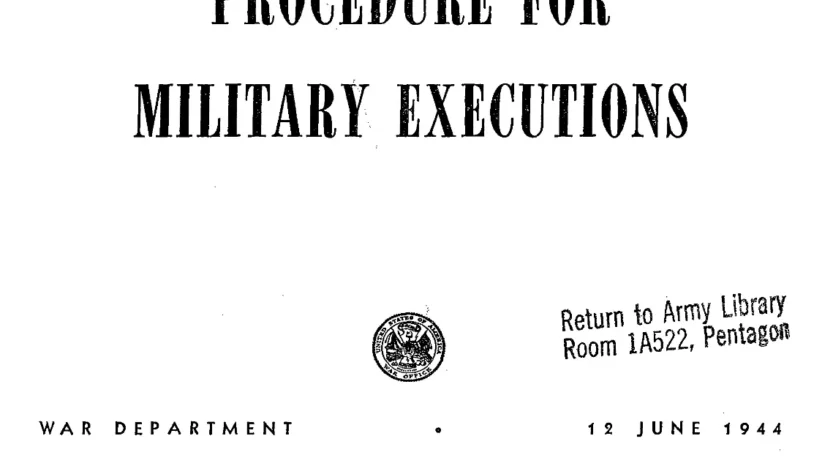
The last time the Army wrote the procedure down was War Department Pamphlet No. 27-4, Procedure for Military Executions, dated June 12, 1944. It was used for Slovik.
Under that pamphlet an officer loaded twelve rifles in his presence. Not fewer than one and not more than four were blanks. The rifles were racked at random so no member of the squad knew which weapon held the blank. The prisoner was strapped upright to a post, hooded, and marked with a four-inch white target over the heart. On a combined arm signal and the oral command “Fire,” the squad fired together. A medical officer examined the body. If death was not immediate, the rifles could be reloaded for a second volley. Slovik’s squad, twelve men of the 109th Infantry with M1 Garands, used eleven live rounds and one blank. He was hit by eleven bullets and died while the squad reloaded. Distance was about twenty paces.
One practical flaw of that blank is well known. An M1 ejects the case of a live round and does not eject a blank the same way, and the recoil of a live cartridge is obvious to anyone who has fired the rifle. The blank’s value was psychological, and mostly beforehand.
What is more likely in December
The 1944 pamphlet is not current doctrine, and the weapons and the setting have changed. The probable design is a hybrid: the military skeleton of a formal execution party, hood, heart target, simultaneous fire, and confidential shooters, filled in with practices from the states that have actually used firing squads in this century.
Utah’s protocol, used for Gary Gilmore in 1977 and Ronnie Lee Gardner in 2010, put five volunteer marksmen behind a barrier about 20 to 25 feet away, aiming at a cloth target over the heart. Four rifles had live .30-caliber rounds; one had a blank or, more recently, a wax bullet meant to mimic recoil. South Carolina, which carried out firing-squad executions in 2025, dropped the blank entirely: three rifles, all live, frangible ammunition meant to destroy the heart, the prisoner strapped to a chair about 15 feet away. Idaho’s newer statute contemplates three primary shooters and two alternates with .308 rifles at roughly 10 yards.
For Hasan, the most plausible Army plan is closer to the older military number than to South Carolina’s three. Twelve remains the historical U.S. Army figure, and the regulation’s emphasis on a trained, anonymous execution team fits a squad drawn from volunteers or detailed marksmen whose names are withheld. Expect at least one non-lethal round—blank or wax—loaded out of the shooters’ sight, because that was the explicit rule the last time the Army did this and because it is still the usual American rationale for diffusion of responsibility. It is also possible the mission plan follows South Carolina and issues only live rounds; nothing in AR 190-55 forbids it.
The prisoner will almost certainly be restrained, hooded or blindfolded, and marked over the heart rather than shot in the head. The 1944 manual and every modern U.S. firing-squad protocol aim there to avoid disfigurement and to stop circulation quickly. A physician will be present to pronounce death, not to direct the shooting. Witnesses, including victim family members who have already been asked whether they want to attend, will be in a separated viewing area. The squad itself will likely fire from behind a screen or wall with ports, both to protect identities and to keep the formation steady.
🚨 WOW! SecWar Pete Hegseth just announced the firing squad execution of Fort Hood Islamist terrorist Nidal Hasan will be **PUBLIC** At the SAME time and place where Hasan carried out the attack. "We’ll make sure that people are able to watch it. That it’s public. Because people need to understand that there’s serious consequences for these types of things!" "He’s gonna get a firing squad of soldiers. As it should be." @JackPosobiec: Did he make any final requests? HEGSETH: "Don’t care. We’ll see him on December 3rd." 🥶 Hasan m*rdered 13 people at Fort Hood in 2009 while yelling "Allahu Akbar" and wounded more than 30 others He was sentenced to death in 2013 and then sat on death row for over a DECADE. The Acting Sec. of the Army made it official The victims’ families finally get JUSTICE 🙏🏻 Our SecWar is stone COLD when it comes to traitors like this who take American lives. @RealAmVoice
— Eric Daugherty (@EricLDaugh) October 8, 2026
Weapons will be military rifles already in the inventory, almost certainly not the M1s of 1945. A modern service rifle or designated marksman rifle in 5.56 or 7.62, zeroed at the short execution distance, is the practical choice. The volley will be simultaneous on command. If the first volley does not kill, the historical rule and ordinary medical practice both point to a second volley or a coup de grâce rather than a prolonged wait.
None of the rifle-by-rifle details has been confirmed by the Army. Until the Provost Marshal General’s mission plan or an after-action account is released, the December 3 procedure remains a reconstruction: Fort Hood, early afternoon, a confidential squad, a hood and a heart target, simultaneous fire, and at least a strong chance that not every rifle contains a live round.
How weird is it to watch an execution?
Today, while we watch countless hours of violence on screens we are remarkable squeamish about the real thing when compared with other generations. London’s Highgate hangings were a day out for the family for centuries. Across Europe, crossroads gibbets were adorned with hanging corpses pecked at by birds and torn at by wild animals. Today, many suggest that witnessing the execution of a murderous traitor is wrong, not just on moral grounds but because it is distasteful to watch another human be killed in cold blood. Where do you stand? Do you think the people complaining would do so if it was a political figure they dislike?
The last public execution was of murderer and rapist Rainey Bethea 94 years ago. Time magazine covered it: "Every bar was packed to the doors. Down the main street tipsy merrymakers rollicked all night. ‘Hanging parties’ were held in many a home" It is healthy to celebrate the elimination of evil.
— Jeremy Kauffman 🦔🌲🌕 (@jeremykauffman) October 9, 2026