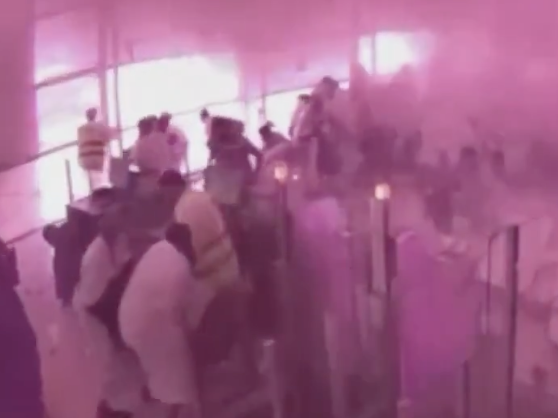
An American citizen is among the dead after a missile slammed into King Khalid International Airport in Riyadh, Saudi Arabia, on Saturday. Saudi officials say at least 12 people were killed and 309 were wounded.
The attack was blamed on the Iran-backed Houthis of Yemen. It was the deadliest attack in any Gulf Arab country since the war with Iran began, according to the Associated Press as reported by CBS News. Now President Trump is weighing whether America should join Saudi Arabia in hitting back.
What happened in Riyadh
According to CBS News, a regional official said the missile struck a complex that houses Terminals 3 and 4, which handle domestic flights. Several of the wounded were in critical condition and were taken to hospitals across the city.
Saudi authorities shut down the airport. FlightAware counted 324 canceled flights that day. The U.S., the U.K., Germany, Australia and Canada all warned their citizens to stay away from the airport.
🚨CATASTROPHIC: PILGRIMS IN IHRAM QUEUE FOR THEIR FLIGHT TO MECCA.⚔️🇸🇦🇾🇪🔥 A Houthi missile strikes Riyadh airport. 13 dead. 300+ injured. This was a civilian terminal. Saudi-led coalition calls it a war crime. Who still claims these are “military targets”?
— 🇵🇰 قـيـس بـن حـارث 🇸🇦 (@Qais_99k2) October 12, 2026
Saudi officials later listed the nationalities of the dead. They included four Saudis, two Bangladeshis, and one person each from Egypt, Jordan, Syria, the Palestinian territories and Sudan, along with the American.
It was not the first hit. Two days earlier, on Thursday, Houthi-claimed attacks on the same airport and a Saudia aircraft killed three Saudi citizens, including a pilot.
And the Houthis did not stop. On Sunday another projectile hit a terminal at the Riyadh airport, and Saudi authorities said King Fahd International Airport in Dammam was also attacked. A Houthi spokesman, Yahya Saree, said the group had carried out at least four operations against the Riyadh airport since Saturday. The Houthis also warned airline passengers not to travel and called Saudi airports and airspace “potential targets.”
🚨🇸🇦⚡️BREAKING: HOUTHIS JUST HIT RIYADH AIRPORT AGAIN.⚔️🔥 A day after killing 13 including one American and wounding over 300 at King Khalid International. 🇸🇦✈️ Another strike Sunday left one dead and 11 injured. 🇸🇦 Airport remains closed. 🇾🇪 Iran-backed Houthis claimed both attacks and warned airlines to stay out of Saudi airspace (except Mecca and Medina). 🇺🇸 Trump says the US “may” join Saudi strikes against them.
— 🇵🇰 قـيـس بـن حـارث 🇸🇦 (@Qais_99k2) October 12, 2026
Rubio: ‘must stop now’
Secretary of State Marco Rubio condemned the strike Saturday night. In a statement reported by the Washington Examiner, he said the U.S. “strongly condemns the recent attacks on the Kingdom of Saudi Arabia by the terrorist Houthis.”
Rubio said the airport strike “took numerous innocent lives, including an American citizen,” and that the attacks “must stop now.” He said America stands “with the Kingdom of Saudi Arabia and its people.”
A State Department spokesperson told CBS News the administration is in close contact with its “Saudi partners.”
Trump weighs joining the fight
Asked Saturday whether the U.S. would join Saudi strikes on the Houthis, President Trump answered, “We may. We’re gonna look at it.” He said a decision would come quickly, according to CBS News.
Asked whether the airport attack would change his plans on Iran, Trump said, “Well, we’re gonna take a look.”
The broader picture is tense. Earlier in the week, Trump said the U.S. would not attack Iran before the Nov. 3 midterm elections. At a rally in New York on Friday, he said Iran must either “give us everything” or face destruction. On Sunday, Mohsen Rezaei of Iran’s Supreme National Security Council called the latest U.S. response in peace talks “insufficient,” CBS reported.
Saudi Arabia launched a major offensive against the Houthis about a week ago, providing air support to Yemeni government forces. Since then, Houthi attacks have hit Saudi airports, military sites and oil facilities. The Houthis’ gains along the Red Sea also give them a better view of the Bab al-Mandab Strait, a key shipping lane and an alternative to the Strait of Hormuz.
The critics
Not everyone wants a U.S. response. Sen. Chris Murphy, a Connecticut Democrat, warned against retaliating on Saudi Arabia’s behalf, calling the war “spiraling out of control,” according to CBS News.
The bottom line
The Houthis are not a rebel group fighting a local war. They are an Iranian proxy firing missiles into crowded airport terminals, and now they have killed an American. Rubio called them what they are: terrorists. Saudi Arabia, Egypt, Pakistan and Turkey jointly condemned the attacks as a “blatant violation of international law.”
President Trump is right to keep every option open and to decide quickly. Peace through strength means a terror group should never be allowed to kill Americans for free. That doesn’t mean a long new war. It means making sure the people who launch these missiles pay a price that they, and their sponsors in Tehran, will remember.
The administration’s job now is to protect Americans in the region, back a partner under fire, and keep pressure on Iran at the negotiating table. Weakness invites more attacks. Strength stops them.