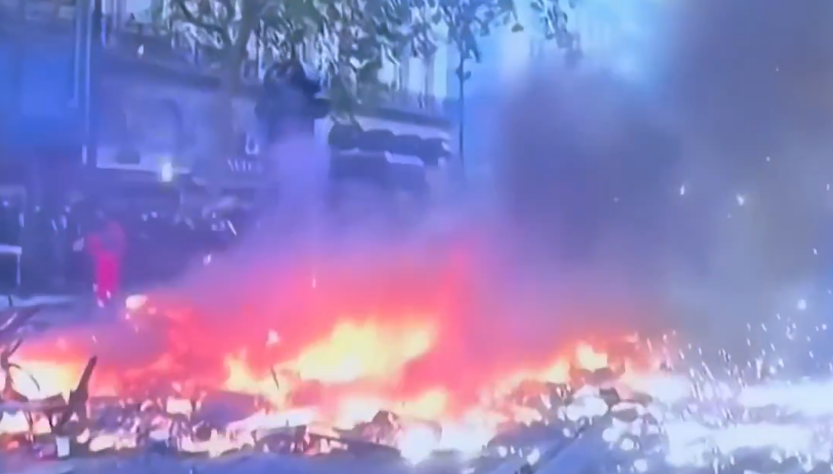
Hundreds of thousands of people took to the streets across France on Saturday over the cost of living and the condition of public schools. Government counts put the turnout near 550,000. Organizers put it closer to 800,000. Most of the organized marches stayed orderly. That is the part many accounts stress. The part that left lasting damage is harder to overlook once the photographs and the official tallies come in.
Masked groups on the edges of the demonstrations broke windows, started fires, and emptied stores. More than 1,800 people were arrested on Saturday, with the total rising past 2,000 by the next day. Hundreds of police officers and emergency workers were injured. One person died during the day in Paris; officials said the death was health-related and not the result of the clashes. A teenager in another city lost a hand to a crowd-control grenade. By Monday night local curfews were in place in parts of Paris, in Lille, in Nice, and in several other cities.
Speaker Mike Johnson rips Democrats over the violent riots engulfing France, calling the chaos a “chilling warning” for Americans ahead of the midterms.
More than 500,000 people took to the streets across France this weekend. French authorities arrested 1,800 people nationwide — over 800 in Paris alone — as protesters set fire to centuries-old buildings and looted stores. France’s centrist government blamed far-left groups for fomenting the violence.
Johnson drew a direct line from France’s immigration policies to the Democratic Party’s platform, warning that if Democrats retake control, “it will be open borders and criminal illegals overrunning our country.” Rep. Brandon Gill, R-Texas, echoed the message, calling the unrest “the progressive political agenda at its natural conclusion.”
Story here: https://t.co/fDVcXn280b
— Fox News Politics (@foxnewspolitics) October 19, 2026
The Cities That Took the Damage
In Limoges a masked group forced its way into the 143-year-old town hall, a neo-Renaissance building opened in 1883 that had come through two world wars. They set fires inside. The roof collapsed. The clock tower fell. The regional prefect called the loss a catastrophe for the city’s heritage. The historic front section was almost entirely destroyed.
In Lyon the tourist office was burned. In Marseille protesters used a metal fence as a battering ram to smash their way into city hall and cover the interior with graffiti. Hundreds of shops in the city center were looted or damaged. In Paris streets were left with shattered glass, burned vehicles, and stripped storefronts. Both luxury shops and ordinary retailers lost their windows and their stock. A synagogue in the 19th arrondissement was broken into overnight; prayer books and ritual objects were found scattered across the floor.
“Paris is going to be a Muslim city very soon.”
President Trump takes aim at French President Emmanuel Macron over immigration as France reels from days of riots, looting and violent clashes that have left thousands arrested and businesses damaged across the country.
Trump claims he warned Macron years ago that France was making a major mistake by allowing too many people into the country.
He says he urged Macron to close France’s borders when they first met roughly eight or nine years ago, arguing the country is now facing the consequences. https://t.co/UcNsaHk5uZ
— Barron Trump (@_barroTrump) October 19, 2026
Lille saw a fast-food restaurant set on fire and a technology store emptied. Bordeaux, Rennes, Strasbourg, Grenoble, Nice, Toulouse, and Angers all reported fires, looting, or attacks on public buildings. Estimates of damaged businesses nationwide ran from about 1,500 to nearly 3,000. Losses were put in the hundreds of millions of euros.
#france #riots #OpenBorders https://t.co/5IogKgXtlN
— Wilfred Sourscrooge (@prawnbound) October 19, 2026
The Reports About Lists and Jewish Property
A French journalist said on television that the people doing the damage in Marseille had come prepared. He claimed they carried lists of addresses for town halls and for Jewish-owned shops. On one street, he said, every Jewish business was set on fire while the Muslim-owned shops on the same street were left alone. Police have not confirmed the claim. The organization that protects Jewish institutions said some Jewish-owned shops were among those hit, but it has found no evidence so far that they were selected because of the owners’ identity. Local Jewish leaders in Marseille described the looting as broad and opportunistic. The synagogue incident remains under investigation. Palestinian flags were visible in a number of the more violent gatherings.
What Officials Are Saying Now
The interior minister said the police lost control in places and that the authorities had not anticipated the scale of the trouble. He offered his resignation. It was not accepted. The prime minister spoke of a shadowy network of far-left instigators seeking to create disorder. Shop owners are still assessing what is left. Clean-up crews continue their work. The main marches may have been mostly peaceful. The cities that woke up to burned buildings, emptied stores, and a historic town hall in ruins did not look that way.