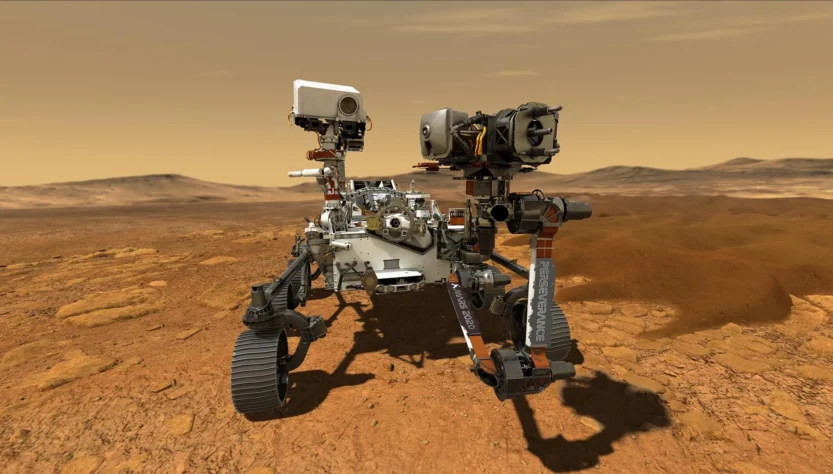
There’s a new long-distance champion in the solar system, and it has six wheels and no driver’s seat!
On Oct. 11, NASA’s Perseverance rover rolled its odometer to 28.10 miles (45.22 kilometers) on Mars. That edged past the old record of 28.06 miles set by its predecessor, Opportunity, and made Perseverance the farthest-traveled vehicle ever driven on another world.
Fun fact: Opportunity needed nearly 15 years to cover that ground. Perseverance did it in about five and a half.
Built for 12 miles, still going
When Perseverance landed in Jezero Crater, nobody planned on a road trip this long.
“The original mission called for no more than 12.4 miles of driving,” said Steven Lee, who manages the Curiosity and Perseverance rover projects at NASA’s Jet Propulsion Laboratory. He said the team expects the rover “to keep adding to this record for many years to come.”
Along the way, Perseverance has also passed the lunar driving records set by Apollo 17’s moon buggy and the Soviet Union’s Lunokhod 2.
It thinks while it drives
The secret is self-driving software called AutoNav. Instead of waiting for step-by-step commands from Earth, the rover snaps pictures of the ground ahead, builds a 3D map of rocks and hazards, and picks its own safe path to a goal set by mission controllers. NASA calls it “thinking while driving.”
The jump in computing power is striking. The first Mars rover, Sojourner, checked 20 measurement points to judge its path. Perseverance analyzes about 600,000 points for each look at the terrain. AutoNav has handled more than 90% of Perseverance’s driving, compared with about 5% for Spirit and Opportunity. In a single Martian day, the rover can cover up to 1,351 feet.
“Perseverance is a better driver than the one that landed, and we’re not done,” said Mark Maimone, deputy team chief for robotic operations. Newer software is meant to cut down on needless steering and check the rover’s position against orbital maps as it rolls.
One problem engineers are still working on is glare. Bright sunlight washes out the navigation cameras, so when the rover drives toward the Sun, the team now stops by mid-afternoon.
What it’s looking for
Perseverance is headed for an area called “Idubi,” beyond the western rim of Jezero Crater, where scientists think the ground may be some of the oldest ever studied in the solar system. They hope to find signs of ancient hot springs, places where heated water may once have made conditions friendly to life.
The rover has already collected 29 rock and soil samples. One rock, nicknamed “Cheyava Falls,” held a potential sign of past life, though non-living processes can sometimes leave similar marks. NASA has extended the mission through about the end of 2028.
The bottom line
There’s a lesson here for anyone who values doing more with what you have. A machine designed to drive about 12 miles has now gone more than twice that far, millions of miles from the nearest mechanic, because the people behind it kept improving it instead of settling.
Keep your gear in good shape, keep learning, and keep upgrading your skills. Perseverance didn’t get its name by accident.
Sources
- NASA’s Perseverance Mars Rover Just Shattered the All-time Off-world Driving Record – NASA/JPL via ScienceDaily
- NASA’s Perseverance Sets Off-World Record for Total Distance Driven – NASA Science