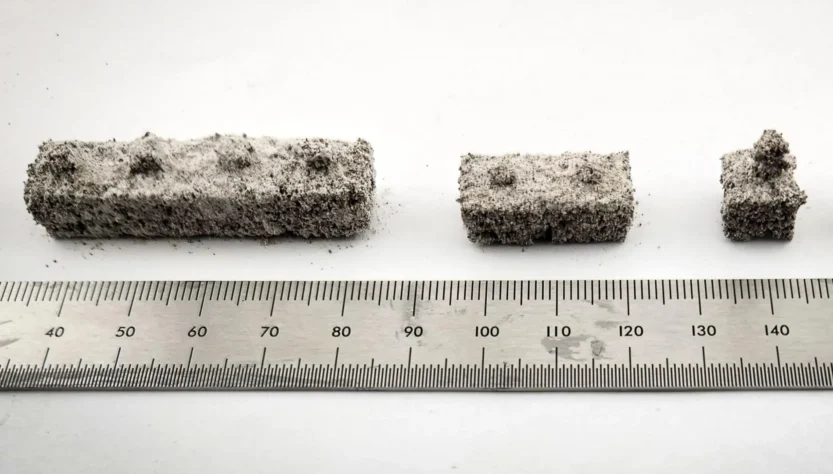
Engineers at the University of Arkansas have used a laser 3D printer to turn simulated moon dust into small interlocking bricks that snap together like LEGO pieces, without any binder or glue shipped from Earth.
The work was published this year in the journal npj Advanced Manufacturing and described in a university release that ScienceDaily ran on Nov. 20. The goal is a way for future lunar crews to build with the material lying at their feet.
How it works
The team used a process called laser powder bed fusion. A thin layer of powder is spread across a platform, and a concentrated, relatively low-power light source fuses the particles together where it strikes. The platform drops, another layer of powder goes on, and the process repeats until a part is finished.
The powder was Lunar Highlands Regolith Simulant, or LHS-1, a commercially sold stand-in designed to match samples brought back by the Apollo missions.
Earlier efforts to build with lunar soil generally needed a binding agent, which would have to be shipped from Earth. The Arkansas process skips that step.
“There’s nothing else it’s binding to. The regolith powder is binding to itself,” said Cole McCallum, the paper’s first author.
Bricks that lock together
The printed pieces are a few centimeters across and come in cross and H shapes that fit into one another. Because they lock together mechanically, they can be assembled, taken apart and rearranged.
“These structures we’re making can be self-supported,” McCallum said.
The researchers were candid about the limits. Compared with parts made with binders, the blocks have more internal pores and less structural strength. Nobody yet knows how they will hold up in the moon’s low gravity and vacuum.
“I would be hesitant to say our process could be used for something that’s supporting other loads,” McCallum said.
An undergraduate project
McCallum did the work as an undergraduate. He graduated in May with degrees in mechanical engineering and physics and is now studying aerospace engineering at ISAE-SUPAERO in Toulouse, France, as a Lafayette Fellow, one of 30 chosen from more than 3,400 applicants.
The senior author is Wan Shou, an assistant professor of mechanical engineering. McCallum credited Shou with pushing students into the lab. “He had this really strong belief that undergrads should get involved more with research,” he said.
Conclusion
The bricks are small and not yet strong enough to carry heavy loads, but the method proves a useful point: a lunar crew might one day print building parts from local soil without waiting on supply shipments from Earth. The team’s next questions are how the blocks behave in vacuum and low gravity, and whether they can be made stronger.
Sources
- ScienceDaily: Scientists Turn Moon Dust Into LEGO-like Bricks for Future Lunar Bases (from a University of Arkansas release)
- npj Advanced Manufacturing: Additive manufacturing of lunar regolith for reconfigurable building blocks toward lunar habitation (DOI 10.1038/s44334-026-00111-x)