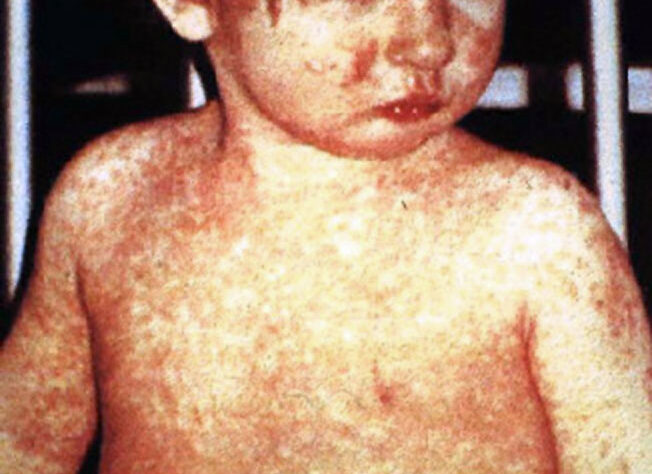
The CDC now reports 6,039 confirmed U.S. measles cases in 2026 as of Nov. 24, after 2,289 in all of 2025 and 285 in 2024. On Tuesday, Dr. Peter McCullough posted on X that the “explosion” is “coincident” with Quest and Labcorp bringing measles PCR testing online, and that testing is driving the “outbreak” through true and false positives. Testing did increase. That is not the same thing as an outbreak without a location. I looked at where the cases actually are.
Ninety-seven percent of this year’s cases, 5,829 of them, are tied to outbreaks. There have been 43 new outbreaks in 2026, and only 18 of the 6,039 cases were among international visitors. This is not a virus falling evenly on the whole country. It is tearing through specific communities with very low vaccination rates. As of its Nov. 19 update, the CDC listed 6 deaths this year. State health departments have now announced 14 measles-associated deaths: 9 in Pennsylvania, 3 in Wisconsin, 1 in Virginia and 1 in New York.
Pennsylvania has confirmed 1,638 cases and 330 hospitalizations this year. Wisconsin has 920 cases and 20 hospitalizations, and on Tuesday the Wisconsin Department of Health Services announced a third death as its count kept climbing.
The Plain communities
Wisconsin’s own health department has said this outbreak is primarily spreading in Amish and Mennonite, or Plain, communities, close-knit groups with low vaccination rates. As of Nov. 24, 913 of the state’s 920 cases, 99.2 percent, were unvaccinated or of unknown status. One of the three deaths was an infant, the first measles-associated death in Wisconsin since 1990.
Pennsylvania’s official releases do not use the word Amish. The state’s own numbers still point to the same kind of pocket. Lancaster County has 558 of the 1,638 cases. Only five of those 1,638 people were vaccinated, less than 1 percent. Local reporting has described the outbreak as centered in Amish Country. I am not going to treat a county with that case count as a random slice of Pennsylvania.
Minnesota has 228 cases this year, its highest total since 1990, and 201 of them are in Todd County. The state health department has not called it an Amish outbreak. The Minneapolis Star Tribune, citing community members, reported that most or all of the cases so far have involved Amish residents, and that Todd County has the state’s lowest measles vaccination rate in part because of those communities.
The pattern started in West Texas last year. The outbreak that Texas declared over in August 2025 had 762 confirmed cases, 414 of them in Gaines County, 99 hospitalizations, 12 intensive-care admissions and two deaths in unvaccinated school-aged children with no known underlying conditions. Officials described a multilingual, close-knit community. The Texas Tribune identified it as the Mennonite community in and around Seminole. Kindergarten measles coverage in the outbreak area was as low as 77.3 percent. An additional 182 potential cases in Gaines County children were never even counted as confirmed.
An immigrant outbreak in South Carolina, and a shelter cluster in 2024
South Carolina’s Upstate outbreak is over, and it was not a Plain community. It ran from October 2025 to March 2026 and finished at 997 cases, 940 of them in Spartanburg County. Nine hundred thirty-two of the 997 people were unvaccinated. About nine in 10 were children. The state health department told Healthbeat that about 90 percent of the cases were among members of the area’s Ukrainian- and Russian-speaking community, which has around 15,000 people in Spartanburg County. Early cases involved Global Academy of South Carolina, a public charter school where about 70 percent of students come from homes where a Slavic language is spoken and where only 21.3 percent of 607 students were vaccinated against measles. A Slavic-language church in Inman, Way of Truth Church, was linked to dozens of infections.
This is not new. In 2024, Chicago had a 57-case outbreak tied to a migrant shelter. The CDC’s own report said 52 of those people were shelter residents, and of those with a recorded country of last residence, 84 percent had come from Venezuela. Seventy-two percent were unvaccinated or of unknown status, and most were young children. That outbreak was contained with a mass vaccination campaign inside the shelter. It is a precedent, not this year’s engine. Eighteen cases among international visitors do not explain 6,039 confirmed infections.
Along the Utah-Arizona border, a large outbreak began in the Short Creek area around Colorado City, Arizona, and Hildale, Utah, a former stronghold of the Fundamentalist Church of Jesus Christ of Latter-Day Saints. Officials usually skip that history. Local reporting found school measles vaccination rates in Colorado City as low as 7.7 percent and 40 percent when the outbreak took off. Utah is still counting 725 outbreak cases, even as new diagnoses have recently gone quiet.
The bottom line
The measles surge is real, and it is not a paperwork illusion. It is also not a mystery plague spreading evenly from sea to sea. It is concentrated in unvaccinated pockets: Amish and Mennonite communities in Pennsylvania, Wisconsin, Minnesota and West Texas; a Ukrainian- and Russian-speaking immigrant community in Spartanburg; and, in 2024, a Venezuelan migrant shelter in Chicago. Officials are quick to publish a national number and slow to name the communities.
The CDC’s death count has lagged the states, and Pennsylvania and Wisconsin alone have already announced 12 measles-associated deaths this year. If health agencies want people to take this count seriously, they should start by telling the truth about where it is.
And let’s keep some perspective: measles is not a death sentence. Before the vaccine, nearly every American child caught it and came out the other side with lifelong immunity. This year’s own numbers, roughly 14 deaths out of more than 6,000 cases, show the overwhelming majority recover. The Amish have chosen to let their communities build natural immunity the way generations did before them, and they may well have it right. Free people get to make that call for their own families without being treated like a public menace.