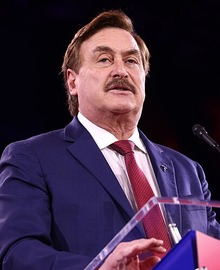
Mike Lindell entered the Minnesota Republican gubernatorial primary with name recognition, a national profile, and a late endorsement from President Trump. He led several polls after that endorsement. On August 11 he finished a distant second. House Speaker Lisa Demuth won with roughly 43 percent. Lindell took about 32 percent. Kendall Qualls, the state party’s endorsed candidate, finished third near 21 percent. Lindell refused to concede on election night, claiming anomalies and insisting votes remained uncounted. The numbers did not move.
The Setup
Minnesota has not elected a Republican governor since 2006. The open seat created by Tim Walz’s departure looked like a rare opportunity after years of Democratic control and recent state-level fraud scandals. Republicans needed a nominee who could expand the map against Sen. Amy Klobuchar, the heavy Democratic favorite.
Lindell, the MyPillow founder and longtime Trump ally, positioned himself as the outsider who would fight election integrity issues and take on the establishment. Trump endorsed him in mid-July, calling him spectacular and saying he loved Minnesota. Some internal and public polls showed Lindell jumping into the lead. That momentum proved soft.
What Went Wrong
Electability killed him. Party leaders and a decisive share of primary voters concluded Lindell could not beat Klobuchar. His years of promoting 2020 election fraud claims, the legal battles with Dominion and others, the financial strain on MyPillow, and his lack of any governing experience made him radioactive in a general election. Demuth, by contrast, had a legislative record, institutional knowledge, and better numbers in head-to-head polling against Klobuchar.
Mike Lindell lost his primary in Minnesota last night
This is a warning to Republicans politicians
Amnesty for illegal aliens will end your careers
— Steve Ferguson (@lsferguson) August 12, 2026
The state party never trusted him. Lindell lost the Republican convention endorsement. Officials openly worried that nominating him would throw away a winnable cycle by handing Democrats an easy target. Residency questions surfaced—Lindell had lived in Texas as recently as the prior year—and a judge found probable cause that he may have violated campaign rules by distributing promotional pillows. His immigration comments, including talk of legal visas for large numbers of illegal immigrants, confused and alienated parts of the base that expected a harder line.
Lol you can see the exact moment Lindell said “Hey let’s give all of the illegals amnesty.” pic.twitter.com/AqM4Nr58lN
— U.S. Ministry of Truth (@USMiniTru) August 12, 2026
Trump’s endorsement delivered a surge but not a coalition. In Minnesota, where Republicans have repeatedly lost statewide races, primary voters prioritized someone who looked capable of winning in November over pure loyalty signaling. Demuth ran as the experienced alternative focused on state issues—fraud investigations, spending, and competence. That message landed.
The Larger Lesson
Lindell’s defeat is another data point that a presidential endorsement is not automatic victory in every primary, especially when the candidate carries heavy baggage and the local party believes the general election is at stake. Minnesota Republicans chose the candidate they thought could actually compete. Whether Demuth can close the gap against Klobuchar is a separate question. The primary made clear that name recognition and loyalty alone were not enough. Lindell’s campaign never solved the fundamental problem: too many Republican voters decided he was unelectable.