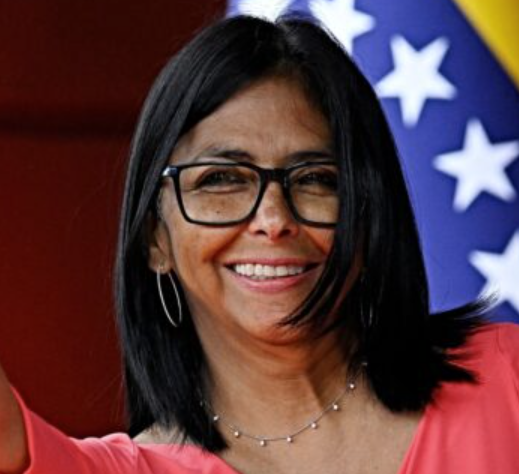
Friday night Trump announced what he called the biggest oil deal in world history: majority U.S. control of more than 65 billion barrels of Venezuelan proven reserves, through a private partnership, at no cost to the taxpayer. Caracas’s interim president, Delcy Rodríguez—on the job since American forces took Nicolás Maduro in January—called it historic and said it would revive the country. The contract text is not public. The pitch is.
WHEN FOLKS SEE THESE TYPES OF ANNOUNCEMENTS FROM PRESIDENT TRUMP, MANY JUST TAKE IT AS ANOTHER POST ON TRUTH SOCIAL.
But slow down and look at what is actually happening.
This Venezuela oil agreement is not just about oil.
It is about geopolitical leverage.
It is about… pic.twitter.com/XoofYEUH8v
— AJ Inapi (Allan) (@aj_inapi) August 29, 2026
What They Say They Signed
Seventeen fields. About 65 billion barrels—roughly a fifth of Venezuela’s official reserve number, which is the largest on the books. A new joint venture with a private operator already on the ground. Washington’s cut: about 55 percent effective output, meaning an ownership slice plus the right to lift crude at cost. Destination for the American barrels: the Strategic Petroleum Reserve and the military. Concession talk on the U.S. side has included a century. Rodríguez says the bilateral project runs 25 years and Venezuela keeps legal title to the rock.
She wants those 17 fields to produce more than 1.5 million barrels a day. National output is about 1.25 million now, up a few hundred thousand since Maduro left in cuffs. She says more than $100 billion in investment and more than $209 billion in government take. She also says Caracas gets $19 a barrel on volumes sold to the United States, against a $65 marker that will move with the market. Those figures do not all sit neatly on the same napkin. Treat the press conference as a term sheet, not an audited model.
Companies, including American ones already operating there, are supposed to sign field-level papers this week and fold old joint ventures into the new framework.
Delcy Rodriguez Thanks Trump for U.S. Oil Deal: Venezuela Will Become ‘an Oil-Producing Power’https://t.co/DEQ0f0ZJjX
— Melchizepepe – Garbage Scow Captain (@melchizepepe) August 31, 2026
What America Gets If the Steel Actually Turns
Heavy sour crude is not West Texas candy. It is exactly what a lot of Gulf Coast iron was built to cook. A locked-in hemispheric supply at cost is a hedge against a blocked strait, a Canadian tantrum, and a market that spikes every time a missile flies. Filling the reserve and the fleet from a nearby basin is strategy, not a slogan.
Reserves on a slide do not equal gasoline next month. They equal optionality: barrels you can develop when you want them, under a flag you can lean on, instead of begging a hostile court for a cargo. If production scales, the bid for imported crude in the Gulf gets a new seller. That is how prices ease—slowly, if at all, and only if the oil shows up.
Venezuela gets capital, know-how, and a customer. The United States gets a claim on the biggest reserve pile in the hemisphere without writing a Treasury check for the acreage. That is the theory.
Trump is thinking big. Venezuela has enormous oil reserves, and securing access to that energy could mean more jobs, investment, and energy security. The dealmaker is back. 🇺🇸
— Jim Mattis (@JimMattistlc) August 31, 2026
Why It May Not Work as Advertised
Venezuela’s oil industry was looted, starved, and electrified by people who thought slogans pumped wells. Upgraders are junk. Power fails. Pipelines leak. Extra-heavy crude from the Orinoco needs diluent, heat, and adults. A 1.5-million-barrel target from a subset of fields is a plan. Getting there is a decade of work if nobody shoots the contractors.
No public contract means no public map of liability, royalties, arbitration, or what happens when the next strongman declares the deal void. Rodríguez says sovereignty is intact. Trump says majority control. Those sentences can live in the same press release. They do not always live in the same courthouse. A 100-year concession and a 25-year political term are not the same animal.
Output already moving to the United States—about half the country’s oil, by one energy official’s count—shows the tap can turn. Turning a ruined system into a second national oil company is something else. Sanctions relief, security for rigs, and a government that does not steal the joint-venture cash are the real machinery. None of that is a social-media post.
Trump will meet with executives from US oil companies following the agreement with Venezuela, according to Fox News. https://t.co/hUByiByUJt
— Gabriel Moyssen (@gabriel67891734) August 31, 2026
The Honest Bet
This works if American operators get title that sticks, power that stays on, and a security umbrella that keeps the fields from becoming a militia ATM. Then the heavy barrels flow to the Gulf, the reserve gets cheap fill, and pump prices feel a distant downward tug over years, not weeks.
It fails if it is a press conference bolted onto a failed state: paper reserves, missing transformers, and a partner who needs the $19 more than she needs your lawyers.
Trump’s bet is that after January, Caracas does not get to play Qatar. The oil is in our hemisphere, the navy is not theoretical, and the last guy who said no is in a New York courtroom. That is leverage. Leverage is not a flowing well. Watch the signatures this week and the first extra barrels after that. Everything else is a speech about 65 billion barrels that are still in the ground.