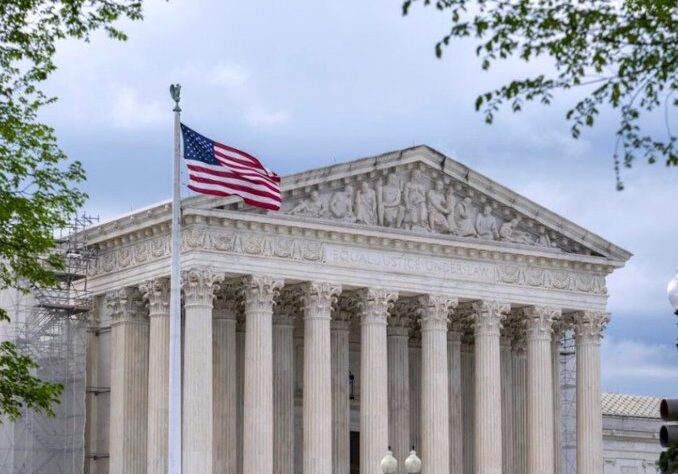
The Supreme Court on Tuesday handed the Trump administration a major win on immigration enforcement, allowing federal officials to resume deporting migrants to countries other than their own while the justices decide whether the policy is legal.
The order lifts a lower-court ruling out of Massachusetts that had halted the practice. The Court will hear full arguments in December, which means a final decision likely won’t come until 2027. Until then, the deportations can go forward.
What the Court Did
According to Roll Call, the justices set aside an order from U.S. District Judge Brian Murphy in Boston, which the 1st Circuit Court of Appeals had upheld. Judge Murphy had found that the policy violated migrants’ rights by denying them a hearing on whether they would face torture or persecution in the country they were being sent to.
Now for the second time, SCOTUS just granted our stay in conducting all third-country removals of illegal aliens. Again, this is entirely lawful and a critical tool for immigration enforcement. Unlike the lower court, SCOTUS waited to hear from both sides before making the… https://t.co/xQWiKnxNzm pic.twitter.com/husJQ2nUSd
— Attorney General Todd Blanche (@AGToddBlanche) September 29, 2026
The vote broke along familiar lines. The Court’s three liberal justices, Sonia Sotomayor, Elena Kagan and Ketanji Brown Jackson, said they would have denied the administration’s request, but tellingly none of them wrote a dissent explaining why.
This is not the first time the high court has stepped into this fight. Back in 2025, the justices also let the administration move forward while legal challenges played out.
How the ‘Third-Country’ Policy Works
“Third-country” removals apply to people who already have final deportation orders but who can’t be sent home. Sometimes their home countries simply refuse to take them back.
As reported by the Associated Press through CP24, the administration has used a series of agreements, many of them kept confidential, to deport roughly 25,000 people to more than two dozen countries. Most have gone to Mexico. Other destinations named in reporting include Liberia, Guyana, Guatemala, Honduras, El Salvador, Libya and South Sudan.
Under the Department of Homeland Security program, migrants can be sent to a third country that has given diplomatic assurances it won’t persecute or torture them. Where no such assurances exist, deportees get notice and a chance to raise concerns themselves.
The appeals courts had required that migrants get “a meaningful chance to object” before removal to a country where they have no ties. That ruling temporarily stopped flights, including one carrying about 70 people bound for three countries, according to the AP report.
The Administration’s Case
The Justice Department told the Court that the lower-court order was keeping dangerous people in American communities. In its filing, as quoted by Roll Call, the government warned that the migrants “whose removal is most urgent, including those who have committed serious crimes like murder, attempted murder, rape, child rape, kidnapping, and aggravated assault, will be allowed to remain.”
The administration also argued that its agreements with the receiving countries, including blanket assurances against torture, should be enough to satisfy the courts. Federal lawyers described the policy as an essential tool for removing some of the worst criminal offenders.
Immigrant advocates see it differently. They argue that many of the deportees have no criminal record, face danger or imprisonment in unfamiliar countries, and are often left with little choice but to return to the home countries they fled.
Our Take: A Judge in Boston Shouldn’t Run Foreign Policy
Every sovereign nation has to be able to enforce its own immigration orders. When a court has already ordered someone deported, and that person’s home country refuses to take him back, the alternative to a third-country removal can be release into an American neighborhood. For someone convicted of a violent crime, that is not a small risk. It is a risk that falls on ordinary families, not on the judges who issue the orders.
The Constitution puts foreign affairs in the hands of the elected branches. Negotiating agreements with other countries, judging the value of their promises, and deciding where to send people with final removal orders are exactly the kinds of decisions voters can hold a president accountable for. A single district judge cannot.
Critics have fair questions about how the government checks on people after they land. Those questions deserve answers, and the December arguments are the place to air them. But freezing the program, while thousands of people with final orders stay put, was never a reasonable way to settle them. Tuesday’s order restores some balance.
What Comes Next
The justices will hear oral arguments in December. A ruling is expected in 2027, and it could set the rules for third-country deportations for years to come.
In the meantime, the flights can resume. Watch for whether the administration expands the list of receiving countries, and whether Congress steps in to write clearer rules so this question isn’t settled one courtroom at a time.
Sources
- Roll Call: Justices allow third-country deportations as case proceeds
- CP24 (Associated Press): U.S. Supreme Court lets quick deportations to third countries resume for now
- The Conservative Treehouse: Supreme Court allows rapid third-country deportations to continue