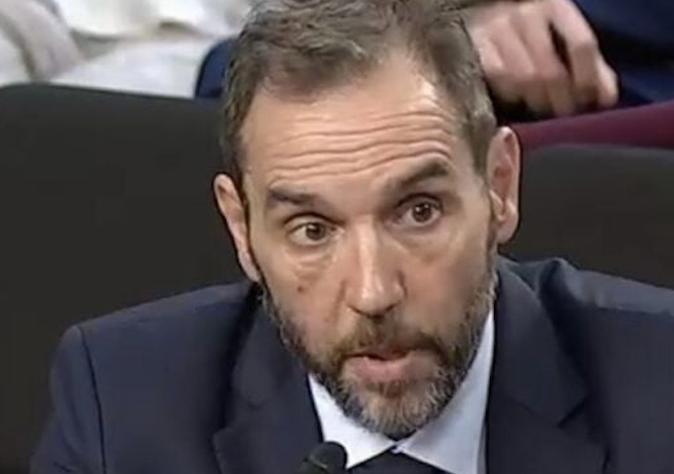
Former special counsel Jack Smith sat before the Senate Judiciary Committee on Tuesday and refused to give an inch. Asked about his two criminal cases against Donald Trump, he told senators he would do it all again.
Republicans, led by committee chairman Chuck Grassley of Iowa, spent the hearing pressing a different question: why a federal prosecutor went after the phone records of sitting members of Congress in the first place.
What Smith Said
Smith opened with a firm defense of his work. “I stand by my decisions as special counsel, including my decision to bring charges against President Trump,” he said, according to ABC News.
He went further. Smith told the committee that if he faced the same facts today, he would bring the same charges “regardless of whether that President was a Republican or a Democrat,” ABC reported. He also insisted that “anybody who has worked with me or knows me” knows he would not let politics play a role, according to PBS.
Smith called the treatment of his former staff “an outrage.” Nearly all of the prosecutors and agents tied to his office have since been fired or have resigned, ABC noted. Smith also said he would “not be silenced by the continued threats of prosecution,” PBS reported. The Justice Department is reviewing a criminal referral from House Republicans that accuses him of perjury.
The Cases That Went Nowhere
Smith’s office brought two federal cases. One accused Trump of trying to overturn the 2020 election. The other involved classified documents kept at Mar-a-Lago.
Both cases were dropped after Trump won the 2024 election, citing longstanding Justice Department opinions that a sitting president cannot be federally indicted, PBS explained. Neither case ever reached a jury.
Arctic Frost and the Phone Records
The sharpest Republican questions centered on “Arctic Frost,” the FBI investigation that grew into Smith’s election case.
During that probe, prosecutors subpoenaed phone “toll records” of Republican members of Congress who had been in contact with Trump’s circle around January 6, 2021. Toll records show who called whom, when and for how long, but not what was said, PBS reported.
Documents Grassley released in March showed that Smith’s team drew up a list of 14 members of Congress to target for phone data. Internal notes acknowledged that those members “likely have a valid Speech or Debate privilege,” the constitutional shield that protects lawmakers’ legislative work. Grassley has also released records showing 197 subpoenas that sought financial information on more than 400 Republican groups and individuals.
Grassley did not mince words on Tuesday. “Mr. Smith’s operation was a partisan weapon that broke the rules, lied to the court and engaged in bad faith,” he said, according to ABC.
Sen. Ted Cruz of Texas called it “the most egregious abuse of power in the history of the Department of Justice,” ABC reported. Sen. Eric Schmitt of Missouri called Smith a “villain,” and Sen. John Kennedy of Louisiana told him, “You make me want to throw up in my mouth,” according to PBS.
Democrats defended Smith. Sen. Dick Durbin of Illinois called the Republican attacks “petty, personal and political,” ABC reported.
Our Take: “I’d Do It Again” Is the Problem
Smith wants credit for consistency. But the issue was never whether he believed in his cases. It is whether any prosecutor should be allowed to quietly pull the phone records of elected lawmakers of the other party, with the Constitution’s Speech or Debate protections flagged in his own team’s notes.
The brutal read is simple. A special counsel spent years on cases that died without a verdict, quietly pulled communications metadata on elected officials of the other party while his own notes flagged a constitutional shield, and then told the Senate he would run the same play again.
That is not consistency. It is a prosecutor who treated political opponents as investigative targets and now wants credit for refusing to blink.
Imagine the roles reversed. If a Republican special counsel had subpoenaed the call logs of 14 Democratic members of Congress and hundreds of progressive groups, the outrage would be bipartisan and deafening. The standard has to be the same no matter which party is in the crosshairs.
Small-government conservatives have warned for years that the federal law enforcement apparatus had grown too big, too secretive and too willing to aim at political opponents. Arctic Frost is exhibit A. A prosecutor who spends years on cases that never reach a jury, and then says he’d do it again, is making the case for reform better than any critic could.
The fix isn’t revenge. It’s rules: clear limits on subpoenas targeting members of Congress, real notice requirements, and consequences when those limits are ignored.
What to Watch
The Justice Department’s review of the perjury referral is still pending. Grassley has released Arctic Frost records in batches this year, including records obtained from Verizon. Congress also has an opening to write those guardrails into law before the next administration, of either party, is tempted to use the same playbook.