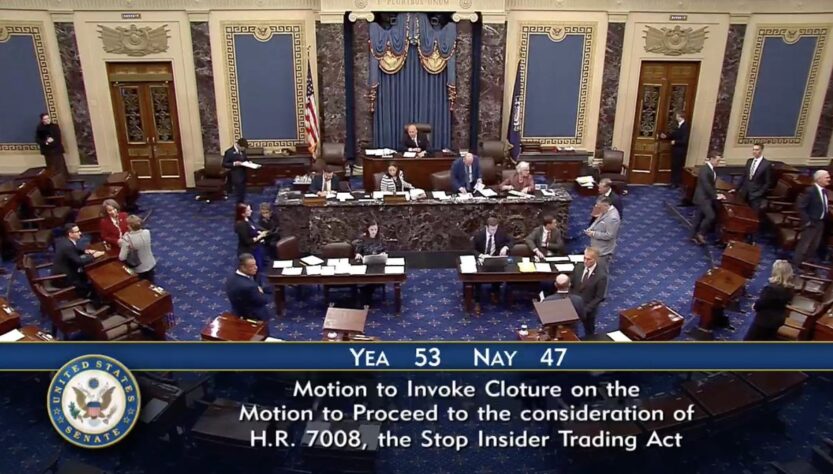
The Senate had a chance on Wednesday to stop members of Congress from buying individual stocks. It failed. The vote was 53-47, seven short of the 60 needed to move forward, and not a single Democrat voted yes, according to Newsweek and The National Desk.
The reason Democrats gave is telling. The bill also carried a requirement that voters show photo ID at the polls. Democrats called that a “poison pill.” Republicans called it common sense. Either way, the result is the same: members of Congress head home for the midterm campaign still free to trade stocks.
BREAKING: Senate Democrats have just blocked a congressional stock trading ban bill that had a voter ID attachment to it requiring photo ID to vote in federal elections. The "Stop Insider Trading Act", which passed the House with the help of 13 Democrats, just failed a procedural… pic.twitter.com/evrMXQj2UX
— Bill Melugin (@BillMelugin_) September 30, 2026
What the bill would have done
Here are the reported facts.
The measure, called the Stop Insider Trading Act, was led in the Senate by Republican Sens. Pete Ricketts of Nebraska and Jon Husted of Ohio, according to 24/7 Wall St. The House passed its version in July by a vote of 232-198, with 13 Democrats voting yes, The National Desk reported.
According to Roll Call, the bill would have:
- Banned members of Congress, their spouses and dependent children from buying new individual stocks.
- Let lawmakers keep and sell stocks they already own, but only after 7 to 14 days of public notice.
- Fined violators $2,000 or 10 percent of the trade’s value, whichever is greater, plus any profits.
- Exempted widely held investment funds.
Republicans added the voter ID requirement before the House vote in July, Roll Call reported.
What each side said
Ricketts made the case for the bill. “Congress’s approval rating is only 15%,” he said, according to The National Desk. He tied that lack of faith in part to lawmakers’ stock trading.
Republican Sen. John Thune of South Dakota said Democrats “can’t take yes for an answer,” Roll Call reported.
Senate Minority Leader Chuck Schumer argued the bill was too weak. He called it “as ineffective as a screen door on a submarine” and “a permission slip for corruption.” He objected that it still lets members trade stocks in privately held companies. Sen. Jack Reed of Rhode Island called it a “sham” with “unrelated voter suppression language,” according to Newsweek.
Schumer also complained that the bill does not cover the president or vice president.
The public is not divided on the core question. A YouGov/Economist poll found 76 percent of Americans oppose members of Congress trading stocks, Newsweek reported. A Data for Progress poll found 60 percent support a ban.
Two popular ideas, one excuse
Americans want two things here, and they are not complicated. They want lawmakers to stop profiting from information the rest of us don’t have. And they want to know that the people casting ballots are who they say they are. Both ideas enjoy broad support. This bill offered both.
Democrats say the stock ban wasn’t tough enough. Maybe it could have been tougher. But “not perfect” is a strange reason to vote for nothing. A ban on buying new stocks, with public notice before selling and real penalties, is far better than today’s rules. Every Democrat chose today’s rules.
The voter ID objection doesn’t hold up much better. Showing an ID is routine in American life. You need one to board a plane, pick up a prescription or open a bank account. Asking voters to do the same is a modest step to protect the most important thing citizens do.
Small-government conservatives should care about this vote for a simple reason. A Congress whose members can trade on what they learn in closed-door briefings has a personal stake in a bigger, busier government. More regulations, more contracts and more spending mean more inside information. Cutting that link is one of the cleanest ways to make Washington serve voters instead of itself.
What comes next
The Senate is leaving town for the election, and no further action is expected before the midterms, according to Roll Call. Newsweek reported the issue could come back in the lame-duck session or in the new Congress in 2027.
That makes it a campaign issue. Voters who want both a real stock-trading ban and voter ID now know exactly where every senator stood on Wednesday. Ask your candidates where they stand before you vote.