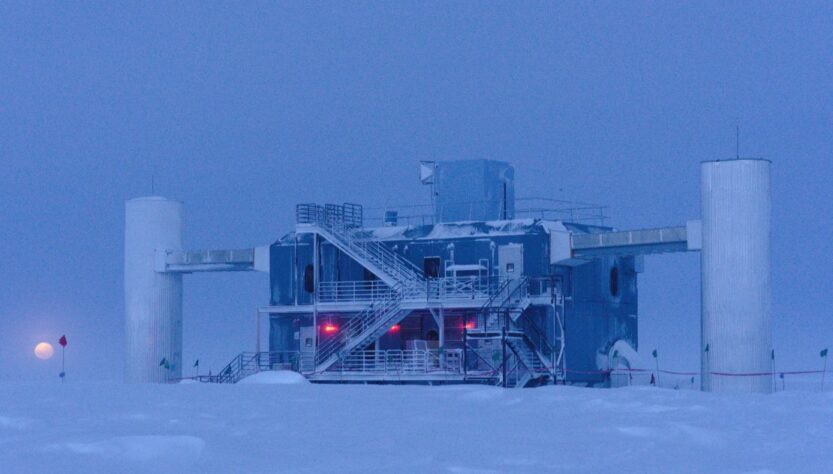
Most telescopes point up at the sky. The one that just won a Nobel Prize points down, through nearly a mile of Antarctic ice.
On Tuesday, October 6, the Royal Swedish Academy of Sciences awarded the 2026 Nobel Prize in Physics to Francis Halzen of the University of Wisconsin–Madison. The prize honors him “for decisive contributions to the IceCube Neutrino Observatory and the discovery of high-energy neutrinos of astrophysical origin,” according to the IceCube collaboration.
It is a story of one big idea, a lot of patience and some very cold engineering.
Catching the “ghost” particles
Neutrinos are tiny particles that zip through space, and through planets and people, almost without a trace. Trillions pass through your body every second, and you never notice. That makes them very hard to catch, but also very useful: because almost nothing stops them, they can carry information straight from the most violent places in the universe.
Halzen’s idea was to use a huge block of natural ice as a detector. Every so often, a neutrino crashes into an atom in the ice and gives off a tiny flash of light. If you have enough sensors in enough ice, you can spot those flashes and trace where the neutrino came from.
Halzen first presented the concept in 1988, according to Forbes. The South Pole was the place to build it. Its ice is clear, deep and geologically stable, and it is free of many kinds of interference, Forbes reported.
How big is IceCube?
The finished observatory is staggering:
- It watches about a cubic kilometer of ice, roughly 0.24 cubic miles.
- It uses 5,160 digital light sensors frozen into the ice, according to Interesting Engineering.
- It was completed in 2011, with major funding from the U.S. National Science Foundation.
- An upgrade this year added hundreds of more advanced sensors.
- About 450 scientists from 58 institutions in 14 countries now work on it, according to the IceCube collaboration.
“IceCube is like no other telescope in the world,” said Eric Wilcots, interim chancellor of UW–Madison, as quoted by Interesting Engineering. He praised Halzen’s “idea to create a neutrino detector under almost a mile of ice.”
What it found
The payoff came in steps, according to the IceCube collaboration and Interesting Engineering:
- 2013: IceCube detected the first high-energy neutrinos from outside our solar system.
- 2017: It traced a high-energy neutrino to a distant galaxy powered by a supermassive black hole.
- 2022: It found neutrinos streaming from another active galaxy about 47 million light-years away.
- 2023: It produced the first picture of our own Milky Way made with neutrinos instead of light.
That 2017 detection helped scientists pin down, for the first time, a source of cosmic rays, the high-energy particles that strike Earth from space. It had been a mystery for about a century.
The man behind it
Halzen was born in Belgium in 1944 and joined the UW–Madison physics faculty in 1972, according to Interesting Engineering. He is the sixth physicist connected to the university to win the Nobel and its 23rd laureate overall.
“Francis Halzen has led an international team of researchers and engineers who have provided us with a fantastic instrument,” said Mark Pearce, chair of the Nobel Committee for Physics, according to Forbes.
Halzen shared the credit. “It’s a great relief for me to finally deliver the recognition that this great collaboration deserves,” he said, according to the IceCube collaboration.
The prize is worth 12 million Swedish kronor, a bit over $1 million.
Why it matters to the rest of us
You will not use a neutrino detector at home. But the lesson behind IceCube is one any self-reliant person will recognize: use what nature gives you. Instead of building a giant detector from scratch, Halzen’s team used ice that was already there, by the cubic kilometer, at the bottom of the world.
It also took grit. Building and running an observatory at the South Pole means working in one of the harshest places on Earth, and the idea took more than two decades to go from a 1988 proposal to a finished detector.
The bottom line
A professor in Madison, Wisconsin, had an unusual idea nearly 40 years ago, stuck with it, and helped build an instrument that lets humanity see the universe in a new way. The result is a Nobel Prize, a new window on black holes and the first neutrino map of our galaxy.
Next time someone says big American ideas are a thing of the past, point them toward the South Pole. There is a telescope buried in the ice that says otherwise.
Sources
- IceCube Neutrino Observatory: Francis Halzen, IceCube principal investigator, wins 2026 Physics Nobel Prize
- Interesting Engineering: World’s largest neutrino telescope creator wins 2026 Nobel Prize
- Forbes: University of Wisconsin professor wins the 2026 Nobel Prize in Physics