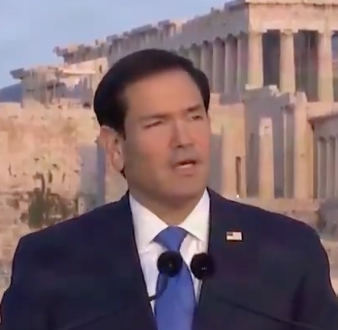
Secretary of State Marco Rubio spoke on October 7, 2026, from the Pnyx in Athens—the hillside where the ancient Athenian assembly met—with the Parthenon behind him. The address was a civilizational argument: the West’s rise came from traits first fully realized in Greece, those traits have been abandoned, and the next decade will decide whether the West stays “at the head of the world” or slides into “atrophy, servitude and decline.”
The inheritance
He opened with the Persian sack of Athens in 480 BC: a handful of Athenians held the Acropolis against Xerxes, were overwhelmed, and then, under Pericles, raised the Parthenon from the ruins. Empires rose and fell under its shadow, he said, and “the sons of Athens and Rome” carried that civilization to the ends of the earth. Standing there as Secretary of State and the great-grandson of Spanish settlers in the New World, he called the debt permanent.
What Athens gave the West, in his telling, was not only democracy, philosophy, law, and the vocabulary of politics. It was a character: fierce individuality, relentless ambition, curiosity, a hunger for discovery and glory, and impatience with impossibility. Greek city-states were full of rivalry and conflict; from that struggle came the flowering of art, philosophy, and political energy. He invoked thumos—the fire of passion, strength, courage, and pride—as the heart of great civilization. Without it, nations lose the will to fight, strive, and survive. That foundation, he argued, later shaped Christendom, natural law, and a shared view of man, virtue, and objective standards of truth, goodness, and beauty.
The indictment
The diagnosis of the present was sharp. The West grew ashamed of what made it exceptional. Prosperity became a source of guilt; nationalism a dirty word. Monuments were torn down, history condemned, children taught to be ashamed of the countries they would inherit. Borders were opened, industry outsourced, militaries allowed to decay, and sovereignty transferred to distant global bureaucracies. Adversaries filled the vacuum. “It has become fashionable today to believe that enlightened foreign policy means prioritizing the ‘global community’ over one’s own people.” The ancient Greeks, he said, knew there was nothing selfish about loyalty to one’s nation or defending its interests above all else. They also understood that statecraft requires both prudence and the credible willingness to use force.
The choice
He framed the moment as an inflection point: war has returned, great-power competition is back, and threats from aggression, terrorism, and technological rivalry are as real as those of antiquity. Under President Trump, he said, the United States has chosen “the unapologetic pursuit of national power”—control of supply chains, reindustrialization, rebuilt defense, and dominance in the technologies of the future (manufacturing, artificial intelligence, drones, chips, minerals, energy, space). Alliances, he argued, exist to defend the sovereignty of their members, not to erase national identities. He pointed to Greece as a model partner on defense, energy, technology, and border security, and closed by recalling Daniel Webster’s 1824 address on Greek independence: free government, debate, and even the architecture of the American republic remind us that “Greece has existed and that we… are greatly her debtors.”
The speech echoed the line of Vance’s 2025 Munich address and the 2025 National Security Strategy’s warning of European “civilizational erasure,” while tying “America First” to a longer Western inheritance running from Athens through Rome, Christendom, and the American founding. Coverage treated it as both a foreign-policy statement and a broader political argument about confidence, national loyalty, and the refusal of managed decline.
And kudos to the advance team – the setting was perfect.
WATCH IN FULL: @SecRubio delivers a major foreign policy address from beneath the Acropolis in Athens https://t.co/6o3hA4aNsJ
— Rapid Response 47 (@RapidResponse47) October 7, 2026