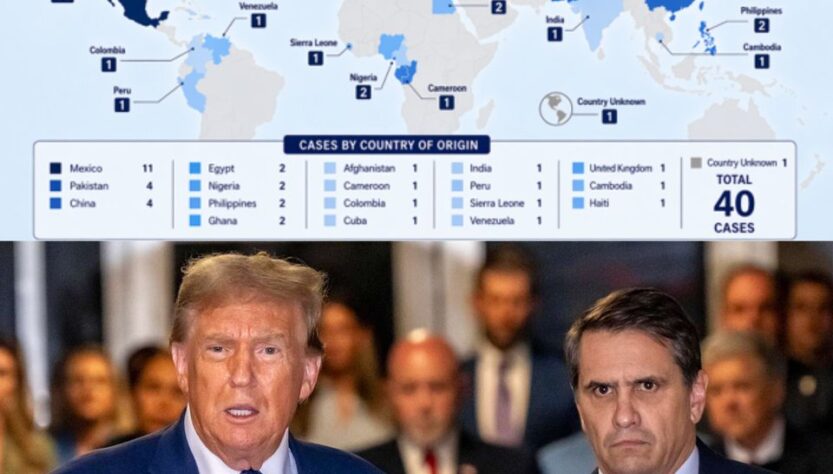
The Justice Department is going after people who lied their way into American citizenship, and it is not being quiet about it.
In a statement released Monday, Oct. 5, the department said it filed denaturalization complaints against 40 people in federal courts between Aug. 21 and Oct. 2. The cases were filed in 19 federal districts, from Southern California to the Eastern District of Virginia. Attorney General Todd Blanche called it “the largest denaturalization effort in modern history.”
A DOJ spokesperson told Axios the department has now filed more than 200 denaturalization complaints overall and “remains on track to meet its objectives, with many more actions to come.” Axios reported the administration’s goal is 250 cases by the end of October.
🔥 LET’S GO! The Trump DOJ just filed to REVOKE citizenship for 40 more naturalized citizens from foreign countries We need a LOT more of this. The newest round of de-naturalization include people from India, China, Nigeria, Pakistan, and more. “Today’s announcement marks the largest denaturalization effort in modern HISTORY,” said Attorney General Todd Blanche. “From an individual convicted of espionage to others convicted of sexuaI offenses against minors, these defendants concealed critical facts from the U.S. government and represent serious criminal offenders." What I REALLY want to see is a surge of de-naturalizations for Somalis out in Minnesota. Our country desperately needs to remove those leeches.
— Nick Sortor (@nicksortor) October 5, 2026
Who is on the list
The 40 cases read like a rap sheet. According to the DOJ’s own summaries, the defendants include:
- A convicted Navy spy. Jinchao Wei, a 26-year-old from China, became a citizen in 2022 under fast-track rules for service members. DOJ says his espionage conspiracy began while he was in the Navy. He was sentenced to 200 months in prison.
- An agent of Beijing. Ping Li, 61, also from China, pleaded guilty in August 2024 to acting as an unregistered agent of China’s Ministry of State Security.
- Child abusers. Several defendants are accused of sexually abusing minors before they naturalized, then hiding it on their paperwork. Most were convicted after they took the oath.
- Identity frauds. One man allegedly used two names, was ordered excluded under one in 1994, and naturalized under the other in 2008. Another allegedly used a forged birth certificate to claim he was born in the United States.
- Tax and benefit cheats. An Iranian-born man allegedly underreported at least $12.5 million in income. Another defendant was convicted of a scheme to file false IRS refund claims.
Assistant Attorney General Brett Shumate, who runs the Civil Division, put it bluntly: “Every single one of these individuals lied their way into U.S. citizenship.” He added that the United States “will not tolerate deception in the naturalization process.”
How denaturalization works
This is not a power the government can use on a whim. Under the Immigration and Nationality Act, citizenship can be revoked only if it was illegally obtained, or obtained by hiding a material fact or by willful lies.
The government must file a lawsuit in federal district court and prove its case. According to USCIS, the burden of proof is “clear, convincing, and unequivocal evidence.” That is a high bar. The DOJ release itself notes that the complaints are allegations and that no court has yet found anyone liable.
In other words, every one of these defendants gets a federal judge and a full hearing. What they do not get is a free pass for lying under oath.
A priority, not an afterthought
For years, denaturalization was a rare tool. This administration has made it a priority. In May, Axios reported that USCIS lawyers were temporarily moved into U.S. attorneys’ offices to work these cases. In April, the New York Times reported that DOJ had identified 384 foreign-born Americans whose citizenship it wanted to revoke, according to Axios.
Blanche said the defendants “concealed critical facts from the U.S. government.” DOJ says the goal is to protect national security and “restore trust and integrity in U.S. citizenship.”
A fair question is whether a push this big could catch people who simply made honest paperwork mistakes. The 40 cases in this batch, however, center on alleged deliberate fraud, fake identities and serious crimes hidden from immigration officers. And each defendant can fight the charge in court.
Why this matters for legal immigrants
Millions of people have become Americans the right way. They waited in line, filled out the forms truthfully, passed background checks and swore an oath. Every person who cheated that system cheapened what those honest immigrants earned.
Naturalization forms ask applicants directly whether they have committed crimes, used other names or lied to immigration officials. Those questions exist for a reason. A system that never checks the answers is a system that invites more lies.
The bottom line
Citizenship is the most valuable thing this country can give anyone. It comes with the right to vote, to hold a U.S. passport and to sponsor relatives. When someone gets it through a fake identity, a hidden child-abuse case or a spy ring, the government has every right, and a duty, to take it back.
For too long, Washington treated naturalization fraud as paperwork to be filed away. A Chinese intelligence agent and a convicted Navy spy holding U.S. citizenship should have set off alarms long ago. This DOJ is finally treating the oath as something that means what it says.
The cases still have to be won in court, under a tough legal standard, and that is how it should be. But the message to anyone thinking of lying their way in is clear: the paperwork will be checked, and the lies can follow you for the rest of your life.