Every radio, from a pickup truck’s AM dial to a satellite in orbit, needs an antenna. Usually that means a piece of metal: a whip, a mast, a dish. Engineers at North Carolina State University just showed you can build one out of thin air instead.
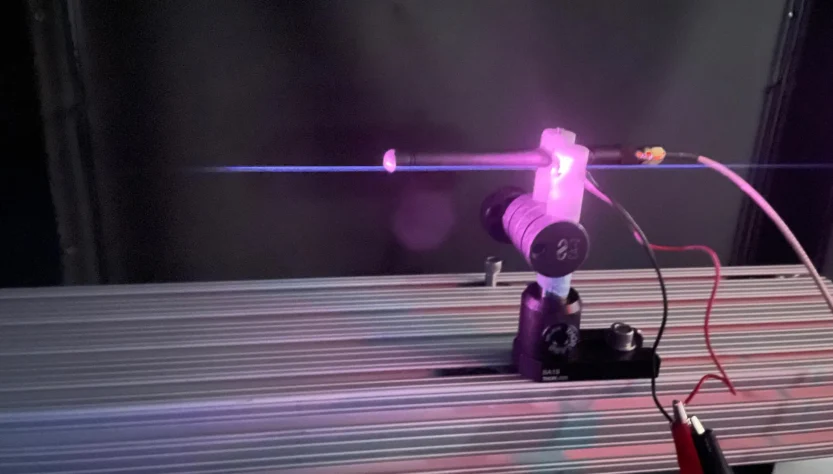
The team used a laser to turn a narrow column of air into a glowing thread of plasma, then used that thread to transmit radio waves. Their results were published in the IEEE Journal of Microwaves in a paper titled “Laser-Induced-Plasma-Filament Antenna Transmitting 30 MHz VHF.”
“This is the first step, but it is a big step,” said Prya Darshni, an NC State Ph.D. student and the paper’s corresponding author, according to the university’s release as published by ScienceDaily.
How it works
The idea sounds like science fiction, but the setup is surprisingly simple.
- A laser fires through the air. Along its path, it strips electrons from air molecules and creates a thin, electrically conductive channel called a plasma filament.
- The laser passes through the center of a metal ring. The ring works like a capacitor, and the plasma filament sits inside its electromagnetic field.
- A radio-frequency generator feeds a signal into the ring. That field passes energy into the filament, and the filament broadcasts the signal as radio waves.
The neat trick is that nothing touches the plasma. The ring feeds it without any physical wire, which is why the researchers call it a “contactless” feed.
In the experiment, the plasma antenna transmitted at 30 MHz, in the VHF band.
Darshni said “it is the first time anyone has ever demonstrated that plasma-filament antennas can work,” according to The Debrief.
Why an antenna made of air is useful
A normal antenna is a fixed piece of hardware. Its size and shape largely set which frequencies it handles well, and changing them means building or swapping parts.
A plasma antenna is different. According to the researchers, its length can be set just by adjusting the laser, and it can be pointed somewhere else by “simply shifting the direction of the laser,” Darshni said. That means one system could, in principle, cover many frequencies and directions without moving parts.
The design “is tunable, meaning we should be able to transmit across a broad range of frequencies,” Darshni told The Debrief.
Built with space in mind
The researchers see the biggest payoff in space. Satellites and spacecraft often need large antennas, and those antennas have to be folded up for launch and then deployed in orbit with heavy, complicated mechanisms. An antenna made from a laser beam could skip that step.
But isn’t space a vacuum? Not entirely, at least where many satellites fly. “In low earth orbit, there is sufficient air to form a plasma,” said Paul Franzon, a distinguished professor of electrical and computer engineering at NC State and a co-author.
The team also listed spacecraft communications, radar and space exploration as possible uses.
The project had help from Arthur Dogariu, affiliated with Texas A&M University and Princeton University, who contributed experimental measurements. Staff in NC State’s instrument shop built parts for the experiments.
What’s still ahead
This is an early-stage lab result, and the team is upfront about the gaps.
So far the antenna has only transmitted. “We have not demonstrated its ability to serve as an antenna that can receive radio signals,” Darshni said. The team still needs to show it works across a broad range of frequencies, and nobody yet knows how it will perform in real space conditions. The published summaries don’t give a range or power output for the test.
So you won’t be swapping the antenna on your shortwave set for a laser pointer anytime soon.
The bottom line
Some of the best innovation comes from asking a simple question: does this part really have to be made of metal? A small team at a public university in North Carolina answered no, and showed that a beam of light and a bit of air can carry a radio signal.
If the idea pans out, future satellites could carry lighter, simpler, more flexible antennas without the heavy deployment hardware they need today. For anyone who values reliable communication, from ham radio operators to the military, that’s a development worth watching.
Sources
- ScienceDaily (NC State University release): Scientists Create a Lightsaber-like Laser Antenna That Transmits Radio Waves
- The Debrief: NC State researchers’ laser-induced plasma antenna