This conversation happened on French X but thanks to its new automatic translation feature, we are all able to read this man’s rebuttal of her defense of Marxism. He gives a masterclass in economics in words we can all follow. Enjoy, and remember it for your next meeting with any lefty relatives.

Hello Julia, sans aucune ironie, c'est top que tu prennes le temps de te renseigner. Mais le problème quand on lit Marx aujourd'hui, c'est qu'on prend pour acquis sa prémisse de départ, alors qu'elle a été démontée scientifiquement il y a plus de 150 ans.
— Brivael (@brivael) April 27, 2026
Toute la pensée de Marx… https://t.co/hbzwbp8xJ1
Translation
Hello Julia, without any irony, it’s great that you’re taking the time to do your research. But the problem when reading Marx today is that we take his starting premise for granted, even though it was scientifically dismantled more than 150 years ago.
All of Marx’s thought rests on the labor theory of value. The idea that the value of a good comes from the amount of labor necessary to produce it. If you accept this premise, then yes, his entire reasoning holds up. The capitalist “steals” the surplus value from the worker, exploitation is mathematical, revolution is inevitable.
Except that in 1871, three economists (Menger in Austria, Jevons in England, Walras in Switzerland) independently discovered the same thing: value is not objective, it is subjective and marginal.
A glass of water in the desert is worth a fortune. The same glass next to a river is worth nothing. The embodied labor is identical. So labor does not determine value. It’s the consumer who values a good according to its marginal utility in a given context.
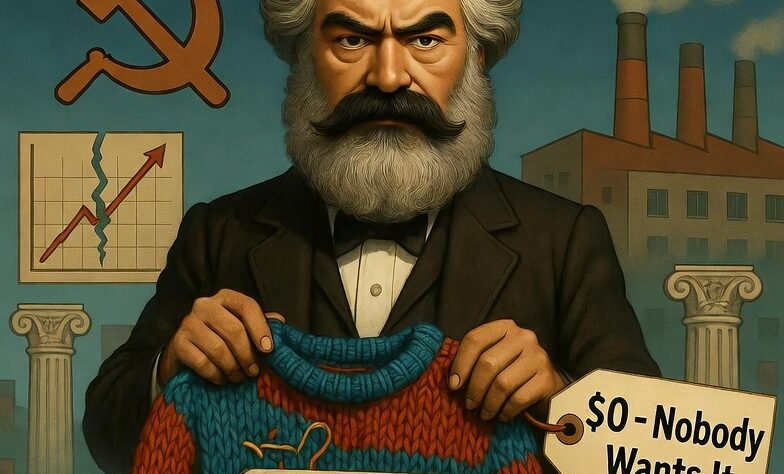
Concrete example: you can spend 1000 hours knitting an ugly sweater that no one wants. According to Marx, that sweater has enormous value (lots of embodied labor). According to reality, it’s worth nothing. Because no one wants it.
Conversely, Bernard Arnault creates billions in value not because he “exploits” but because he knew how to anticipate and organize human desires on a massive scale. Value is created through coordination, not extracted through theft.
This discovery (the marginalist revolution) invalidated the entire Marxist edifice. Not for ideological reasons, but for scientific ones. That’s why no serious economics department in the world today teaches Marx as a valid analytical framework. We teach him in the history of thought.
Now, the important thing. If your intention in reading Marx is to help the poor (it’s a noble intention), then you’re going to be surprised by what follows.
Liberalize your economy
Look at the World Bank’s figures. In 1820, 90% of humanity lived in extreme poverty. Today, less than 9%. This historic drop did NOT happen in countries that applied Marx. It happened in countries that liberalized their economies.
China post-1978, Vietnam post-1986, India post-1991, Poland post-1989. Every time a country liberalizes, hundreds of millions of people escape poverty in a single generation. Every time a country applies Marx (USSR, Cambodia, North Korea, Venezuela), it’s famine and gulags.
This isn’t an opinion, it’s the most massive experiment ever conducted in the social sciences. Billions of human guinea pigs, over a century.
So paradoxically, if you really care about the poor, the most coherent position isn’t to be a Marxist. It’s to be for economic freedom. Because empirically, it’s the only thing that’s ever massively lifted people out of misery.
To dig deeper, I recommend three reads that will change your perspective:
“The Law” by Frédéric Bastiat (short, brilliant, free online)
“The Road to Serfdom” by Hayek
“Economics in One Lesson” by Henry Hazlitt
Happy reading, and really, hats off for seeking to understand rather than sticking to your certainties. That’s rare.