
President Trump is in Beijing for a state visit from May 13-15, 2026, his first since 2017. He received a formal welcome with a military honor guard, troop parade, cheering children waving flags, and a meeting with Chinese President Xi Jinping at the Great Hall of the People. The two leaders held an initial round of talks on May 14, with more sessions planned, including a state banquet.
The arrival everyone has waited for. 🇺🇸🇨🇳 pic.twitter.com/B1DTgI9HKR
— The White House (@WhiteHouse) May 13, 2026
Trump brought a large delegation of U.S. CEOs, including Tim Cook of Apple, Elon Musk of Tesla, and Jensen Huang of Nvidia. Discussions cover trade, technology, market access for U.S. businesses, and global issues like the Iran conflict.
HERE'S WHAT HAPPENED IN BEIJING IN THE LAST FEW HOURS — IN ORDER:
— 🇨🇳 Liu Feng 刘锋 (@LiuInTheShadows) May 13, 2026
→ Trump's plane lands in Beijing, May 13, 2026
→ China's Vice President meets him on the tarmac — not Xi
→ Motorcade forms — Elon Musk and Nvidia CEO Jensen Huang riding alongside
→ 8:19pm local time —… pic.twitter.com/JvHoFd6LVP
Trump invited Xi to the White House in September. No major agreements have been announced yet, but the tone has been described as cordial with progress on preparatory talks from earlier in the week.
🚨 NOW: Elon Musk is REPEATEDLY being approached by fans in China begging for photos, he keeps making funny faces 🤣
— Eric Daugherty (@EricLDaugh) May 14, 2026
This will be the world's first trillionaire, he deserves it! pic.twitter.com/XL7tweCWmd
Chips Situation
Semiconductors and AI chips are a central topic in the summit. The U.S. side, with Nvidia’s CEO in the delegation, is pushing for expanded access or sales of advanced chips to China. China has criticized recent U.S. legislation that would tighten controls on chip manufacturing equipment and restrict its AI development. Previous U.S. approvals for certain high-end chips (like Nvidia H200) exist, but actual exports have been limited.
JUST IN: U.S. approves around 10 Chinese firms to purchase $NVDA H200 chips, sources say$BABA, ByteDance, $TCEHY Tencent, and $JD among Chinese companies approved by the U.S. to buy NVIDIA H200 chips, sources say
— Sam Badawi (@Sam_Badawi) May 14, 2026
Lenovo, Foxconn, and other distributors also received U.S.… pic.twitter.com/EHVaqe7Jda
Talks include potential frameworks for non-sensitive goods and technology issues, alongside broader trade truce extensions involving critical minerals. No new chip-specific deals have been finalized as of May 14, but the presence of tech executives signals a focus on balancing export controls with business interests in AI and semiconductors.
Iran Strait Situation with Chinese Vessels
Meanwhile, the U.S.-Iran conflict has led to a U.S. naval blockade and efforts to control passage through the Strait of Hormuz, a key oil route. China, as Iran’s largest buyer of oil, (Beijing buys 90% of Iran’s oil; its economy runs on Gulf crude), has seen dozens of Chinese-linked tankers granted passage by Iran in recent days, including over the past 48 hours before the summit and reports of roughly 30 approved since late Wednesday. Iran has prioritized these vessels under its control regime amid reduced overall traffic, while charging high tolls.
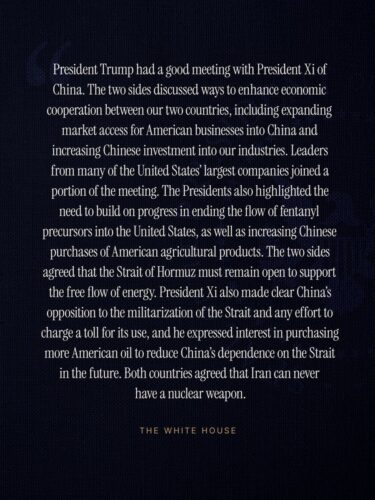
The U.S. has blocked or targeted some vessels, but Chinese ships have continued transiting.
SECRETARY RUBIO: President Trump raised the issue of Iran with China and it was important.
— Department of State (@StateDept) May 14, 2026
The Chinese side said they are not in favor of militarizing the Strait of Hormuz and are not in favor of a tolling system, and that's our position. pic.twitter.com/9JYpbvztd8
The Iran war and Strait access are explicit agenda items in Trump-Xi talks, with Trump stating the U.S. does not need China’s assistance to resolve the conflict. China has previously called the U.S. blockade dangerous and has held related diplomatic meetings. These developments are unfolding in parallel with the Beijing summit.
China Eyes Major Surge in Alaskan Oil Imports
In a clear win for American energy dominance, President Trump’s Beijing summit has spotlighted China’s keen interest in dramatically ramping up purchases of U.S. crude—particularly from Alaska—to bypass the chaos in the Strait of Hormuz. With Iran’s tolls and restrictions disrupting flows, Xi Jinping signaled a strong desire to diversify supplies by tapping America’s abundant, reliably produced oil, ending a year-long pause on U.S. imports caused by prior trade friction.
🚨 JUST IN: In a MASSIVE IRAN BACKFIRE, China is looking to start surging oil imports from *ALASKA*…
— Eric Daugherty (@EricLDaugh) May 14, 2026
Because — you guessed it — it's closer and easier than the Strait of Hormuz.
The ChiComs are hedging on Iran.
Trump wheeling and dealing overseas, playing chess.
47 IS A… pic.twitter.com/PN9YZkpbR0
Trump has shrewdly highlighted Alaska’s strategic proximity to Asian markets for “very large scale” deals, leveraging the U.S. energy renaissance he helped unleash to create export opportunities that boost domestic jobs, strengthen the economy, and give China a stable alternative without relying on unstable foreign chokepoints. While no final agreements are locked in yet, the momentum underscores Trump’s effective approach: using American strength and resources to forge pragmatic deals that put U.S. interests first and turn global tensions into tangible wins for American producers and workers.
Flashback
As we kick off Thursday's show, how is Trump China trip going…Kind of like this.
— Jon Justice (@JonJustice) May 14, 2026
Listen live: https://t.co/ojNfCPx2D7 pic.twitter.com/COfkmm4vRw