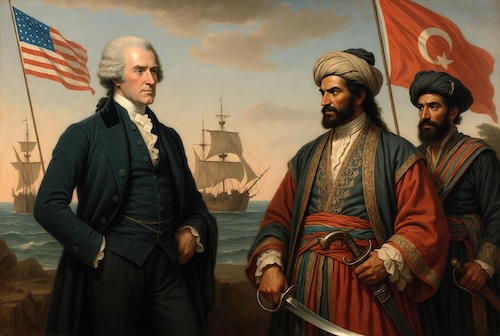
In the late 18th century, shortly after American independence, the young United States faced a direct challenge from the Barbary states of North Africa—Tripoli, Algiers, Tunis, and others nominally tied to the Ottoman Empire. These Muslim pirate states routinely seized merchant ships and enslaved their crews, demanding tribute for safe passage. Between roughly 1750 and 1815, historians estimate that around 1 to 1.5 million Europeans and Americans were captured and enslaved by Barbary corsairs. In 1785–1786, Thomas Jefferson and John Adams, then American diplomats in Europe, met with Tripoli’s ambassador in London to protest the unprovoked attacks on U.S. vessels. They pointed out that the United States had never quarreled with the Muslim world, had taken no part in the Crusades or earlier European conflicts against Muslim powers, and therefore expected no hostility.
Christopher Hitchens: ”In 1786, when the United States was barely a country, it was having its sailors taken as slaves by the Barbary states, the states of the Ottoman Empire and North Africa. Tripoli, shores of Tripoli. Ships stopped, its crews carried off into slavery. We… pic.twitter.com/4M3ox9YlAI
— Teddy – PolyBackTest.com (@Bitcoin_Teddy) June 19, 2026
Infidels are fair game
The ambassador, Abd al-Rahman, gave a direct and doctrinal reply. According to Jefferson’s contemporary account, he explained that the Quran granted Muslims the right and duty to make war on nations that did not acknowledge Islamic authority. Non-Muslims were considered infidels; their ships and crews could lawfully be plundered and enslaved, and any Muslims killed in such jihad would enter paradise. This theological justification stunned the Americans. When diplomacy failed, President Jefferson later authorized military action. The U.S. Navy and Marines were dispatched in the First Barbary War (1801–1805), culminating in operations against Tripoli that ended the immediate threat and produced the famous line in the Marine Hymn: “to the shores of Tripoli.”
Christopher Hitchens frequently cited this episode to argue that Islamic fundamentalism and jihadist aggression are not modern reactions to American foreign policy, democracy promotion, or support for Israel. He described claims that U.S. actions “created” such extremism as a “masochistic lie” that excuses aggressors and blames the victims. For Hitchens, the Barbary conflict demonstrated that the ideological roots of this hostility long predated the United States itself and were explicitly grounded in religious texts and centuries-old practice. The early American response, he maintained, was a necessary defense of civilized norms against religiously sanctioned piracy and slavery.
Click this to go to YouTube to watch the original interview and an elegant take-down of a cocky young Bill Maher.