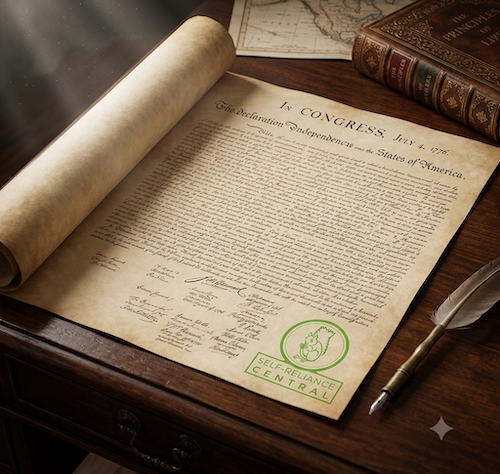
On July 4, 2026, the United States marks 250 years since fifty-six men signed a document that was, in every sense, an act of self-reliance. The Declaration of Independence was not a petition asking a distant king for better terms. It was a statement that a people had already decided to govern themselves, and were simply informing the world of a fact already settled in their own minds and hearts. That spirit — the willingness to stand on one’s own judgment and one’s own labor rather than wait for permission — runs through American life in ways far beyond the political sphere, and this anniversary is a fitting moment to trace it.
The Declaration as an Act of Self-Reliance
Thomas Jefferson and the Continental Congress did not ask permission to become free; they asserted that freedom was already theirs by natural right, and then set about defending that assertion with their “Lives,” their “Fortunes,” and their “sacred Honor.” This was self-reliance at the level of nationhood: a refusal to outsource the colonies’ fate to a government three thousand miles away that no longer served their interests. The document’s central claim — that governments derive their just powers from the consent of the governed — is itself a philosophy of self-reliance applied to politics. Power flows upward from free individuals, not downward from a throne or a bureaucracy. The people are the source, not the subjects, of their government.
Self-Reliance in the American Character
That founding impulse echoed across the land. The pioneers who pushed west built homes, dug wells, and settled disputes without a distant authority to call on. The farmer who diversified crops against drought, the immigrant who arrived with nothing but a trade and a willingness to work, the family that saved for hard times before a safety net existed — all of these are chapters in the same American story. Ralph Waldo Emerson gave this impulse its clearest name in his essay “Self-Reliance,” arguing that a person’s trust in their own judgment, rather than conformity to institutions or crowds, is the wellspring of genuine achievement. This is not merely a economic or political idea; it is a cultural one. Americans have long measured character partly by the ability to solve one’s own problems, care for one’s own family, and meet one’s own obligations without leaning unnecessarily on others.
The Republic and Its Warning
When Benjamin Franklin left the Constitutional Convention in 1787, a woman reportedly asked him what kind of government the delegates had created. His answer has echoed for two centuries: “A republic, if you can keep it.” That phrase was not a boast. It was a warning — an acknowledgment that self-government is fragile, and that its survival depends on the constant, active vigilance of the people themselves.
That warning deserves renewed attention on this 250th anniversary. A republic can be lost in two ways that seem opposite but are really the same failure: it can be seized by force, or it can simply be governed away from the people by degrees, as decision-making drifts from elected representatives accountable to voters toward permanent bureaucracies, agencies, and institutions that answer to no ballot box. Critics across the political spectrum have long warned that when unelected administrators accumulate the power to write, interpret, and enforce rules with little direct oversight, the constitutional promise that power flows from the consent of the governed grows thinner. Concerns about what has come to be called a “Deep State” — a durable and often malevolent administrative apparatus infiltrated by forces ill-disposed to our notion of freedom and aften with a globalist agenda that persists and asserts itself regardless of who wins elections — reflect this same anxiety Franklin voiced: that a republic is not a machine that runs itself, but a trust that must be actively defended against those, inside government or out, who would quietly substitute their own judgment for the people’s.
The same warning applies to a government that simply grows too large and too burdensome for its own citizens to bear. A state that taxes, regulates, and administers every corner of daily life does not merely inconvenience its people; it slowly atrophies the muscle of self-reliance itself. Every problem handed to a distant agency is a problem citizens no longer practice solving themselves — in their families, their churches, their neighborhoods, and their local governments, where knowledge of local conditions and accountability to neighbors are naturally strongest. The Founders understood this trade-off. They built a system of enumerated powers and checks precisely because they trusted concentrated authority less than they trusted a free people, organized in communities, to manage their own affairs.
We, the People, Are Capable
The evidence that self-reliance still works is not abstract. Communities that rebuild after disasters usually do so with the help of neighbors, local charities, and volunteer labor well before any distant agency response arrives. Small business owners routinely solve problems — of supply, of finance, of labor — using ingenuity and local knowledge that no central planner could replicate. Families still make enormous decisions about education, health, and provision for their own without waiting for direction. This is not a romantic exaggeration; it is the ordinary, daily reality of a free people who have never lost the habit of taking responsibility for themselves.
Our take
Two hundred fifty years after independence was declared, the document’s deepest lesson may not be about kings or Parliaments at all, but about the character required to remain free. Self-reliance — in the individual, the family, the community, and the nation — was the engine that made the Declaration’s promise real, and it remains the best defense against both an overgrown government and an unaccountable one. Franklin’s warning still stands: the republic is ours to keep, and keeping it will require the same thing it always has — a people willing to govern themselves before someone else offers to do it for them.