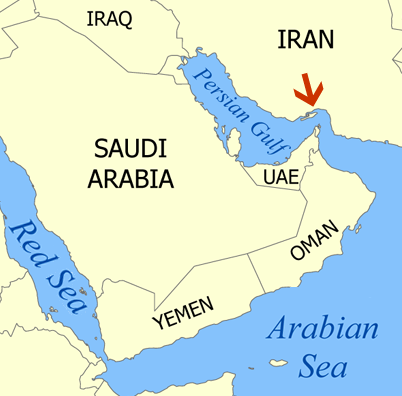
When I first entered the Strait of Hormuz as a young third officer aboard a supertanker, I learned something no strategic briefing can fully convey: in Hormuz, events unfold faster than politics.
I was twenty-one years old, newly graduated from the United States Merchant Marine Academy and standing watch alone on the bridge of one of the largest commercial vessels afloat. The captain was below deck. Ahead of us lay the narrow shipping channel into the Strait.
At first, the radar seemed manageable. Then, almost instantly, the screen filled with traffic. Tankers. Cargo ships. Smaller vessels cutting across the channel. Everything compressed into a narrow corridor where massive ships with limited maneuverability were forced to make constant adjustments in close proximity.
A supertanker does not turn like a patrol boat. It responds slowly, deliberately, with enormous momentum behind every movement. In congested waters, hesitation matters. Misreading another vessel matters even more.
I remember stepping away from the radar and moving to the bridge wing to navigate visually, calling rudder commands directly to the helmsman by degree — small corrections, one after another, feeling the traffic pattern develop in real time rather than simply watching it electronically. Only after we safely cleared the channel did I look back at the radar and fully appreciate how many vessels had surrounded us.
That experience stayed with me because it revealed something policymakers still underestimate today: the Strait of Hormuz is not merely a geopolitical flashpoint. It is an operational environment where miscalculation can develop in seconds.
Even if current diplomacy reduces tensions, commercial traffic will eventually return to one of the most compressed and volatile waterways on earth. The central danger will not be the absence of military power. Hormuz already has plenty of that. The danger will be the absence of coordination among the actors operating there.
Naval vessels, commercial shipping, paramilitary maritime forces, insurers, and port authorities all operate under different chains of authority, different assumptions, and often without reliable real-time communication. In such an environment, escalation is rarely planned. More often, it emerges from confusion — a maneuver interpreted incorrectly, a delayed response, or a vessel operating under different procedures in a crowded channel.
What the Strait lacks is not deterrence. It lacks a durable operational framework.
That framework should take the form of a standing maritime coordination mechanism involving all actors with direct operational presence in the Strait — including Iran. Its purpose would not be diplomatic reconciliation. It would be practical risk reduction: agreed communications procedures, incident coordination protocols, and continuous working-level engagement before crises erupt. Iran’s inclusion would be politically uncomfortable for many governments. But there is no operational substitute for it. One of the principal actors in the Strait cannot remain outside the communication structure while the world expects stability inside it.
I came to recognize this dynamic repeatedly in later assignments involving adversarial actors operating in high-risk environments. During my service as an FBI legal attaché in Moscow, and later while advising the Organization for Security and Co-operation in Europe on border security and cross-border coordination issues, I saw that stability often depended less on political trust than on maintaining continuous operational contact between professionals even during periods of geopolitical tension.
That layer remains dangerously underdeveloped in Hormuz.
Any future agreement to reopen or stabilize the Strait will ultimately succeed or fail not in conference rooms, but in real-time encounters between ships operating under pressure in confined waters. Without mechanisms to manage those encounters, the next crisis may begin the way maritime crises often do: suddenly, locally, and faster than leaders can react.
Dennis T. Cosgrove is a former FBI Special Agent, legal attaché, and former Head of the Border Security and Management Unit at the Organization for Security and Co-operation in Europe in Vienna. He worked extensively in Central Asia, the former Soviet Union, and the Balkans in a variety of law enforcement, diplomatic, and international security roles, including numerous assignments with U.S. Embassies overseas. He writes on geopolitics, transnational threats, and strategic affairs, and is the author of two published books with a third currently in progress.
image: The Arleigh Burke-class guided-missile destroyer USS Roosevelt (DDG 80) transits the Strait of Hormuz in the U.S. Central Command (CENTCOM) area of responsibility. Roosevelt is deployed to the U.S. 5th Fleet area of operations to support maritime security and stability in the CENTCOM area of responsibility. (U.S. Navy photo by Mass Communication Specialist 1st Class Indra Beaufort)
