Last week, I had the privilege of joining President Donald Trump in Pennsylvania for a rally celebrating the passage of his signature tax cut legislation. It was an unforgettable day, made even more meaningful when the President recognized me by name before thousands of Americans.
But what truly excited me was something else.
President Trump affirmed his commitment to working with the National Rifle Association to enact National Right to Carry, a commonsense reform that would protect the constitutional rights of law-abiding gun owners across America.
No president in modern history has done more to defend the Second Amendment than Donald Trump. His administration has consistently recognized that the right to keep and bear arms is not a second-class right.
He recently signed legislation eliminating federal excise taxes on certain firearms and accessories regulated under the National Firearms Act, providing long-overdue relief to lawful gun owners. His Department of Justice has moved aggressively to reverse anti-Second Amendment policies adopted during the Biden administration and has joined legal challenges against unconstitutional state restrictions on the right to bear arms. Perhaps most importantly, President Trump’s judicial appointments transformed the federal courts, leading to landmark Supreme Court decisions that restored the Second Amendment to its proper place among our constitutional liberties.
Adding National Right to Carry to that legacy would be a fitting next chapter.
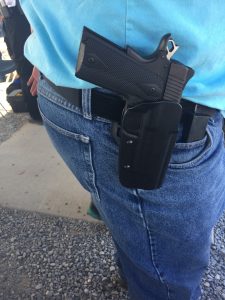
Representative Richard Hudson’s Constitutional Concealed Carry Reciprocity Act, H.R. 38, is remarkably straightforward. If you are legally permitted to carry a concealed firearm in your home state, you should be able to exercise that same right while traveling throughout the United States, subject to the laws governing where firearms may or may not be carried.
Today, that is often impossible.
Instead, responsible gun owners face a bewildering maze of conflicting state laws and reciprocity agreements. A concealed carry permit that is perfectly valid in one state may become meaningless the moment someone crosses an invisible state line. In some jurisdictions, a law-abiding citizen can unknowingly become a criminal simply by driving home from vacation or traveling for work while exercising the same constitutional right they enjoyed a few miles earlier.
Imagine if your First Amendment rights were modified or if your driver’s license suddenly became invalid because you crossed a bridge into the next jurisdiction. Americans would never tolerate that kind of legal chaos for most constitutional rights or everyday activities. Yet millions of concealed carry permit holders must navigate exactly that uncertainty every time they travel.
Though constitutional carry laws adopted by 29 states have alleviated the problem in much of the country, in some areas it’s becoming even more pronounced.
Ten states and the District of Columbia refuse to recognize any out-of-state permits at all. Others, like Virginia, have begun revisiting or narrowing existing reciprocity agreements, creating additional confusion for gun owners attempting to comply with the law. Even diligent permit holders who carefully research state laws can find themselves struggling to keep pace with constantly changing regulations.
H.R. 38 would not eliminate states’ authority to determine who qualifies for a concealed carry permit. States would remain free to establish their own permitting standards for their own residents.
What it would do is end the practice of treating responsible Americans as criminals simply because they crossed a state border.
Predictably, opponents claim the legislation would increase violent crime or flood communities with firearms. Those arguments ignore an important fact: H.R. 38 applies only to individuals who are already legally authorized to carry concealed firearms in their home state. Criminals don’t concern themselves with reciprocity agreements or permitting requirements. This legislation benefits people who already demonstrate a commitment to obeying the law.
For generations, the NRA has fought to ensure that Americans can exercise their constitutional freedoms without fear of government overreach. The right to self-defense should not expire at the state line. Families deserve the ability to protect themselves whether they are at home, traveling on business, or visiting loved ones across the country.
President Trump has made his position unmistakably clear. The constitutional foundation has been strengthened by the Supreme Court. The only thing missing is action from Congress.
The House should pass H.R. 38 without delay and send it to the Senate.
Doing so would not only reinforce President Trump’s historic record as the strongest defender of the Second Amendment in modern times. More importantly, it would provide millions of responsible Americans with the certainty that their constitutional right to defend themselves and their families does not end at the state line.
