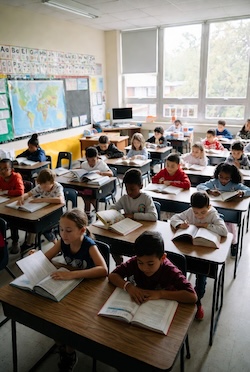
Mississippi’s education turnaround is one of the more closely watched stories in American K-12 policy, and the numbers back it up. In the 2026 KIDS COUNT Data Book, published by the Annie E. Casey Foundation, the state’s education ranking held steady at 16th nationwide — the highest it’s ever been. Mississippi was one of just two states, along with Louisiana, to post improvements in education between 2019 and 2024. Under the report’s new 0–1,000 scoring system, Mississippi scored 448 in education, a gain of 17 points over that five-year span — notable because national education scores were the weakest of the four domains tracked, with most states losing ground.
The trajectory: Mississippi ranked 48th in education in 2014, climbed to 39th in 2022, 32nd in 2023, and 20th in 2024, before reaching 16th. The statewide graduation rate rose from 74.5% in 2013 to 90.8% in 2024-25, now above the national average. Roughly 70% of fourth graders are reading at a proficient level, and the state has become a top performer nationally in early reading.
What drove it — the “science of reading” approach: Mississippi didn’t rely on typical fixes like smaller class sizes or big funding increases. Instead it made sweeping policy changes:
- Changed how reading is taught, adopting the phonics-based “science of reading” method statewide
- Raised academic standards and started grading every school A through F
- Deployed literacy and math coaches to low-performing elementary schools
- Vetted and approved curricula used by most districts — an unusually centralized approach for a state that traditionally prized local control
- Held back third graders who weren’t reading proficiently — the Literacy-Based Promotion Act, described as the policy’s most controversial piece
- Expanded early childhood education through Early Learning Collaboratives and state-invested pre-K programs
- Invested in teacher training, particularly in reading instruction
Results have been striking on a poverty-adjusted basis: Mississippi ranks first in fourth-grade reading and math when adjusted for poverty and other demographic factors, according to the Urban Institute, and its low-income fourth graders now outperform those in every other state.
Looking ahead: The education department plans to request $9 million from state lawmakers to expand literacy coaching beyond early elementary grades, and other states — Louisiana and Alabama among them — are now trying similar strategies, dubbed the “Mississippi Miracle” in education circles.
🚨 Mississippi Proves Conservative Education REFORMS Work
— Laura Ingraham (@IngrahamAngle) July 15, 2026
Gov. @tatereeves: "We've gone from 49th in the country in fourth-grade reading to No. 9 in America… and from 50th in fourth-grade math to 16th in America. We instituted conservative reforms that have brought about… pic.twitter.com/2MLQR0RNFI