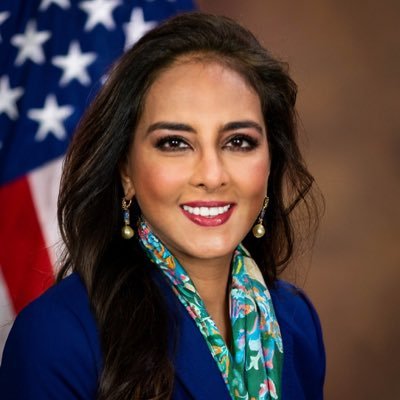
And the Law Is on Her Side
Assistant Attorney General Harmeet Dhillon just put New Jersey on notice. After the state’s Democratic governor admitted that roughly 6,600 noncitizens were improperly registered to vote—and that fewer than 400 of them actually cast ballots—Dhillon’s office is demanding the full list of names, registration details, and voting records. She has made clear that those who voted illegally face prosecution and removal from the United States. In some cases, denaturalization is on the table. This is not theater. It is the federal government finally treating noncitizen voting as the crime and national security problem it is.
The New Jersey Admission
Governor Mikie Sherrill disclosed that a software error in the state’s motor vehicle system between June 2023 and June 2024 automatically registered people who had answered “no” when asked if they were U.S. citizens while applying for driver’s licenses or IDs. The glitch dumped them onto the voter rolls anyway. Fewer than 400 of those individuals voted. Sherrill ordered an investigation, removal from the rolls, and a vendor change. The timing—coming right after national attention on election integrity—raised obvious questions about how long the problem had been known and how many other states have the same vulnerability.
It is not the job of the software vendor to verify citizenship!https://t.co/rvDzGEWIxD
— Election Integrity Network (@EIwatchdogs) July 24, 2026
Dhillon’s Stand
Dhillon is not accepting the “glitch” excuse as the end of the story. She has given New Jersey a short deadline to hand over the identities, personal information, registration dates, precincts, and exact methods by which the roughly 400 voted. She described the request as the start of a federal investigation and stated that those involved are subject to both criminal prosecution and removal. For naturalized citizens who may have lied or voted while ineligible, denaturalization proceedings are part of the toolkit. Her position is straightforward: American citizens’ votes must not be diluted by noncitizens, and the federal government has both the authority and the duty to enforce that principle.
DOJ civil rights chief Harmeet Dhillon is pledging a “broken windows” approach to illegal voting — meaning every single provable case gets prosecuted, no matter how small.
The shift comes after New Jersey’s governor revealed thousands of noncitizens landed on voter rolls through… pic.twitter.com/Svj1JHmlaK
— Fox News Politics (@foxnewspolitics) July 24, 2026
The Legal Basis
Federal law is unambiguous. Noncitizens are prohibited from voting in federal elections. Doing so is a crime under 18 U.S.C. § 611. It is also a deportable offense. Naturalized citizens who procured citizenship by concealing material facts—such as prior illegal voting or false claims of eligibility—can face denaturalization under the Immigration and Nationality Act. Courts have upheld denaturalization for fraud in the naturalization process. Voting while a noncitizen, or lying about citizenship status to register, provides the factual predicate. The Department of Justice can pursue criminal charges, civil denaturalization actions, and removal proceedings in parallel. State motor-voter systems that automatically enroll noncitizens create the paper trail federal investigators need.
Will She Succeed?
Success depends on three practical factors. First, obtaining the data. New Jersey can resist, claim privacy concerns, or slow-walk the request. Dhillon has already framed the demand as a records-preservation notice tied to existing litigation, which strengthens the federal position in court. Second, proving individual cases. Some of the 6,600 may have been lawful permanent residents who never intended to vote. Others may have been illegal aliens who voted willfully. Evidence of knowledge and intent will decide which cases move forward. Third, political and bureaucratic resistance. Blue-state officials and career staff often treat election integrity enforcement as partisan. That resistance slows cases but does not erase the statutes.
The numbers are manageable. Fewer than 400 actual voters is a finite list. Cross-checking against immigration databases, naturalization records, and voting histories is routine work for federal investigators once the state produces the names. Prior administrations largely ignored these cases. This one is not ignoring them. Even if only a fraction of the voters face removal or denaturalization, the precedent matters. It signals that noncitizen voting will no longer be treated as a clerical inconvenience.
DOJ’s Harmeet Dhillon Puts a Final Nail in Coffin of the Left’s ‘Illegal Voting Is Rare’ BS
It ain’t just New Jerseyhttps://t.co/orKHffT7BK
— Michael Dorstewitz Backup (@MDorstewitzBkUp) July 24, 2026
Why This Matters
Every illegal ballot dilutes a citizen’s vote. Systems that automatically register noncitizens—whether by design or “glitch”—invite exactly the problem New Jersey has now admitted. Dhillon’s approach treats the problem as enforcement rather than public relations. The legal tools exist. The political will now exists. Whether New Jersey cooperates or fights, the federal government has the authority to demand accountability. The test will be whether the cases are actually brought and whether the removals and denaturalizations follow. On the law and the facts so far, Dhillon has the stronger hand.