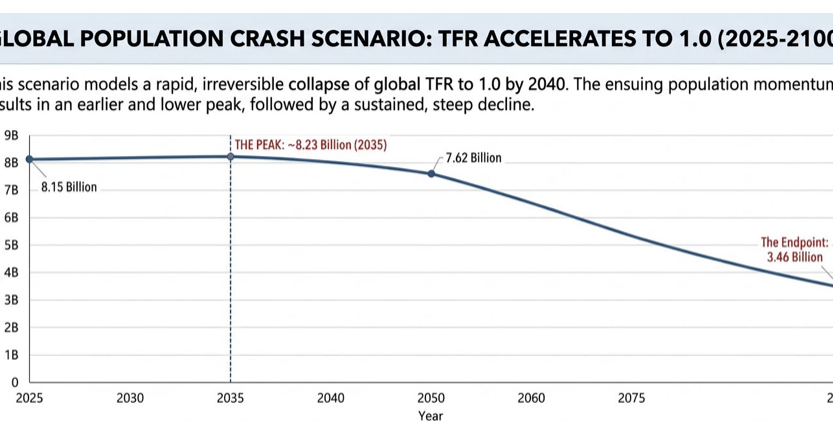
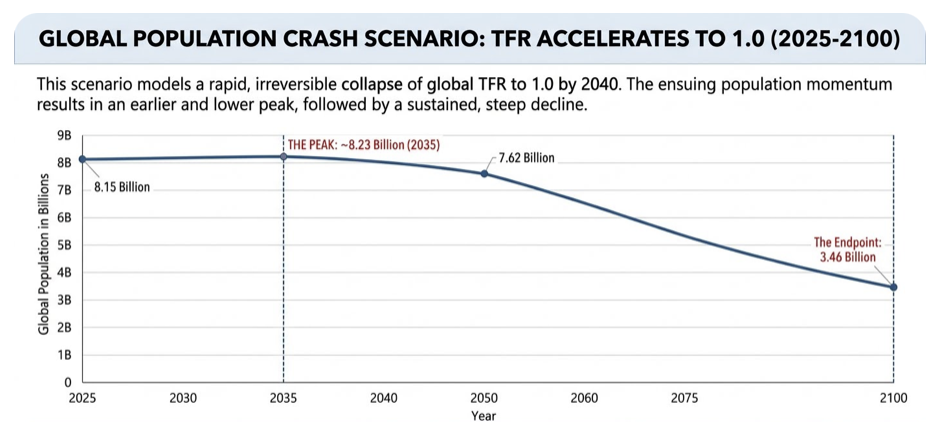
Paul Ehrlich spent the 1970s warning that 3.5 billion people would soon trigger mass famine, disease, and collapse. World population has more than doubled past 8 billion. Living standards rose. Calories increased. Extreme poverty plummeted. The catastrophe never arrived. What arrived instead is sustained fertility collapse across most of the developed world and much of Asia. The problem is no longer too many people. It is too few babies in the places that built modern civilization.
Global total fertility sits near 2.2 to 2.4 children per woman and is still falling. Replacement is roughly 2.1 in low-mortality societies. Dozens of countries have already passed peak population. Projections show the global total peaking later this century and then declining. The drop is structural, driven by choices, economics, and culture, not temporary shocks.
The Numbers That Matter
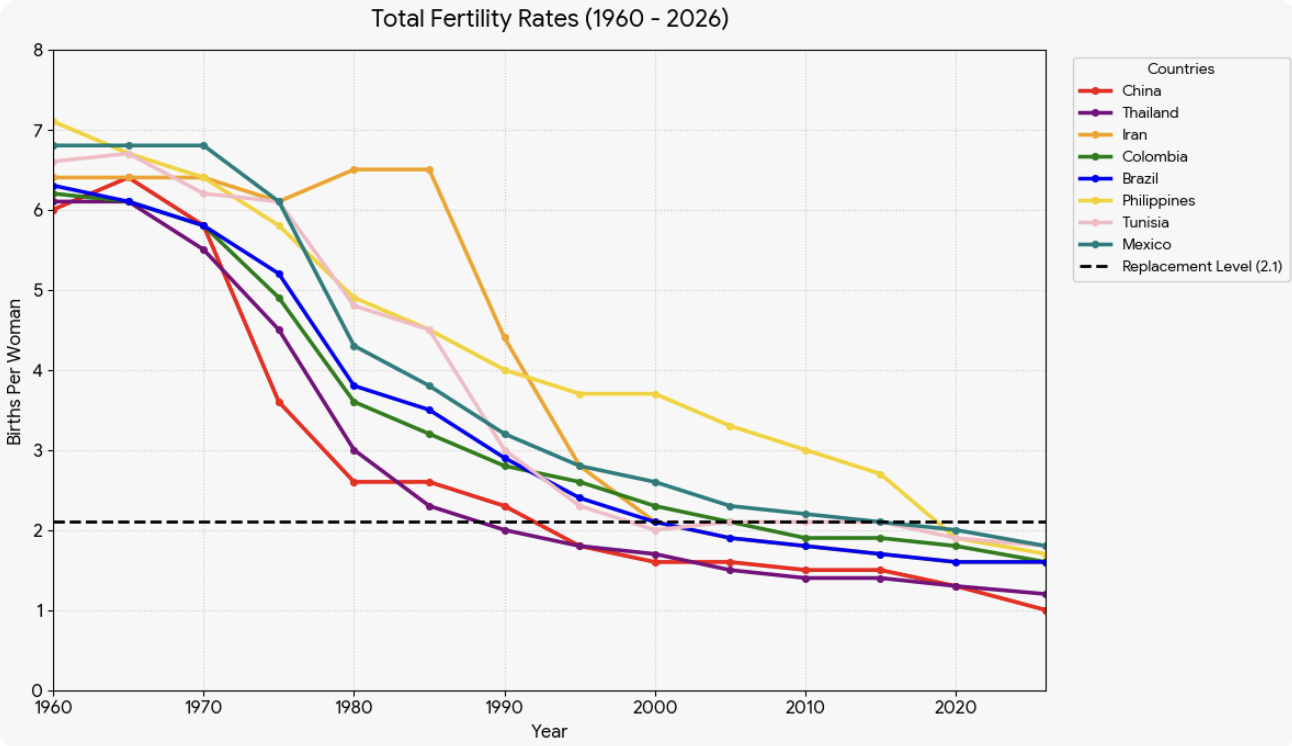
East Asia leads the collapse. South Korea has hovered near or below 1.0. China sits around 1.0. Japan is near 1.3 to 1.4. Taiwan and Singapore are similarly bleak. Southern and Eastern Europe follow close behind: Italy, Spain, and others linger in the 1.2 to 1.4 range. Much of the rest of Europe is under 1.6. The United States is around 1.6. These rates, sustained for decades, produce rapid aging and eventual absolute decline.
Sub-Saharan Africa remains the exception, with rates still above 4 in many countries. That region will account for a growing share of future births. Latin America and much of Asia have already crossed below replacement. Even places that industrialized later have seen steep drops.
Childlessness is rising sharply. In several high-income countries, 20 to 40 percent or more of women in recent cohorts remain childless. The share is especially high in South Korea, Japan, parts of Southern Europe, and among highly educated urban professionals everywhere. Delayed marriage, delayed first births, and higher rates of never starting families drive the numbers. Once women pass their early thirties without children, completed fertility falls hard.
Who Is Having Children and Who Is Not
Fertility differs sharply by group. In the United States and Europe, rates are higher among religious conservatives, certain immigrant communities from higher-fertility regions, and lower-education cohorts in some cases. They are lowest among secular, highly educated, urban professionals. The same pattern appears across East Asia: the more education and career focus, the fewer children. Cultural shifts toward individualism, high housing and childcare costs, dual-career norms, and later pairing compound the effect.
Countries that rely on immigration to mask low native fertility are buying time, not solving the problem. Immigrants eventually adopt local low-fertility norms. Native population decline still reshapes the electorate, the labor force, and the culture.
The Consequences Already Visible
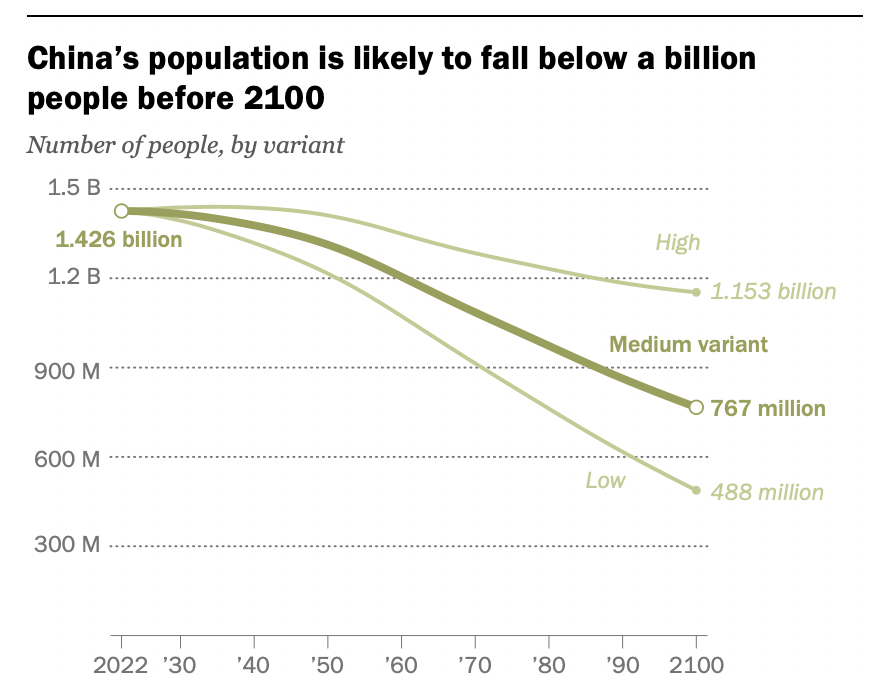
Aging populations mean fewer workers supporting more retirees. Pension and healthcare systems designed for growing young cohorts face strain. Labor shortages appear in skilled trades, care work, and the military. Innovation and risk-taking slow when the median age rises. Housing markets, schools, and local economies contract in places that empty out. East Asian and European societies are already living with these pressures. China faces a particularly sharp version after decades of one-child policy plus rapid fertility collapse.
The countries that maintain higher fertility will gain relative demographic weight. Those that do not will shrink in absolute numbers and influence. History is not kind to civilizations that stop replacing themselves.
Ehrlich got the direction wrong. The real long-term risk is not a planet overwhelmed by people. It is advanced societies that forget how to reproduce, then discover too late that prosperity, security, and continuity require the next generation. Policy experiments with cash bonuses and childcare subsidies have produced only modest results so far. Culture, family formation, and the basic willingness to have children remain the harder variables. The data are unambiguous. The baby bust is here.