Two-month extension delays a November deadline, but the core disputes over purchases, rare earths and tariffs remain unresolved
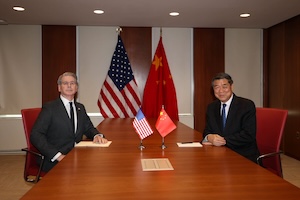
Today in Washington, Vice Premier He Lifeng and I held substantive discussions on the U.S.-China economic relationship ahead of President Trump’s meeting with President Xi. Our discussions continued to focus on securing meaningful commitments that protect American workers,… pic.twitter.com/YgBBr2LT4W
— Treasury Secretary Scott Bessent (@SecScottBessent) September 23, 2026
WASHINGTON — The United States and China have agreed to extend a bilateral trade truce that was set to expire in November through Jan. 10, Treasury Secretary Scott Bessent said Wednesday. Bessent said the extension would give both sides “more time to see what we can do on the economic front.”
The announcement came after Bessent and China’s vice premier, He Lifeng, held an unscheduled meeting in Washington, and as Chinese President Xi Jinping arrived in Washington for a third summit with President Donald Trump on Sept. 24-25. It is Xi’s first state visit to the U.S. in more than a decade.
What the truce covers
The two countries had agreed to pause tariff hikes until Nov. 10, 2026, following the summit between Trump and Xi in Busan, South Korea, on Oct. 30, 2025. Under that deal, the U.S. reduced fentanyl-linked tariffs on Chinese imports to 10 percent and suspended a Section 301 investigation into China’s maritime and logistics sectors. China committed to suspending retaliatory tariffs and non-tariff countermeasures, pausing the implementation of export controls on rare earths, and purchasing 25 million metric tons of soybeans over three years.
The legal footing of some U.S. duties has also shifted since the truce began. The fentanyl-related tariffs had been imposed under the International Emergency Economic Powers Act, a statute the Supreme Court ruled in February could not be used for such levies.
Compliance questions
Bessent gave Beijing mixed marks. He said China has met its soybean commitments but is somewhat behind schedule on about $17 billion in other agricultural purchases, and that Washington is pressing it to catch up. He said some Chinese deliverables had fallen short and that the U.S. wants to see fuller implementation over the coming months now that it has laid out its expectations.
Analysts read the short timeframe as a signal. Scott Kennedy of the Center for Strategic and International Studies said the two-month extension suggests the U.S. is unsatisfied with China’s offers and wants to keep up pressure, with the added benefit of making Xi more likely to attend the G20 in Miami.
Business groups say the extension leaves practical problems untouched. Jens Eskelund, president of the European Chamber of Commerce in China, noted that extending the truce does not address challenges such as the lack of a standardized process for rare-earth export license applications.
Toward a broader deal
Bessent said a larger economic package could be agreed by January, but that the two sides might also simply roll the current deal over again. The White House has not yet formally documented the extension.
One option under discussion is a tariff-reduction framework. U.S. Trade Representative Jamieson Greer said the two countries could agree on lists of goods eligible for lower tariffs, likely Chinese consumer and low-tech goods, and U.S. energy, agricultural products and potentially medical devices. China’s commerce ministry said the two sides agreed to discuss a framework to reduce reciprocal tariffs on certain products and resolve non-tariff barriers.
Talks are also extending beyond trade. Bessent and Greer announced that the U.S. and China had proposed exchanging alerts about AI-related hacking incidents, particularly those involving national security. Xi struck a conciliatory tone on arrival, saying the two countries “should be partners, not adversaries.”
What to watch
The next several months offer multiple chances for progress or friction. Trump and Xi could meet again at the APEC meeting in Shenzhen in November and the G20 summit in Miami in December. Beyond trade, competition over AI and semiconductors, the status of Taiwan, and differences over Iran remain significant fault lines.
Bottom line: The extension lowers the near-term risk of a renewed tariff shock and gives supply chains and markets another quarter of relative stability. But it is a stopgap, not a settlement. With purchase commitments lagging, rare-earth licensing still opaque and no broader framework agreed, January 10 now becomes the next real test of the relationship.