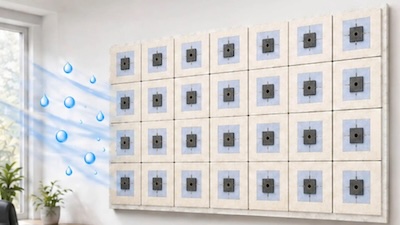
What if the walls of your house could make electricity out of thin air? Engineers at Binghamton University in New York have built a wallpaper that does exactly that. It pulls moisture from indoor air and turns it into a small, steady electric current, and it dries out the room a little while it works.
It won’t run your refrigerator. But in a test, a full sheet of it powered a wireless keyboard with no batteries at all, according to Interesting Engineering.
Who built it
The project comes from the lab of Professor Seokheun “Sean” Choi in Binghamton’s Thomas J. Watson College of Engineering and Applied Science. He worked with PhD student Guangya “Roger” Yuan and recent graduate Yang “Lexi” Gao, according to Binghamton University. Their research appears in the journal Advanced Energy Materials.
Choi is known for “papertronics,” the idea of printing electronic circuits right onto paper. Paper is cheap, light and easy to work with, which makes it a natural fit for something you’d hang on a wall.
How it works
The wallpaper is covered with tiny devices called moist-electric generators. Here’s the basic idea, in plain English:
- The edges soak up water. Each tiny generator has glycerol along its edges. Glycerol acts like a sponge for water vapor in the air.
- The center controls the flow. A raised center layer, patterned with wax, controls how fast that moisture leaves.
- Moving water makes voltage. As water moves through the material, it frees up charged particles called ions. They gather unevenly between the front and back of the paper, and that difference creates a voltage, much like a battery.
All the wiring runs behind the wallpaper, so the room looks like a normal room, Interesting Engineering reported.
The numbers
According to Interesting Engineering:
- A single tiny unit makes about 0.34 volts.
- At 80 percent humidity, the material produces about 2.2 microwatts per square centimeter. A microwatt is one millionth of a watt.
- A full sheet with 1,596 connected units ran a wireless keyboard continuously.
- In testing, the wallpaper lowered a room’s humidity from 38 percent to 32 percent.
Indoor air tends to hold “a very constant humidity between 30 and 60 percent,” according to Binghamton University. That steady supply is what makes the idea work. Unlike solar panels, the wallpaper doesn’t need sunlight.
Power and a dehumidifier in one
The most practical twist is that the wallpaper does two jobs at once. Every bit of moisture it captures is moisture your air conditioner or dehumidifier doesn’t have to remove.
Choi put it this way: “We put a lot of energy into HVAC systems to remove moisture from the air, but if we use this concept, we could reduce or control moisture levels while also generating electricity.”
What it could power
Let’s be realistic. A few microwatts per square centimeter is a tiny amount of power. The researchers are aiming at small, low-power electronics, not big appliances. Interesting Engineering lists the kinds of devices in mind:
- Smart thermostats
- Temperature and climate sensors
- Wireless keyboards
- Other small “smart home” gadgets
Anyone who has climbed a ladder to swap a dead battery in a smoke detector or a wireless sensor can see the appeal. Devices that sip power straight from the air could, in time, mean fewer batteries to buy and fewer to throw away.
Why self-reliant folks should pay attention
This is still a lab project, not something you can buy at the hardware store. But it points in a direction that self-reliant households care about: small, quiet power sources that don’t depend on the grid, the sun or the battery aisle.
Picture a root cellar, basement or workshop where a humidity sensor runs for years on the very moisture it’s measuring. Or a greenhouse monitor that never needs a battery change. Ideas like that start with research like this.
The bottom line
Binghamton’s power-making wallpaper won’t take your house off the grid. But it shows that useful energy is hiding in places we’ve never thought to look, even the damp air in a basement. That’s American ingenuity at work, and it’s worth keeping an eye on.
Sources
- Binghamton University: Wallpaper that generates power? Binghamton University researchers have developed it
- Interesting Engineering: New home wallpaper absorbs humidity from air to generate power for devices