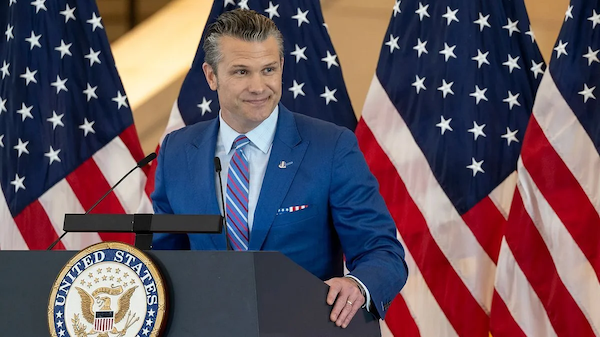
Defense Secretary Pete Hegseth stood before 600 troops at Marine Corps Base Quantico on Wednesday, Sept. 30, and laid out a plan to change how America fights. The headline announcement was a brand-new, four-star command devoted to drones and robotic weapons. He also confirmed a 20% cut in the number of generals and admirals.
It was billed as a “State of the Force” address. Instead of speaking to the brass, Hegseth spoke to staff sergeants and captains, the E-6 noncommissioned officers and O-3 junior officers who actually lead troops, according to Stars and Stripes.
A command built for drones
Hegseth announced the creation of Autonomous Warfare Command, or AutoWarCom. “We are announcing the creation of Autonomous Warfare Command — or AutoWarCom — a four-star combatant command,” he said, according to Stars and Stripes.
The new command will oversee the military’s drones, robotic systems and related artificial intelligence across all the services. Air & Space Forces Magazine reports it will have “service-like authorities,” meaning its own manpower, budget and power to buy equipment. The target date to stand it up is Oct. 1, 2027.
“The autonomous and robotic revolution has enormous implications for equipment, doctrine, organization, and the assumptions that have governed warfare for decades,” Hegseth said, as quoted by DefenseScoop.
Until the command is ready, a one-year effort called Project Agincourt will lay the groundwork. It will be led by Owen West, director of the Defense Innovation Unit, and Navy SEAL Senior Chief Max Strasiser. Military Times describes it as a “CEO, COO partnership,” with West on strategy and Strasiser on how the systems work in combat.
Hegseth said the goal is to “fuse procurement with operations at scale,” so troops and entrepreneurs can “learn, adapt, and rapidly iterate,” DefenseScoop reports. He also described a “high-low mix” that pairs expensive, advanced weapons with large numbers of cheaper autonomous systems, according to Military Times.
Congress still has a say. Air & Space Forces Magazine reports that senators had already proposed a similar command in the 2027 defense policy bill. That measure cleared committee but still needs House approval.
Fewer generals
Hegseth confirmed a 20% reduction in general and flag officers, with a deadline of Jan. 1, 2027, according to Stars and Stripes. He addressed critics directly. “The media calls that a purge. I call it accountability,” he said.
Bases that keep the lights on
Another initiative, FORTRESS America, aims to make sure major military bases can produce their own power. “If an adversary takes down the grid … our bases stay lit,” Hegseth said, according to Stars and Stripes. A program office is supposed to be up and running within 30 days.
He also announced a “Next Great American Base” competition, inviting states to pitch locations for a new installation built around autonomous systems and its own power supply.
The rest of the list
Stars and Stripes reported several other moves:
- Project Meridian: A 120-day study of future battlefield technology led by Under Secretary of Defense Emil Michael and co-directed by Elon Musk, defense entrepreneur Palmer Luckey and former House Speaker Newt Gingrich.
- America’s Corps of Cadets: Partnerships with Louisiana State, Liberty, Tuskegee, Mississippi State and Hillsdale College to create full-time cadet programs.
- Office of Religious Affairs: A new office reporting directly to the secretary. Americans United for Separation of Church and State criticized it.
The bottom line
Wars are now being won and lost with cheap drones, and Hegseth’s plan reflects that reality. A dedicated command with real budget and buying power is a serious answer to a Pentagon acquisition system that often takes years to field what troops need in months. “The pace of war is changing faster than the process to support it,” Hegseth said, according to Military Times. He’s right.
Cutting one in five generals and admirals fits the same idea. A leaner headquarters means fewer layers between a good idea and the troops who need it. Critics will call it a purge, but taxpayers have every right to expect a military that spends more on fighting power and less on brass.
The FORTRESS America plan may be the most practical piece of all. Self-reliant families keep a generator and supplies in case the grid fails, and our military bases should be able to do the same. Congress should move quickly to authorize AutoWarCom and fund it, and then hold the Pentagon to its own deadlines.
Sources
- Stars and Stripes: Hegseth returns to Quantico to lay out technology and people initiatives (Sept. 30, 2026)
- Military Times: Hegseth announces new four-star command for autonomous warfare (Sept. 30, 2026)
- DefenseScoop: U.S. creates new Autonomous Warfare Command (Sept. 30, 2026)
- Air & Space Forces Magazine: Hegseth unveils new Autonomous Warfare Command (Sept. 30, 2026)