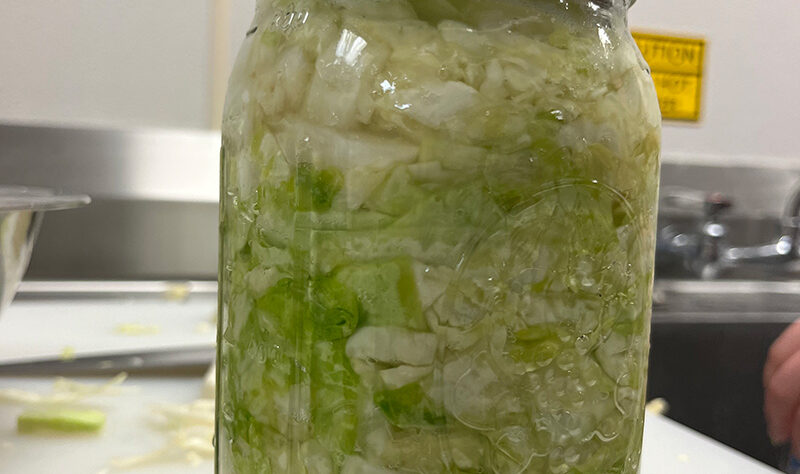
Long before refrigerators, families kept cabbage through the winter by turning it into sauerkraut. It still works, and it may be the simplest food preservation project there is: cabbage, salt and a few weeks of patience.
Fall, when garden cabbage comes in and houses cool down, is a natural time to try it.
Here’s how to do it the tested way, following the recipe from the National Center for Home Food Preservation, which bases its guidance on USDA recommendations.
Why it’s safe when done right
Fermentation is a natural process that sours the cabbage. Done properly, Clemson University says, it can even make vegetables safer than raw ones, because fermentation kills harmful bacteria.
Clemson’s Home & Garden Information Center notes that properly fermented kraut reaches a safe acid level of pH 4.6 or below. The key word, as one USDA microbiologist quoted by Clemson stressed, is “properly.” That means following a tested recipe, keeping everything clean and controlling the temperature.
What you need
- Cabbage: firm, fresh heads. The NCHFP suggests shredding within 24 to 48 hours of harvest.
- Salt: canning or pickling salt.
- A container: a stoneware crock, a large glass jar or a food-grade plastic container. Clemson advises against aluminum, copper, brass, galvanized or iron containers, which react with salt and acid. Plan on about 1 gallon of space for every 5 pounds of cabbage.
- A weight: a plate that fits inside the container, plus something to hold it down.
- A clean bath towel to cover it all.
Step 1: Shred and salt
Work with about 5 pounds of cabbage at a time. Pull off the outer leaves, rinse the heads under cold running water and drain. Quarter them, cut out the cores and shred or slice to about 1/4 inch thick.
Put the shredded cabbage in your container and add 3 tablespoons of salt for each 5-pound batch. Mix it thoroughly with clean hands.
Step 2: Pack it down
Pack the cabbage firmly until the salt draws out its juices. Repeat the shredding, salting and packing until all your cabbage is in. Leave at least 4 to 5 inches between the top of the cabbage and the rim of the container.
If the juice doesn’t cover the cabbage, make extra brine: 1 1/2 tablespoons of salt per quart of water that has been boiled and cooled.
Step 3: Weigh it down and cover
The cabbage must stay under the brine. Set a plate on top and weigh it down. Clemson suggests keeping the cabbage under 1 to 2 inches of brine.
A simple weight is a brine bag. Put one extra-large food-grade plastic bag inside another, fill the inner bag with brine (1 1/2 tablespoons of salt per quart of water) and seal it. Clemson says filling the bag with brine guards against accidental punctures. You can also use sealed glass jars filled with water. Cover the container with a clean towel.
Step 4: Wait
Temperature controls everything:
- 70°F to 75°F: fully fermented in about 3 to 4 weeks.
- 60°F to 65°F: about 5 to 6 weeks. Clemson notes that warmer ferments turn out more acidic, with less flavor.
- Below 60°F: it may not ferment at all.
- Above 75°F: it may turn soft.
If you use a brine bag, leave the container alone until bubbling stops. If you use jars as weights, check the kraut two or three times a week and skim off any scum that forms.
Step 5: Store it
Fully fermented sauerkraut keeps for several months in the refrigerator if tightly covered. For shelf-stable jars, the NCHFP gives two ways to can it in a boiling-water canner, with 1/2 inch of headspace:
- Hot pack: Slowly bring the kraut and its juice to a boil, stirring often. Fill jars firmly. Process pints 10 minutes and quarts 15 minutes at 0 to 1,000 feet.
- Raw pack: Fill jars firmly with kraut and cover with juice. Process pints 20 minutes and quarts 25 minutes at 0 to 1,000 feet.
Add time at higher elevations. For hot-packed quarts, for example, it’s 20 minutes from 1,001 to 6,000 feet and 25 minutes above that. Check the NCHFP’s full table for your altitude.
One full 25-pound batch makes about 9 quarts.
A few tips
- Start with clean produce, and wash your hands, tools and containers.
- Stick to a tested recipe from a source like the NCHFP or a university Extension office. Don’t improvise on salt amounts.
- Mushy kraut usually means it got too warm. Kraut that never sours probably sat somewhere too cold.
The bottom line
Sauerkraut is old-fashioned self-reliance at its best. It turns a cheap fall vegetable into a tangy side that lasts for months, and all it costs is a few heads of cabbage, some salt and a little shelf space.
Start with one 5-pound batch this weekend. Keep it cool, keep it under the brine and give it a few weeks. By the first snow, you’ll have a crock of something you made yourself.
Sources
- National Center for Home Food Preservation: Sauerkraut
- Clemson University Home & Garden Information Center: Want to Ferment Vegetables? Start with Sauerkraut