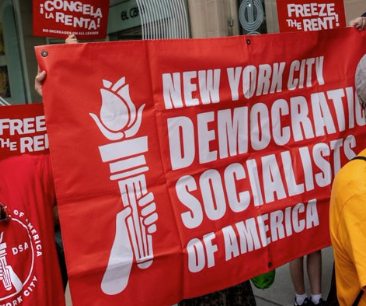
Tuesday night the Democratic Party took both chambers of Congress. Inside that blue wave a smaller group of self-described socialists expanded its beachhead in the House. They started the cycle with two members. They finished it with roughly seven. Almost every new seat came from a deep-blue district where the primary, not the general election, decided the winner. They lost the one statewide race where a member of their group faced a real contest. The pattern is clear: they can win where the other party barely exists. They still have not shown they can win where it does.
Democratic Socialists of America are projected to win two out of every three races they entered this cycle, according to a Fox News Digital analysis of 161 candidate contests.
From Berkeley rent boards to congressional seats in New York and Michigan, DSA-backed candidates are racking up wins in deep-blue districts and low-turnout primaries, pulling the Democratic Party further left from the inside, according to a digital analysis by Fox News senior editor of investigations @AsraNomani..
Alexandria Ocasio-Cortez and Rashida Tlaib both won their races. In Ann Arbor, a democratic socialist toppled a longtime Democratic mayor. In Los Angeles, DSA-backed City Councilmember Nithya Raman is in a too-close-to-call race against incumbent Mayor Karen Bass.
The organization isn’t a formal political party. It runs candidates on the Democratic ballot line while openly describing its long-term goal as building an independent mass socialist party and ending capitalism.
— Fox News Politics (@foxnewspolitics) November 4, 2026
What They Actually Took
The new faces heading to Washington include a young lawyer from Colorado’s 1st District who beat a long-serving Democrat in the primary and then took 78 percent in the general. In Pennsylvania’s 3rd District a state legislator who had the open endorsement of the most famous socialist in the House ran away with the seat. Two New Yorkers filled open or primary-cleared seats in the city: one in the 7th District who has called for nationwide rent control, and one in the 13th District who ousted a senior Hispanic Caucus chairman and has been a sharp critic of Israel. In Michigan’s 13th District a candidate who first knocked out an incumbent Democrat in the primary is headed to the House. The two already there—one from New York, one from Michigan—won reelection by large margins in safe seats.
They also picked up local prizes. A member of the group will be the next mayor of Providence. Another is set to take the mayor’s office in the District of Columbia. Down the ballot they claimed seats on city councils, state legislatures, and rent boards in places already under long-term Democratic control. Their own count of victories ran past 50 by early Wednesday, though many of those were low-turnout local races or ballot measures on rent control and public housing.
Over 50 DSA victories tonight prove socialism can win in the U.S.
Workers deserve more and a reality where all of us live with dignity and hope is closer than we think.
The job’s not done, though. Tomorrow, we continue organizing, fighting, and winning for the working class!
— DSA (@DemSocialists) November 4, 2026
The biggest miss was in Florida. A candidate who had joined the group earlier this year lost the special Senate election to the Republican incumbent. The group itself had not endorsed her. She came closer than many expected in a state that went heavily the other way two years ago, but she still lost.
What They Intend to Do With the Seats
The new members have already signaled they will not simply fall in line. None has publicly committed to supporting the expected Democratic speaker. In a House where the majority is real but not enormous, a bloc of half a dozen can extract concessions or slow the calendar. Their stated priorities are the ones they ran on: universal government-run health care, expanded child-care and housing subsidies, stronger union rules, and an end to the current immigration enforcement apparatus. Several have also called for cutting military aid to Israel and for new restrictions on private data centers and artificial-intelligence development.
They are not in a position to pass those bills into law. The president still holds the veto pen, and the Senate still has a 60-vote threshold on most legislation. What they can do is force votes, demand committee time, and attach riders to the must-pass spending bills. They can also use the enlarged bloc to pull the larger Democratic caucus leftward on Israel, on policing, and on the size of the welfare state. Their longer-term public goal, stated in their own platform documents, is to build an independent socialist party and replace the current economic system. For now they are content to use the Democratic ballot line as the vehicle.
The Stage is Being Set for Socialism in 2028
Ten years ago, the world was stunned when Donald Trump beat Hillary Clinton.
Two years from now, it should could be stunned if a socialist wins the White House.
The pieces are moving into place. Gallup’s latest polling shows 43% of Americans now view socialism positively, a record high. Among 18-to-34-year-olds, a majority prefer socialism to capitalism.
Roughly one-third of Democrats identify as democratic socialists.
The Democratic Socialists of America are openly organizing for 2028, with chapters pushing candidates like Alexandria Ocasio-Cortez and building off local wins (including Zohran Mamdani’s rise in New York).
Progressive and DSA-aligned candidates have been winning primaries and shifting the Democratic Party’s center of gravity leftward on economics, immigration, and government power.
This isn’t a fringe movement anymore. Economic frustration, cultural shifts in education and media, and a younger generation more open to redistributive policies have normalized ideas that were political poison a generation ago.
Peter Thiel and others have publicly floated the odds of a socialist-leaning president in 2028 as uncomfortably high if the Democratic primary veers hard left and the general election is close.
That is exactly why Republicans cannot afford a weak or compromised nominee.
The party needs its strongest possible candidate in 2028, someone who can clearly contrast free enterprise, limited government, border security, and constitutional principles against the expanding socialist project. A nominee who energizes the base, persuades independents, and exposes the practical failures of the left’s agenda is not optional; it is essential.
History does not repeat itself exactly, but it rhymes. 2016 was a wake-up call. 2028 will be the next one. The stage is being set. Republicans must put forward their best and refuse to cede the argument.
Stop Communism
Vote RED in the Midterms
Vote America First 🇺🇸— Patricia 🇺🇸 (@1109Patricia) October 29, 2026
The Limits of the Night
These gains are real inside the safest Democratic districts. They do not yet amount to a governing majority, even inside the Democratic Party. The candidates who won statewide or in competitive seats this cycle largely avoided the socialist label. The ones who embraced it stayed in places where the other party is a token presence. That is a useful foothold. It is not the same as having convinced the rest of the country. The next test comes in 2028, when the presidential field will have to decide how much of this agenda it is willing to carry into states that are not already deep blue.