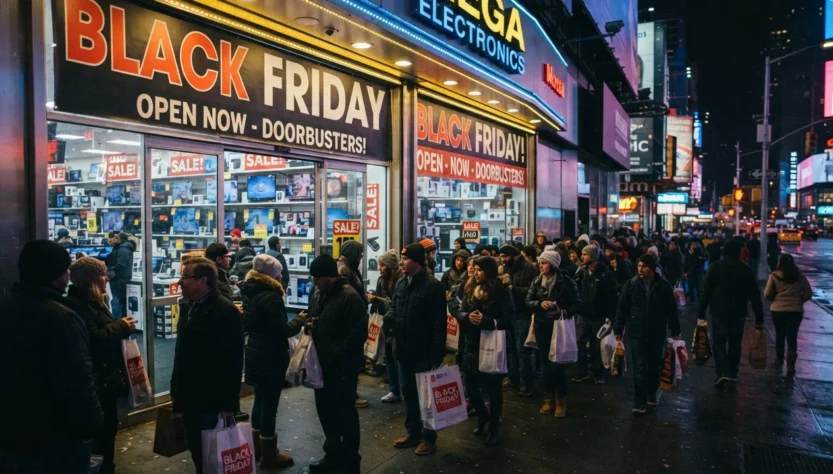
Black Friday is the Friday after Thanksgiving, Nov. 27 this year, and the name did not start with cheerful retailers. According to History.com, police in Philadelphia used it in the 1950s for the chaos on the day after Thanksgiving, when crowds of shoppers and visitors filled the city ahead of the Army-Navy football game. Officers could not take the day off, and shoplifters took advantage of the crowds. By 1961 the city’s merchants tried to rename it “Big Friday,” and the effort failed.
Where the “into the black” story came from
The tale that stores finally turned a profit that day, moving from red ink to black ink, came later. History.com calls it the officially sanctioned but inaccurate explanation, one that retailers began promoting in the late 1980s. The sale itself kept growing. It became a four-day weekend, Cyber Monday arrived with online shopping, and now the big retailers begin days earlier. Best Buy and Amazon both opened their Black Friday events on Nov. 19, and Target’s runs Nov. 22 through Nov. 29.
What forecasters expect
The National Retail Federation forecasts that holiday retail sales for November and December will grow 4.2 percent to $1.013 trillion, up from $972 billion last year. NRF’s economist warned that inflation, higher gas prices and pressure on household budgets will affect shoppers differently depending on income.
Adobe Analytics expects Americans to spend a record $275.1 billion online this holiday season, up 6.7 percent. It projects $12.9 billion online on Black Friday, up 9.2 percent, and $15.1 billion on Cyber Monday, Nov. 30, up 6.2 percent. Adobe says discounts will reach up to 30 percent during Cyber Week. By category, it expects the best deals on TVs, toys, apparel, appliances and furniture on Black Friday, on electronics and computers on Cyber Monday, and on sporting goods on Thanksgiving.
Deals worth a look
These are prices the retailers advertised. They can change, and quantities are limited.
Best Buy lists the 13-inch MacBook Air at $1,049, a TCL 65-inch TV at $229.99, Sony noise-canceling headphones at $169, a Shark cordless stick vacuum at $199.99 and an Insignia refrigerator at $299.99. On Black Friday only, in stores, members of the free My Best Buy program can buy a $100 gift card for $60, with at least 50 cards available per store.
Target says it has up to 50 percent off thousands of items from Nov. 22 through Nov. 29, including headphones, laptops, small appliances and toys. On Black Friday the first 100 guests at each store receive a gift card worth $25, $50 or $100, and one guest per store receives a $1,000 card. Target stores close Thanksgiving Day and open at 6 a.m. Friday.
Amazon says its deals run through Nov. 30. For the first time, deals of up to 60 percent off will drop at midnight and 8 a.m. Pacific on both Black Friday and Cyber Monday.
How to keep the savings
Both Best Buy and Target offer a holiday price match, so if an item you bought drops in price later, you can ask for the difference. Target’s runs through Dec. 24, and Best Buy’s covers items it sells itself through the holiday season. Best Buy is closed on Thanksgiving Day and opens at 6 a.m. on Friday.
My own advice is to write down the three or four things you actually need before you look at an ad. A sale price only counts if you were going to buy the item anyway, and a short list keeps the weekend from running over budget.